

Skip the 12–36 Month Wait: Wine Release Cycles for Collectors
Wine release cycles are the schedules producers and merchants use to drip-feed stock to buyers, mainly through en primeur campaigns, allocation lists and flash drops. The fastest way in is boring but true: join every merchant and winery mailing list you can, turn on SMS or app alerts, and treat those first ten minutes of a release like a race. Get that right and everything else, price, timing, delivery, becomes a lot easier to manage.
TL;DR:
- Joining multiple merchant and winery mailing lists and acting quickly during releases is crucial for securing high-demand wines and minimizing chances of missing out.
- En primeur purchases often require upfront payment or deposits well before the wine exists, with delivery typically taking 12 to 36 months, carrying quality and timing risks.
- Consistently buying across a producer’s range, including off-vintage bottles, and responding promptly to offers can significantly improve your allocation priority.
- Flash drops peak seasonally and often result in stock disappearing within minutes, so automation and preparedness are essential for success.
- Alternative sourcing options like direct boutique and cellar-aged wine drops at FU Wine can bypass long waitlists and often provide better prices for immediate needs.
Table of Contents
- What are en primeur and wine futures, and how do they work?
- How allocation releases actually decide who gets the bottle
- When to check and how to move fast on flash drops
- Pre-release checklist: get purchase-ready before the window opens
- Regional variations in wine release cycles
- How vintage variations shift release timing
- What happens to price after release, and when resale kicks in
- An editorial take on chasing release windows
- Get first access to limited and cellar-aged bottles
- Sources
- FAQ
What are en primeur and wine futures, and how do they work?
En primeur is the practice of buying wine while it’s still sitting in barrel, usually a year or more before it’s bottled. You’re not tasting the finished product. You’re betting on a barrel sample, a critic’s score, and the producer’s track record.
Bordeaux runs the biggest and most organised en primeur campaign in the world, releasing tranches of new vintage each spring to négociants, who then push allocations out to merchants and, eventually, you. The timeline is longer than most buyers expect: offers typically appear months after harvest, and bottles often don’t ship for 12 to 36 months. That’s a long wait for a wine you haven’t tasted yet.
The payment mechanics matter just as much as the timeline. Here’s what you’re usually signing up for:
- An upfront deposit or full payment at the time of the offer, well before the wine exists in bottle
- Minimum purchase requirements, often by the case, not the bottle
- Storage in bond, meaning the wine sits in a tax-free warehouse until you decide to ship it
- Duty and tax due only when you withdraw the wine from bond, which can be years later
The trade-off in one line: en primeur usually gets you the lowest price the wine will ever carry, but you’re carrying quality risk, delivery risk and cashflow risk for the privilege. If the vintage disappoints or a château stumbles on bottling, you’ve already paid.
For readers who want the discount without the multi-year wait, FU Wine’s wine futures explainer walks through how cellar-aged stock can land you a similar saving with far less patience required.
How allocation releases actually decide who gets the bottle
Allocation is the system producers use when demand outstrips supply, and it has almost nothing to do with being first in line. Merchants and wineries divide limited stock among buyers based on a ranking system that rewards loyalty over enthusiasm.
Producers commonly weigh three things: multi-year purchase history, how broadly you buy across their range, and how quickly you respond to offers. A collector who’s bought steadily for five years, including the vintages nobody wanted, will usually outrank someone chasing a single trophy label for the first time.
Release cadence follows a seasonal rhythm too, generally clustering around spring and autumn campaigns, and lists tend to punish inconsistency. Skip too many offers and some producers quietly downgrade your priority, a practice sometimes called a skip rule, which trade accounts manage by committing to a set percentage of every release rather than cherry-picking.
Here’s how to actually move up the list:
- Buy consistently, including the “off” vintages, not just the trophy years everyone wants
- Diversify across a producer’s portfolio instead of only chasing the flagship wine
- Respond to every offer fast, even a small one, because responsiveness is tracked
- Stay visible with the merchant, phone calls and follow-up emails still count for something human systems reward
Pro Tip: Buy the producer’s entry-tier wine every single release, even when you don’t love it. It costs little and does more for your allocation rank than a one-off splurge on the flagship ever will.
FU Wine’s guide on wine allocation explained breaks this down further if you’re building a long-term collecting strategy.
When to check and how to move fast on flash drops
Flash releases don’t wait for you to finish your coffee. Stock can vanish in minutes, and the buyers who win are the ones treating monitoring as a habit, not a hobby.
Allocation and flash campaigns tend to peak seasonally, generally clustering in spring (March to May) and autumn (September to November), when producers push new vintages and clear cellar stock before the next harvest cycle. That’s when you tighten your monitoring, not loosen it.
Your toolkit should include:
- Active accounts with every merchant and winery you actually want to buy from, not just the ones you already have
- Saved payment details and verified shipping addresses, so checkout takes seconds instead of minutes
- Email filters or a dedicated folder so release notices don’t drown in your regular inbox
- Phone or app alerts for merchants that offer them, since email is often the slowest channel
Restocks and returned holds are the sleeper opportunity most buyers miss entirely. These often land at odd hours, overnight, mid-week, with no warning, and the collectors who win them are usually running an automated check or a saved search rather than refreshing a page by hand.
Pro Tip: Set a recurring calendar reminder for the first Monday of each release season to audit your mailing list subscriptions. Lists you joined two years ago might have changed their notification method entirely.
Operational readiness is the unglamorous half of this game, but it’s the half that decides whether you actually get the bottle or just get the disappointment email.
Pre-release checklist: get purchase-ready before the window opens
A release window rewards preparation, not enthusiasm discovered at the last minute. Run through this before your target vintage drops:
- Verify your accounts are active with every merchant and winery on your list, don’t assume last year’s login still works
- Save your payment method and confirm your delivery address is current, especially if you’ve moved
- Set a firm spending limit and know where the wine is going, your own cellar or a bonded facility, before you buy
- Sign up for SMS or app alerts specifically, since newsletter delays can cost you the whole allocation
- Understand your duty and tax exposure ahead of time, particularly if the wine sits in bond until you call it forward
FU Wine’s tips for buying limited release wine covers the logistics side of this in more depth, including how bonded storage decisions affect your total landed cost.
Regional variations in wine release cycles
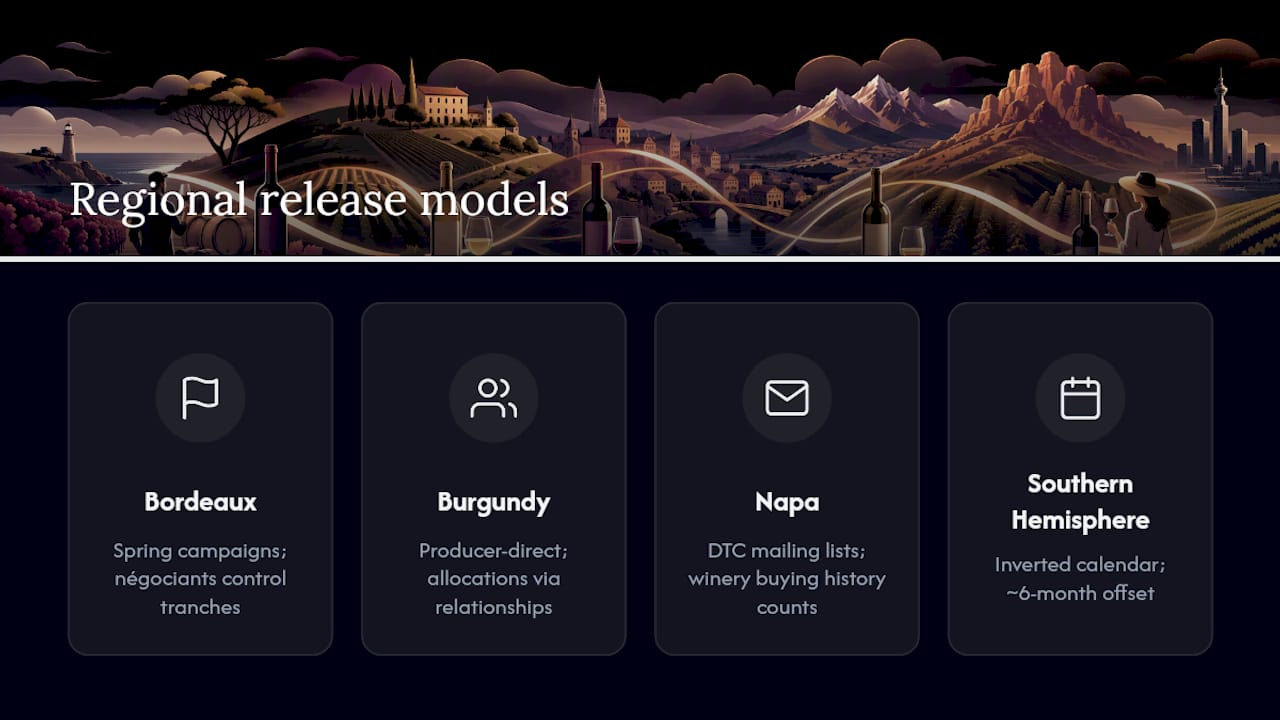
Bordeaux dominates the en primeur conversation, but it’s far from the only model, and treating every region the same way will trip you up. Bordeaux campaigns are the largest and most structured globally, running each spring with négociants controlling the flow of tranches to merchants.
Burgundy runs a tighter, more producer-direct model. Small production volumes mean allocations get decided almost entirely on relationship history, with far less room for new buyers to break in quickly.
Napa Valley and other new-world regions tend to lean on direct-to-consumer mailing lists rather than a trade intermediary layer, which means your buying history with the winery itself, not a merchant, is what counts. Some cult Napa producers run multi-year waitlists just to get on the list.
Australian and other southern hemisphere producers work on an inverted calendar entirely, since harvest and release timing sit roughly six months out of step with the northern hemisphere. A “spring release” in the Barossa or Margaret River lands nowhere near a European spring campaign.
The practical lesson: don’t assume the cadence you’ve learned from one region transfers to another. Check each producer’s own release rhythm rather than guessing from habit.
How vintage variations shift release timing
A strong vintage moves faster than a mediocre one, and producers know it. When early reviews and barrel scores come in hot, châteaux and wineries often compress their release windows, pushing offers out sooner to capture demand while critical buzz is at its peak.
A difficult or inconsistent vintage does the opposite. Producers may delay the offer, wait for more bottle age before showing the wine, or quietly reduce allocation volumes rather than dump a weaker year onto loyal buyers at full price. This is also where quality risk in en primeur buying becomes real: you’re accepting delivery risk on a wine you can’t yet taste in its finished form.
Vintage reputation also affects how tightly a release is rationed. A universally praised vintage typically sees allocations shrink and waitlists grow, while an average year can mean more available stock and a longer window to decide. Collectors chasing specific vintages should track early critic scores and barrel reports closely, since these often signal how a producer will time and size the coming release well before the formal offer lands.
FU Wine’s piece on wine vintages explained is a useful companion here if you’re trying to separate hype from genuine quality signal.
What happens to price after release, and when resale kicks in
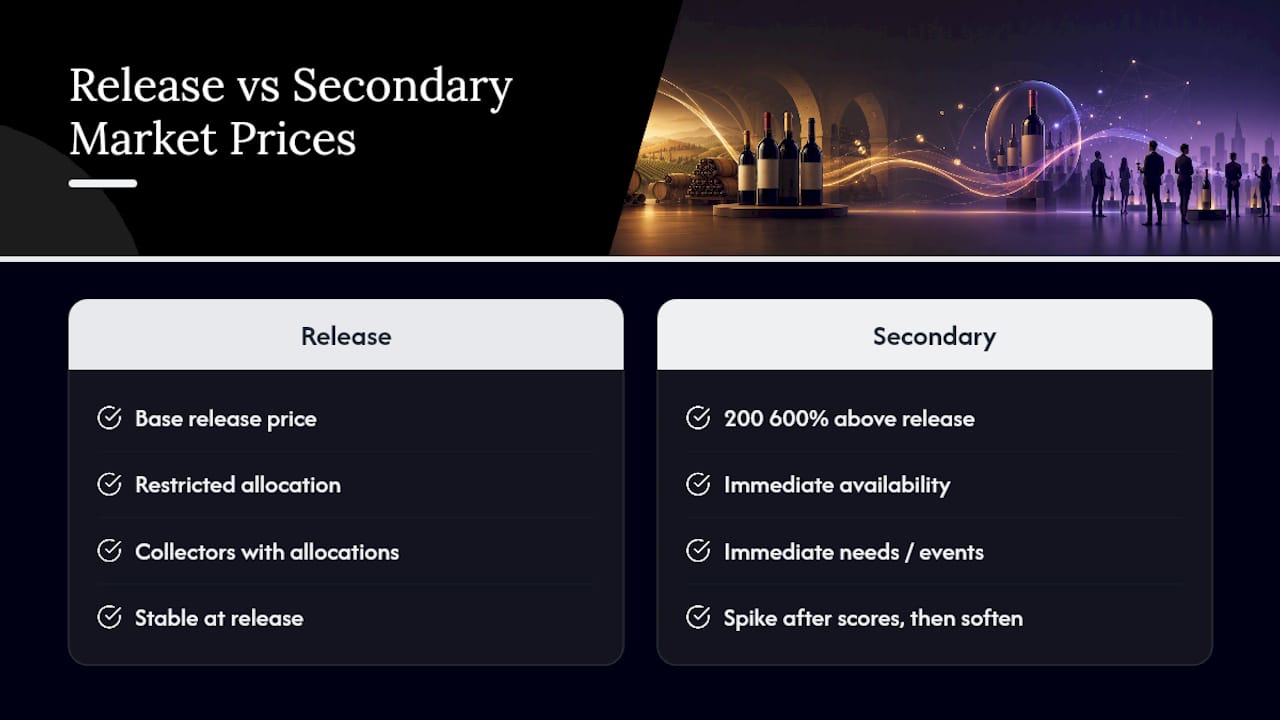
Buying at release is almost always the cheapest entry point you’ll get. Miss the window and your next option is the secondary market, auction houses, brokers, and resale platforms, where prices for sought-after labels can run 200 to 400 percent above the original release price for the most coveted names.
That premium exists because secondary markets solve a different problem than release cycles do. Release buying rewards patience and relationships; secondary markets sell immediacy. If you need a specific bottle for an event next month and missed the allocation, you pay for the convenience of skipping the queue entirely.
Timing matters on the resale side too. Prices for a hyped new release often spike immediately after critic scores land, then soften once the initial excitement passes and more bottles quietly re-enter circulation from buyers who overbought. Patient resale hunters who wait a few months past the initial score frenzy often do better than those buying at the peak of the headlines.
The lesson for collectors is straightforward: every dollar you pay above release price is the cost of not being on the list. FU Wine’s comparison of retail versus allocation wines unpacks this gap in more detail if you want to see how the numbers stack up across different buying paths.
An editorial take on chasing release windows
Most advice on this topic treats allocation like a game of patience. It’s really a game of consistency, and those aren’t the same thing. Patience means waiting quietly. Consistency means showing up, offer after offer, including the years and the labels that don’t excite you, because that’s what merchants and wineries actually track.
At FU Wine, that reality shapes how we source. We go after limited and cellar-aged stock through the same relationships and opportunistic buying, distressed inventory, allocation runs, cellar clearances, that reward long-term engagement rather than one-off luck. A rotating, deal-driven catalogue works in a collector’s favour precisely because it doesn’t ask you to win one high-stakes release. It gives you repeated shots at rare bottles without the multi-year waitlist grind that traditional allocation demands.
If there’s one thing collectors underestimate, it’s how much release access is a numbers game disguised as a taste game. Buy consistently, diversify your interest, and read how to secure limited wine releases for the tactical detail this section didn’t have room for.
— Damien
Get first access to limited and cellar-aged bottles
An alternative to grinding through years of allocation waitlists just to land one good bottle exists. This approach cuts out the middlemen and markups that traditional release channels charge for access, sourcing limited releases, boutique producer runs and cellar-aged stock and passing it on at prices below traditional retail.
Getting started takes about two minutes. Sign up for alerts so you’re not relying on a slow newsletter, then check the current rotating drops, because what’s live today won’t be live next week. There’s no multi-year waitlist to earn your way onto, no minimum case commitment to prove your loyalty. Just real access to bottles worth drinking, at prices that don’t insult you. Head to the FU Wine catalogue and see what’s dropped this week.
Sources
For deeper detail on the mechanics covered here, Wine-Searcher’s en primeur guide and its beginner primer explain futures buying step by step. Decanter covers Bordeaux’s campaign structure, while Sotheby’s and Wine Companion cover futures risk and allocation behaviour respectively.
- Buying en primeur wines: How to approach it | Wine-Searcher
- Buying en primeur wines: How to approach it | Decanter
- Winery allocations and mailing lists | Wine Companion
- Buying Futures – a guide | Sotheby’s
FAQ
What is a wine release cycle?
A wine release cycle is the schedule by which wineries and merchants make wine available to buyers, covering en primeur campaigns, allocation lists and flash drops. It determines when a wine hits the market, at what price, and who gets first access.
How long does en primeur delivery take?
Bottles bought en primeur typically arrive 12 to 36 months after purchase, since the wine is still ageing in barrel at the time of sale. Buyers usually pay upfront and settle duty or tax later if withdrawing the wine from bonded storage.
How do I get onto an allocation list?
Join the winery or merchant’s mailing list directly and buy consistently across releases, since purchase history and portfolio breadth are the main factors producers use to rank buyers. Responding quickly to every offer, even small ones, also improves your standing over time.
Is buying at release cheaper than buying on the secondary market?
Yes, almost always. Coveted labels can trade 200 to 400 percent above release price once they hit auction or resale platforms, making release-time purchase the most cost-effective entry point for most collectors.
Does FU Wine offer allocation or en primeur wines?
FU Wine focuses on sourcing limited-release, boutique and cellar-aged stock through direct relationships and opportunistic buying rather than running a traditional allocation waitlist. Check the current wine catalogue for rotating drops on rare and hard-to-find bottles.