

Wine provenance explained: protect your collection's value
Wine provenance is the documented, verifiable chain of custody that proves a bottle’s authenticity, storage history, and condition from vineyard to your cellar. If you’re buying, holding, or selling serious wine, three actions protect you immediately: (1) request the original invoice and bonded-storage receipt, (2) ask for high-resolution, timestamped photos showing the capsule, label, and ullage, and (3) confirm professional custody or obtain a condition report.
- Request the invoice and storage receipt before any money changes hands. No paper trail, no deal.
- Get timestamped photos of the capsule, label, fill level, and cork. These are your visual baseline.
- Confirm bonded or professional storage. Facilities like Wine Ark issue account-linked receipts and environmental logs that satisfy auction-house and insurer requirements. Private home cellars rarely do.
Pro Tip: Aim for at least three independent proofs at every transaction: invoice, storage receipt, and timestamped photos. That triangle is what Christie’s and most Australian insurers want to see.
Key takeaways
Wine provenance is the documented chain of custody that proves authenticity and condition, and the minimum viable proof set is invoice, storage receipt, and timestamped photos.
| Point | Details |
|---|---|
| Three-proof minimum | Always collect invoice, storage receipt, and timestamped photos as the baseline provenance package. |
| Professional storage wins | Bonded and commercial cellars produce account-linked receipts and environmental logs that satisfy auction houses and insurers. |
| Lab testing has a threshold | Spectroscopic or isotope analysis is worth the cost when expected resale value substantially exceeds the testing fee. |
| Ledger records are not enough | Blockchain and NFC entries record ownership events but cannot verify physical condition without linked inspection or lab results. |
| Consult specialists early | For high-value or suspect lots, commission a condition report before buying or consigning, not after a problem surfaces. |
Table of Contents
- What does wine provenance actually cover?
- Why provenance matters more than you think
- What documents should you collect and keep?
- How specialists inspect a bottle before they trust it
- Where you store wine in Australia shapes its provenance story
- What modern authentication technology can and can’t do
- How provenance shapes resale, insurance, and tax in Australia
- Your step-by-step checklist for buying, receiving, and moving bottles
- When should you pay for a specialist or lab test?
- A collector’s honest take on provenance
- Sources
What does wine provenance actually cover?
Provenance in winemaking is broader than most collectors realise. It is not just “where the grapes came from.” It is the full, documented story of a bottle: who owned it, where it lived, how it travelled, and what condition it was in at every handover.
Break it into four components and the picture sharpens fast.
Ownership history covers every transfer from producer to current holder. Ex-château releases, where the wine has never left the producer’s own cellar, sit at the top of the credibility ladder. Single-owner lots come next. Multiple-owner chains are not disqualifying, but each transfer needs its own paper record.
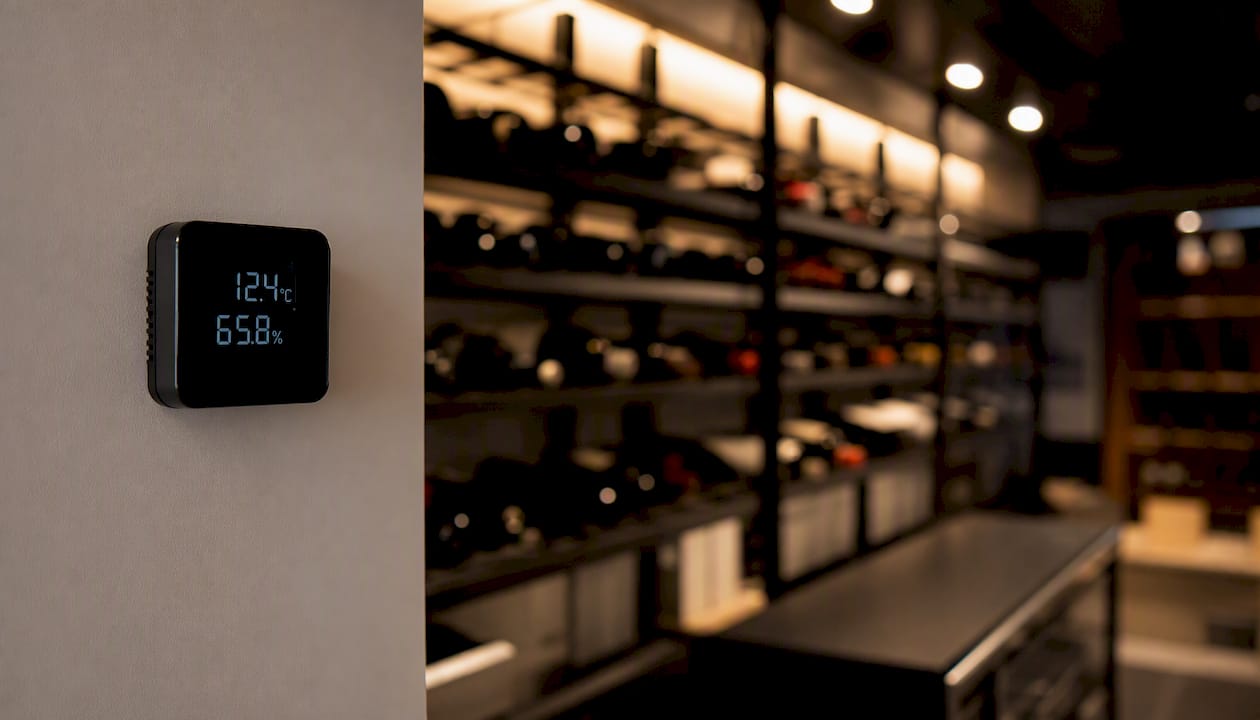
Storage records are the backbone. Trusted provenance standards expect stable conditions at roughly 12–14°C with appropriate humidity. Any gap in the storage log is a gap in the story.
Transport and shipping paperwork includes bills of lading, customs and import declarations, and transfer receipts between facilities. These documents prove the bottle moved safely and legally.
Auction and laboratory records close the loop. Catalogue entries with lot numbers, condition reports, and lab or test seals all add independent verification that no single owner can fake alone.
A few documents collectors must be able to produce or request:
- Original purchase invoice (producer, merchant, or auction house)
- Auction catalogue entry and lot number
- Bonded-storage receipt with facility name and account reference
- Bill of lading and customs/import paperwork for cross-border purchases
- Condition reports and any laboratory test results
- Transfer receipts between storage facilities
One important limit: blockchain and NFC tokenisation create immutable ledger records of ownership events, but they cannot, by themselves, prove the physical contents or current condition of a bottle. A ledger entry says “this token changed hands on this date.” It says nothing about whether the wine inside is sound. Ledger-only provenance needs transparent documentation and physical linkage to be meaningful.
Why provenance matters more than you think
A bottle with a perfect label and a famous name is worth nothing if its storage history is a blank. That is not hyperbole. It is auction-house policy.
Christie’s specialists routinely require documentation and may reject consignments that lack credible storage history outright. Ex-château and single-owner lots command measurable premiums precisely because the chain of custody is unbroken and verifiable. Auction houses are the practical market gatekeepers, and their acceptance thresholds set the de-facto standard every serious collector must meet.
Insurers are equally demanding. A specialist wine insurer will ask for condition assessments, storage records, and purchase documentation before agreeing to cover a collection at replacement value. Without those records, you may find yourself underinsured or uninsured at the worst possible moment.
The stakes look like this in practice:
- A bottle with excellent documentation and professional storage history can unlock top-tier auction acceptance and premium pricing.
- A bottle with a flawless exterior but no storage records is a liability. Buyers discount heavily or walk away.
- A bottle with visible signs of poor storage — seepage, low fill, shrunken cork — is often unsaleable regardless of its label.
Provenance also ties directly to vintage rarity and value. A documented 2005 Pomerol from a single owner who stored it in a bonded facility is a fundamentally different asset to the same wine with a murky history.
The bottom line: provenance is not a bureaucratic nicety. It is the difference between a liquid asset and an expensive bottle of uncertainty.
What documents should you collect and keep?
Think of your provenance file as a dossier that tells the bottle’s story to a stranger who has every reason to be sceptical. Layered documentation — invoice, storage receipt, and timestamped photos — dramatically reduces resale risk and satisfies insurers.
Here is the ordered checklist:
- Original invoice from the producer, merchant, or auction house. Must show date, price, quantity, and seller details.
- Auction catalogue entry and lot number if purchased at auction. This is a primary-source record that is very hard to fake.
- Bonded-storage receipt with facility name, account reference, and intake date.
- Bill of lading and customs/import paperwork for any cross-border purchase.
- Payment/transaction records (bank statement, credit card receipt, or wire confirmation) corroborating the invoice.
- Transfer receipts for every move between storage facilities or from seller to buyer.
- Condition reports and lab results for high-value or suspect bottles.
Archiving best practice: save every document as a PDF with a consistent filename convention (e.g., YYYY-MM-DD_ProducerName_Vintage_LotNumber.pdf). Store copies in at least two locations: a cloud service and an encrypted offline drive. Retain records for the life of the bottle plus seven years to cover potential tax or insurance events. The Australian Taxation Office may treat wine trading as a business activity depending on scale and intent, so clean records protect you there too.
Pro Tip: Three independent proofs is the minimum: invoice, storage receipt, and timestamped photos. If you can only produce one of the three, expect auction houses and insurers to push back hard.
How specialists inspect a bottle before they trust it
Physical inspection is the first filter. Before any document is reviewed, a specialist reads the bottle itself. Here is the step-by-step process, and what each check reveals.
- Capsule condition. Check the material (lead, tin, or foil), embossing quality, and whether it sits flush. A modern plastic capsule on a pre-1990 vintage is an immediate red flag. Damage or lifting can indicate tampering or damp storage.
- Label scrutiny. Examine print quality, paper texture, font alignment, and seam placement. Misaligned text, inconsistent ink saturation, or anachronistic fonts are warning signs. Water staining or mould on the label points to damp storage conditions.
- Ullage (fill level) assessment. Ullage rules differ by bottle shape. For Bordeaux-style bottles, fill should be into the neck for wines under 10 years old; a mid-shoulder fill on a young wine is a serious concern. Burgundy-style bottles have different geometry, so the same fill level reads differently. Specialists use capsule inspection, fill-level rules by bottle shape, and label scrutiny together to form a layered opinion, never relying on one check alone.
- Cork condition. Look for seepage staining on the capsule or label. A shrunken or crumbling cork often indicates temperature fluctuations during storage.
- Glass markings and embossing. Authentic bottles carry period-accurate embossing and glass markings. Reproductions often get these wrong. Advanced collectors verify against period-accurate standards for the specific producer and vintage.
- Colour and clarity (where visible). Through clear or lightly tinted glass, excessive browning in a young red or a flat, oxidised hue in a white can indicate heat damage.
Common red flags to watch for:
- Misaligned labels or inconsistent font weights
- Modern capsule materials on older vintages
- Low ullage inconsistent with claimed storage conditions
- Water stains or mould on labels suggesting damp storage
- Seepage staining around the capsule base
Pro Tip: Use a collector’s identification guide to cross-reference bottle anatomy against period-accurate standards before committing to a purchase.
Where you store wine in Australia shapes its provenance story
Not all storage is equal, and the type of custody you choose directly affects how credible your provenance looks to a buyer, auction house, or insurer.
Bonded warehouse is the gold standard. Wine held in bond is under customs control, which creates a legally recognised paper trail. Receipts are account-linked, environmental monitoring is logged, and transfers generate formal documentation. For high-value collections, this is the cleanest provenance story you can tell.
Professional commercial cellar (non-bonded) offers similar environmental controls — temperature, humidity, vibration management — with account-linked receipts and transfer records. Facilities like Wine Ark operate at this level in Australia, providing the kind of documentation that satisfies auction-house due diligence and insurer requirements. When evaluating any professional storage provider, confirm these specifics:
- Account-linked intake and transfer receipts
- Continuous environmental monitoring logs (temperature and humidity)
- Insurance cover for stored stock
- Clear process for issuing condition reports on request
Private home cellar is the weakest provenance position. Even a well-built home cellar rarely produces the independent, third-party documentation that auction houses and insurers want. If you store at home, compensate with meticulous self-documentation: dated photos, temperature logs, and a written record of every bottle’s intake date and source.
| Custody type | Provenance strength | Key documentation produced | Typical insurer/auction acceptance |
|---|---|---|---|
| Bonded warehouse | Highest | Customs records, account receipts, monitoring logs | Strong |
| Professional commercial cellar | High | Account receipts, environmental logs, transfer records | Strong |
| Private home cellar | Lower | Self-documented records only | Requires supplementary evidence |
Storage at roughly 12–14°C with appropriate humidity is the accepted standard. Exposure above about 25°C can cause irreversible chemical breakdown even when the external packaging looks intact, which is why environmental logs matter so much to insurers.
What modern authentication technology can and can’t do
Technology has made wine authentication more rigorous, but no single method is a silver bullet. Here is what each approach actually verifies.
Blockchain and NFC tokenisation create immutable, timestamped ledger entries for ownership transfers. They are genuinely useful for recording when a bottle changed hands and who held it. What they cannot do is sense the physical condition of the wine inside. A ledger entry is not a thermometer. Treat these tools as one provenance layer, not a standalone guarantee.
Near-infrared (NIR) and NMR spectroscopy analyse the chemical fingerprint of a wine non-invasively or with minimal sample. They can detect adulterants, verify varietal composition, and flag inconsistencies with the claimed origin. A recent technical review highlights spectroscopy, chromatography, isotope analysis, and machine-learning approaches as growing, complementary methods for robust authentication and traceability.
Isotope and elemental profiling is the most geographically specific tool available. Strontium isotope ratios (⁸⁷Sr/⁸⁶Sr) can accurately distinguish geographic origin. Research on sparkling wines found that rubidium concentration serves as a lower-cost proxy, reducing analytical cost by roughly 75% while maintaining high classification accuracy. For a high-value bottle where origin is disputed, this is a compelling option.
Carbon-14 and caesium-137 dating can establish whether a wine was produced before or after 1945 (the nuclear testing era), which is particularly useful for authenticating pre-war vintages.
Forensic paper, ink, and cork analysis targets the label and closure directly. High-end counterfeits often replicate printing and cork branding with impressive accuracy, so pairing label forensics with chemical analysis builds a much stronger case than either alone.
Key considerations when choosing a method:
- NIR/NMR spectroscopy: fast, relatively low cost, non-invasive, verifies composition but not geographic origin alone
- Isotope/elemental profiling: higher cost (reduced with rubidium proxy), verifies geographic origin with high accuracy
- Carbon-14/caesium-137 dating: specialist labs, useful for pre-war vintage authentication
- Forensic label/cork analysis: targeted at suspected counterfeits, pairs well with chemical testing
Pro Tip: Lab testing is worth the cost when the expected resale or replacement value substantially exceeds the testing fee. For bottles above AU$1,000, a condition report is a reasonable baseline; for bottles above AU$5,000, consider spectroscopic or isotope analysis if origin is in question.
How provenance shapes resale, insurance, and tax in Australia
Provenance is not just a collector’s concern. It has direct financial consequences at every exit point.
At auction, the gap between a well-documented lot and an undocumented one is real. Christie’s and other major houses may reject consignments without credible storage history. Single-owner, ex-château, and bonded-storage lots consistently attract stronger bidding because buyers trust what they are getting. Price drivers in the secondary market include condition, rarity, and provenance in roughly equal measure for top-tier bottles.
For insurance, specialist wine insurers require condition assessments and storage documentation before agreeing to cover a collection at replacement value. A provenance shortfall can mean lower coverage limits, higher premiums, or outright exclusion of suspect bottles. Get a formal condition report for any bottle you intend to insure above a modest threshold.
On the tax side, the Australian Taxation Office may treat wine buying and selling as a business activity depending on your scale, intent, and frequency of transactions. If you are regularly buying and reselling, your collection could be classified as trading stock rather than a personal asset, with different tax treatment applying to gains. This is not a simple area. Consult a qualified accountant before any significant resale event.
Provenance shortfalls that affect premiums and coverage:
- Missing original invoice or purchase record
- No bonded or professional storage documentation
- Visible signs of poor storage (seepage, low ullage, mould)
- Gaps in the ownership chain between original purchase and current holder
Your step-by-step checklist for buying, receiving, and moving bottles
Every critical moment in a bottle’s life needs a record. Follow this sequence and you will never be caught short.
- At purchase: request and archive the original invoice. Confirm the seller’s storage history and ask for the storage receipt.
- On receipt: take timestamped photos of every bottle, including capsule, label, ullage, and any visible markings. Do this before you move anything.
- Obtain the storage receipt from the receiving facility or confirm the transfer receipt if moving between professional cellars.
- Log the transfer receipt for every move, even within the same facility.
- Archive payment confirmation (bank record or credit card statement) alongside the invoice.
- Commission a condition report for any bottle showing physical irregularities or for high-value purchases where the provenance chain has gaps.
- Update your records every time a bottle changes location, is appraised, or is prepared for consignment.
For digital archiving: save files as PDF or high-resolution JPEG, use a consistent naming convention (YYYY-MM-DD_Producer_Vintage_Lot.pdf), and maintain dual backups — one cloud-based, one encrypted offline. Capture metadata including seller name, transaction date, lot number, and storage location in the filename or a linked spreadsheet.
Pro Tip: The three-proof minimum — invoice, storage receipt, and timestamped photos — is your baseline. Think of it as the minimum viable provenance package. Everything else builds on top of it.
When should you pay for a specialist or lab test?
Not every bottle needs a forensic workup. But some do, and knowing when to escalate saves money and prevents expensive mistakes.
Here is a practical decision flow:
- Provenance gap exists (missing invoice, unknown storage, multiple owners with no paper trail): get a condition report before buying or consigning.
- Physical signs are concerning (seepage, low ullage, damaged capsule, mould on label): escalate to a specialist inspection before committing.
- High-value purchase (above AU$1,000 per bottle): a condition report is a reasonable baseline cost.
- Origin is disputed or the vintage is pre-war: isotope or carbon-14 testing is worth considering.
- Suspected counterfeit (label inconsistencies, anachronistic capsule, implausible provenance story): forensic label, ink, and cork analysis paired with chemical testing gives the strongest result.
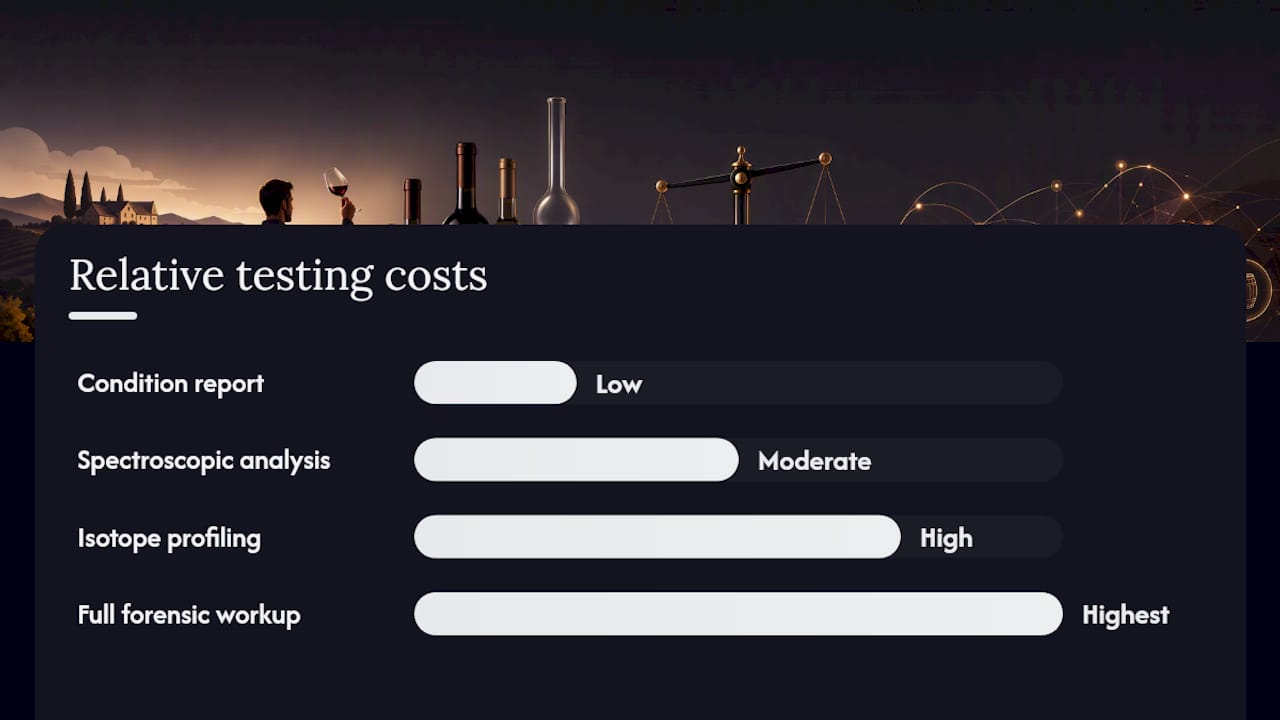
General cost guidance (relative bands, not fixed quotes):
- Condition report from a specialist: lower cost, fast turnaround, covers physical inspection and documentation review
- Basic spectroscopic analysis (NIR/NMR): moderate cost, non-invasive, useful for composition verification
- Isotope/elemental profiling: higher cost (rubidium proxy reduces this), specialist lab required, best for geographic origin disputes
- Full forensic workup (label, cork, chemical): highest cost, reserved for suspected high-value counterfeits
The practical rule: paid verification is worth it when the expected resale or replacement value substantially exceeds the testing cost. For a AU$500 bottle, a AU$400 forensic test is hard to justify. For a AU$10,000 bottle with a questionable story, it is obvious.
When provenance gaps are significant, preparing your documentation for resale before consignment is always a better investment than discovering problems after a lot is rejected.
A collector’s honest take on provenance
There is a tendency in wine circles to treat provenance as a premium collector’s concern — something that only matters when you are buying first-growth Bordeaux or pre-war Burgundy. That framing is wrong, and it costs people real money.
Provenance matters the moment a bottle has resale value. That could be a AU$200 bottle of well-cellared Australian Shiraz or a AU$20,000 case of Penfolds Grange. The documentation habits you build early are the ones that protect you later.
What I find most collectors underestimate is the cumulative effect of small gaps. A missing transfer receipt here, an undated photo there, a storage period with no environmental logs. Each gap alone looks minor. Together, they create a provenance story that a serious buyer or auction specialist will discount heavily, or reject outright.
The other thing worth saying plainly: technology is not a shortcut. Blockchain entries and NFC tags are useful tools, but they do not replace the physical inspection and documentary triangulation that Christie’s and other serious buyers actually require. A ledger record that says “this bottle was transferred on this date” is not the same as a condition report that says “this bottle was inspected and found to be in excellent condition with fill level into the neck.”
At FU Wine, the sourcing model is built around documented, traceable stock. When you buy through us, you are not just getting a great price on a premium bottle. You are getting a bottle with a story you can actually tell.
Sources
- Geochemical fingerprinting and machine learning for authenticating sparkling wine origins | npj Science of Food
- Why wine collectors look for pristine provenance | Christie’s
- Wine provenance and authentication | WineWiki
- Review of analytical techniques for wine authentication | Food Chemistry (ScienceDirect)