

Patient Investors: Wine Investment Risks, 25% Premiums Plus Checklist
Wine can be a genuine portfolio diversifier for investors who accept illiquidity, storage costs and a long game. It’s not a get-rich-quick play, and if you need your capital back in twelve months, look elsewhere. The three pillars of risk to weigh before you buy are illiquidity, provenance and storage, and fees eating your margin. Plan on holding for several years.
TL;DR:
- Wine investments typically require a holding period of at least three to five years to offset transaction costs and achieve meaningful appreciation.
- Market prices are derived from multiple sources that often disagree, making real-time valuation and liquidity unpredictable.
- Fees such as auction premiums, storage, insurance, and resale costs can erode total returns by over 40 percent before sale; careful cost analysis is essential.
- Proper provenance verification and professional storage significantly impact a bottle’s resale value and reduce the risk of purchasing counterfeit or damaged wine.
- Portfolio allocation should be limited to a small percentage of total assets, suitable only for patient investors with long-term horizons and adequate market knowledge.
Table of Contents
- What wine investment risks actually mean for your money
- Illiquidity, market cycles and the valuation gap
- The fees and costs that quietly erode your returns
- Storage, provenance and the condition risk that can wipe out value
- Fraud, counterfeit bottles and how to protect yourself
- A due diligence checklist for reducing wine investment risks
- Ways to invest in wine and the risk profile of each
- Does wine belong in your portfolio, and how much?
- FU Wine’s approach to sourcing, provenance and access
- Sources
What wine investment risks actually mean for your money
Investment-grade wine isn’t just any bottle you fancy. It’s wine with a track record: known producer pedigree, a vintage rated highly by critics, and a secondary market where people actually trade it. Think first-growth Bordeaux, top Burgundy, Champagne houses with cellaring history, or Barolo from producers with decades of auction results behind them. If nobody’s bidding on it at auction or trading it through merchants, it’s not an investment asset, it’s just wine you like.
Here’s where wine parts ways with equities. A share has a live, public price updating every second on an exchange. Wine prices get discovered through a patchwork of sources: the Liv-ex index (the industry benchmark for fine wine trading), auction house hammer prices, and merchant list prices that may or may not reflect what a bottle actually sells for that week. These sources don’t always agree, and the gap between them is where a lot of investor confusion starts.
The bigger structural difference is this: wine pays no yield. A dividend-paying stock hands you cash while you hold it. A bond pays coupons. Wine gives you nothing until you sell the bottle, and only if someone wants to buy it at a price above what you paid plus your holding costs. That single fact should reframe how you think about the asset:
- No income stream while you hold, unlike dividends or interest.
- Returns depend entirely on price appreciation and a successful exit.
- Prices move on scarcity, critic scores, weather vintages and even celebrity endorsement, not on quarterly earnings.
- Liquidity and price discovery are far thinner than listed markets, so quoted values can lag reality.
That last point matters more than most first-time buyers realise. A bottle “worth” $500 according to an index can sit unsold for months if the only buyers in the market right now aren’t interested in that specific producer or vintage. Wine investment returns depend on demand existing at the moment you need to cash out, not on a number on a screen.
Illiquidity, market cycles and the valuation gap
Wine markets move slowly, and that’s the single biggest structural risk of investing in fine wine. You can’t sell a case of Grange on a Tuesday afternoon the way you’d sell shares in a blue-chip stock. Experts recommend a minimum holding period of three to five years to let appreciation outpace the transaction costs baked into every sale, and some advisers push that out to seven years for less liquid regions.
Statistic callout: Auction buyer’s premiums alone can exceed 25% of the hammer price. A bottle needs to appreciate well beyond that just to break even on a quick auction exit.
Market cycles compound the illiquidity problem. The fine wine market isn’t immune to broader economic pressure, and rising interest rates make holding a non-yielding asset less attractive compared with cash or bonds paying real returns. That dynamic played out recently: platform growth pulled in a wave of retail investors, and when rate cycles turned, the market corrected and some newer entrants faced double-digit losses trying to sell into a thin market. It wasn’t wine itself that failed them. It was the mismatch between their expectations of quick liquidity and the reality of a slow-moving asset class.
Concentration risk makes this worse. Investors who load up on one region, one producer, or one vintage are betting on a single critic score, a single harvest, or a single producer’s ongoing reputation. If a producer has a scandal, a run of poor vintages, or simply falls out of critical favour, a concentrated portfolio takes the full hit with nowhere to hide.
Then there’s the gap between quoted valuation and what you’ll actually pocket. An index or a merchant list price tells you what similar bottles have traded for recently. It does not tell you what a buyer will pay for your specific case, in your specific condition, sold through your specific channel, this month. Factors that widen that gap include:
- How many other sellers are offering the same wine at the same time.
- Whether your provenance documentation is complete and verifiable.
- The urgency of your sale (forced sellers rarely get top price).
- Which channel you use, since auction, merchant and private sale all realise different net prices for the same bottle.
Treat any quoted valuation as a starting point for negotiation, never as a cash-in-hand figure.
The fees and costs that quietly erode your returns
Gross returns on paper and net returns in your bank account are two very different numbers, and the gap is almost entirely made up of fees you don’t think about until you’re paying them. This is one of the most underestimated financial risks of wine as an asset class, because the headline appreciation figures that get quoted in wine investment advice rarely account for what it actually costs to buy, hold and sell.
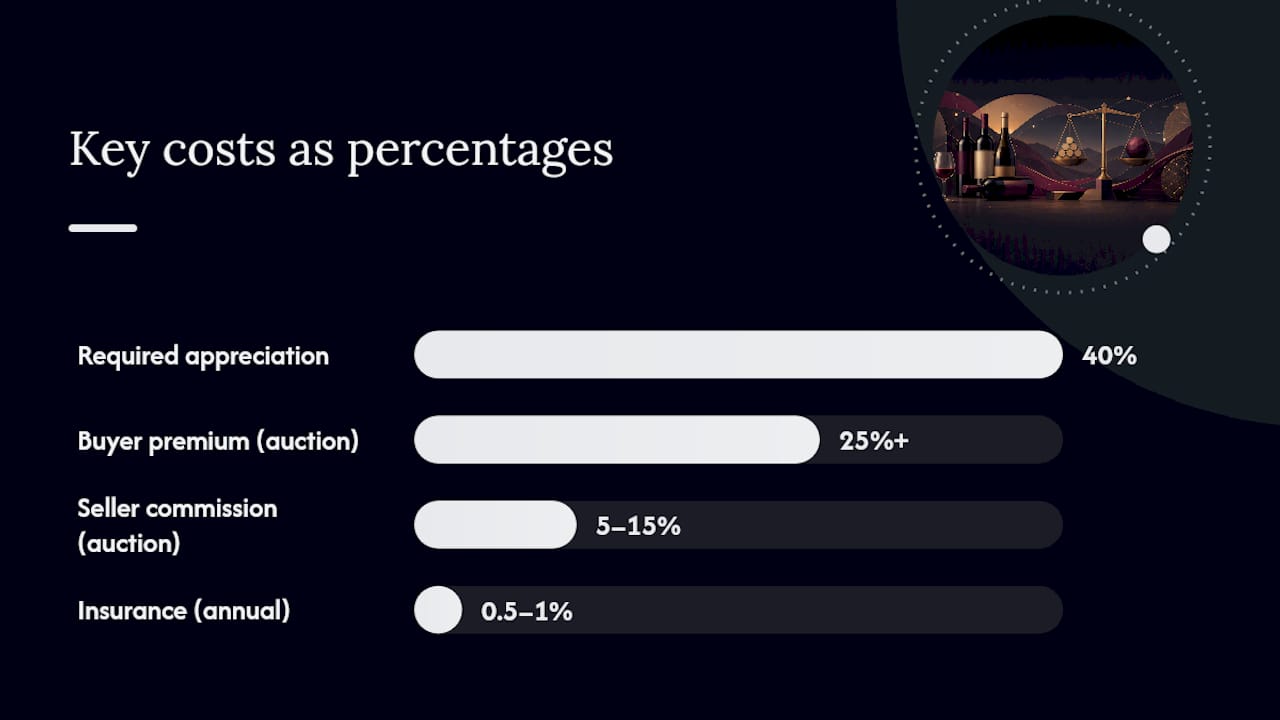
Start with the transaction costs. Selling through auction, the most common exit route for investment-grade wine, means paying a seller’s commission typically running 5% to 15%, while the buyer on the other side is paying a buyer’s premium that can exceed 25% of the hammer price. That buyer-side cost matters to you as a seller too, because it suppresses what buyers are willing to bid in the first place.
Statistic callout: Storage runs roughly US$12 to $18 per case per year in professional bonded facilities, with insurance adding another 0.5% to 1% of the wine’s value annually. On a $10,000 case portfolio held for five years, that’s several hundred dollars gone before you even list a bottle for sale.
Then there’s the holding-cost stack most first-time buyers forget to budget for:
- Bonded warehouse storage fees, charged annually per case.
- Insurance premiums, calculated against current market value, not purchase price.
- Auction listing and photography fees on top of commission, depending on the house.
- Shipping and logistics costs if you’re moving stock between bonded facilities or across borders.
- Currency conversion costs if you’re buying or selling in a different currency to your home base.
Tax and duty treatment adds another layer of variability. How gains on wine are taxed depends on your jurisdiction, whether the wine is held personally or through a structure, and whether tax authorities treat it as a collectible, an investment asset, or something else entirely. Duties on import and export can also apply depending on where the wine physically sits and where it’s sold. None of this is standard across borders, so get specific advice for your own situation rather than assuming the rules that apply to shares apply to a case of Burgundy.
Run the maths before you buy, not after you sell. A wine that needs to appreciate 40% over five years just to cover premiums, commission, storage and insurance isn’t the bargain the price chart makes it look like.
Storage, provenance and the condition risk that can wipe out value
Provenance is the single most valuable piece of paper attached to a bottle of investment-grade wine, and it’s the thing first-time buyers underestimate the most, so it’s important to understand provenance documents for art as a verification guide which can be analogously applied. A bottle with a broken chain of custody, no storage records, or a history of sitting in someone’s home under the stairs isn’t worth the same as an identical bottle with an unbroken bonded warehouse history, even if both bottles taste identical.
The chemistry behind this is straightforward. Wine is sensitive to heat, light, vibration and humidity, and damage from poor storage is often invisible until the bottle is opened, at which point it’s too late to do anything about it. Industry guidance puts the safe range at roughly 7°C to 21°C with humidity at or above 50%, kept away from direct light and constant movement. Fluctuate outside that range repeatedly and you risk cork failure, oxidation and premature ageing, none of which show up on the label.
Bonded warehouse storage exists to solve this problem systematically. These are professional facilities that maintain controlled conditions, keep audited records of who owns what and when it moved, and issue documentation that a buyer can actually verify. Private storage, by contrast, might be perfectly fine, or it might be a garage that hits 30°C in summer, and a buyer has no way to know which without trusting your word. That’s the provenance gap that professional buyers penalise hard: unverifiable storage history knocks meaningful value off a bottle regardless of how it actually tastes.
Consider what breaks provenance in practice:
- Storage outside a bonded or professionally audited facility with no temperature logs.
- Gaps in the ownership chain, especially private sales with no paper trail.
- Damaged labels, sediment disturbance or ullage (the air gap in the neck of the bottle) beyond normal ageing.
- Any period of storage in conditions the seller can’t document or verify.
Pro Tip: Before you buy a case as an investment, ask for the full storage history, not just a certificate of authenticity. A bonded warehouse audit trail showing continuous professional custody is worth more to your eventual buyer than any tasting note.
If provenance or condition comes into question, the effect on value isn’t a modest discount. Serious buyers and auction houses often decline to handle wine at all when custody can’t be verified, which can leave you holding a bottle with no real market rather than one that simply sells for less. Our guide to wine provenance walks through documentation standards in more depth if you want to dig further into what “verified” actually looks like.
Fraud, counterfeit bottles and how to protect yourself
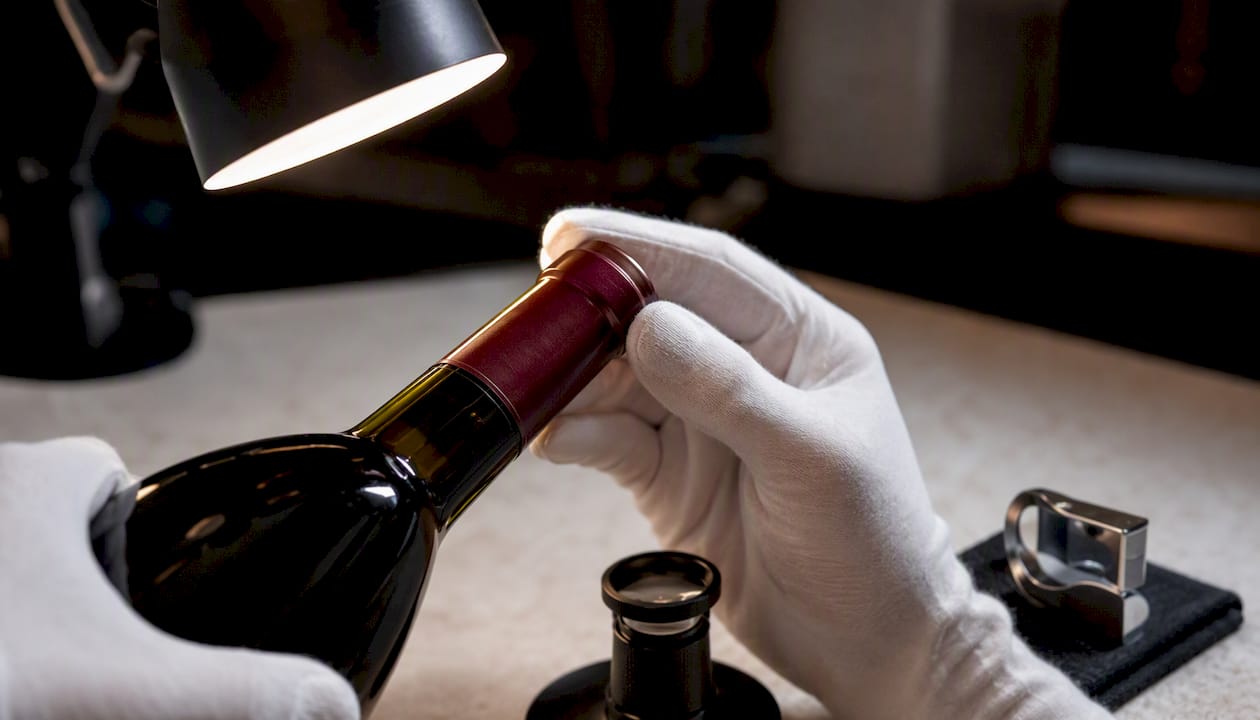
Counterfeit wine is a real and well-documented problem in the fine wine trade, and it scales with price. The most sought-after labels, top Bordeaux, rare Burgundy, cult Napa producers, are the most frequently faked, because counterfeiters go where the margins are. Common methods range from crude refilled bottles with forged labels through to sophisticated operations that source genuine old bottles and refill them with lesser wine, sometimes fooling even experienced buyers at auction.
The market’s largely unregulated nature makes this an investor’s problem to solve, not something a central authority polices for you. Wine Australia’s regulatory guidance covers domestic production and labelling standards, but that framework doesn’t extend to policing secondary-market authenticity claims made by individual sellers or auction lots. Due diligence sits with you.
Practical authentication measures worth insisting on before you commit capital:
- Full provenance documentation, including original purchase receipts and storage records.
- Proof of continuous bonded warehouse custody with audit trails, not just a one-time certificate.
- For high-value lots, laboratory testing or expert physical inspection of capsules, corks and fill levels.
- Buying exclusively through channels with an established reputation and a track record of standing behind what they sell.
Pro Tip: If a deal on a rare vintage looks too good relative to recent auction results, ask why before you ask how to pay. Steep discounts on genuinely scarce wine are the exception, not the rule, and unusually cheap “rare” stock is one of the oldest red flags in the trade.
Before handing over capital to any platform or merchant, ask direct counterparty questions: Who physically holds the wine, and under what contract? What happens to your stock if the platform or merchant becomes insolvent? Is your wine held in your name specifically, or pooled with other investors’ stock in a way that could complicate your claim if things go wrong? These aren’t awkward questions to ask a reputable seller. They’re exactly the questions a reputable seller expects and answers without hesitation.
A due diligence checklist for reducing wine investment risks
Working through a structured checklist before and after every purchase turns wine investment from a gamble into a disciplined process. Here’s the order that actually protects your capital.
- Verify provenance first, price second. Get the full ownership and storage history before you even discuss cost. A cheap price on a bottle with no documented history isn’t a bargain.
- Confirm bonded storage with paperwork, not promises. Ask for the specific facility name and request evidence of continuous custody, not a verbal assurance.
- Cross-check the asking price against independent benchmarks. Compare it with Liv-ex data and recent comparable auction results rather than relying solely on the seller’s own valuation.
- Request insurance and audit confirmation. Ask what’s insured, at what value, and whether independent audits of the storage facility happen regularly.
- Diversify across region, producer and vintage. Spreading capital across several producers and at least two or three regions limits the damage if one falls out of favour.
- Cap your allocation size per holding. No single case or lot should represent an outsized share of your total wine allocation, no matter how confident you feel about it.
- Set a target exit price and route before you buy, not after. Decide upfront whether you’re planning an auction sale, a private sale through a merchant, or a longer hold, and what price makes that exit worthwhile after fees.
- Build in a realistic timeframe. Plan around the three-to-five-year minimum, and don’t buy wine you might need to liquidate on short notice.
Pro Tip: Write your exit plan down before you buy, including your target price and preferred sale route. Investors who decide their exit strategy under pressure, mid downturn, almost always accept a worse price than those who planned it in advance.
Our wine auction bidding guide covers the mechanics of getting a fair price when auction is your chosen exit route, and it’s worth reading before your first sale, not after a disappointing one.
Ways to invest in wine and the risk profile of each
Direct purchase gives you the most control and the clearest ownership, but it also puts custody responsibility squarely on you. Buy a case and store it yourself, and you own the provenance problem entirely: any gap in your storage records becomes a gap a future buyer will penalise. Buy it and place it straight into bonded storage, and you preserve the clean chain of custody that protects resale value.
En primeur, buying wine as a future while it’s still ageing in barrel, gets you early access to allocations at a price set before the wine even bottles. That’s attractive when a vintage is being talked up early, but it carries genuine counterparty risk: if the merchant handling your futures contract becomes insolvent before delivery, you can lose your capital, the wine, or both, with limited recourse.
Auctions offer the most transparent price discovery in the market, since hammer prices are public and comparable. The tradeoff is cost: buyer’s premiums and seller’s commissions both bite hard, and realisation prices can swing significantly between similar lots depending on who happens to be bidding that day.
Managed portfolios and platforms bundle the sourcing, storage and administration into one service, which suits investors who don’t want to manage bonded logistics themselves. The convenience comes with its own risk layer, though:
- Fee structures vary widely between platforms and can include management fees on top of standard storage and insurance costs.
- Custody arrangements need scrutiny: understand exactly how your specific stock is held and titled.
- Counterparty risk exists here too, since a platform’s financial health matters as much as the wine’s quality.
- Exit terms and minimum holding requirements differ by provider and can restrict when you’re actually able to sell.
Whichever route you choose, the underlying rule stays the same: control over provenance and clarity on fees matter more than the appeal of the entry price.
Does wine belong in your portfolio, and how much?
Wine tends to suit patient investors with existing collector knowledge, or high-net-worth individuals who can treat an allocation as a genuine long-term hold rather than a trading position. If you’re drawn to the idea of quick flips or need liquidity within a year or two, this isn’t your asset class, and no amount of due diligence changes that basic mismatch.
Academic research suggests wine can improve portfolio diversification thanks to relatively low correlation with equities, but that benefit comes with real constraints around market structure, transaction costs and investor limits. The diversification case is genuine, not a marketing line, but it’s modest rather than transformative.
Most advisers who work with alternative assets suggest keeping a wine allocation as a small slice of an overall portfolio, commonly cited in the low single digits as a percentage of investable assets, and rarely more. That’s deliberate. The illiquidity and cost structure covered earlier mean wine works best as a satellite holding alongside more liquid core assets, not as a centrepiece.
A few practical considerations worth factoring in before you allocate:
- Tax treatment of gains varies by jurisdiction and by how the wine is held, so get advice specific to your situation before assuming any particular rate applies.
- Estate planning matters more with wine than with most assets, since physical stock needs to be located, valued and transferred, not just recorded on a statement.
- Lending against wine as collateral exists in some markets but isn’t universally available, and terms vary significantly by lender and by the quality of your provenance documentation.
Our guide to building a versatile wine portfolio covers how to balance genuine drinking enjoyment with investment intent, which is often the more sustainable way to approach this category anyway.
FU Wine’s approach to sourcing, provenance and access
We built FU Wine because the traditional path into investment-grade wine is loaded with middlemen and inflated pricing before you’ve even opened a bottle. We source rare and limited stock through direct relationships, allocation releases and opportunistic buying, cellar clearances, distressed inventory, boutique producer runs, and pass the savings straight to you instead of pocketing the spread. Buying in at a sharper price changes your risk math from day one: you’re not paying someone else’s markup to take it on.
We treat custody seriously. Provenance and condition are what protect resale value, so sourcing and storage practices matter as much as the label on the bottle. That said, we’re straight with you: nothing here is regulated financial advice, and wine carries the same illiquidity, storage and market risk outlined throughout this article no matter who you buy it from. Getting in at a sharper price doesn’t remove the risk. It just means you’re not paying someone else’s markup to take it on.
Sources
The AAWE working paper on wine investment remains the clearest academic source on holding periods and auction cost structures. The Pacific-Basin Finance Journal study offers a rigorous look at wine’s diversification benefits and limits. For storage standards, industry guidance on optimal wine conditions sets the benchmark most bonded facilities follow. ModernAlts breaks down historical cost and return data in practical terms, and Business Insider’s 2025 reporting documents how market corrections have hit newer, less experienced investors.
This article is general information, not a substitute for advice from a qualified financial advisor. Consult a qualified financial professional about your own circumstances before acting on anything here.
- AAWE working paper: wine investment liquidity and costs
- Wine investment returns: historical performance data (ModernAlts)
- Wine investing is getting popular, but pros urge caution in a complex market - Business Insider (2025)
- Is wine a good choice for investment? (Pacific-Basin Finance Journal, 2018)