

Wine desirability: your guide to quality and value
TL;DR:
- Wine desirability is driven by balance, winemaking style, aging potential, and terroir.
- Expert scores are helpful filters, but should be cross-referenced with notes and context.
- Advanced statistical analysis reveals underpriced wines within high-quality equivalence classes.
Most people assume that a big price tag or a famous label is what makes a wine worth drinking. That logic is comforting, but it’s also wrong. The most exciting bottles in any serious collector’s rack often come from producers you’ve never heard of, regions that don’t get magazine covers, and vintages that flew under the radar. Understanding what truly drives wine desirability gives you a serious edge. You stop paying for prestige and start paying for quality. This guide breaks down the intrinsic factors, scoring systems, and advanced rating tools that savvy collectors use to find exceptional wine at prices that don’t require a second mortgage.
Table of Contents
- Key intrinsic factors that determine wine desirability
- How expert scoring and ratings indicate value
- Advanced rating systems: finding underpriced gems
- Applying desirability principles: beyond prestige labels
- Our surprising take on wine desirability
- Explore premium selections with FU Wine
- Frequently asked questions
Key Takeaways
| Point | Details |
|---|---|
| Intrinsic factors matter most | Balance, structure, winemaking style, and terroir outshine brand prestige for true desirability. |
| Scores reveal but don’t dictate | Expert ratings signal quality but require nuanced understanding for value-focused selection. |
| Find value at every price | Statistical rating systems can identify underpriced premium wines that deliver exceptional quality. |
| Apply insights for smarter selection | Use principles from this guide to confidently discover and enjoy wines beyond well-known labels. |
Key intrinsic factors that determine wine desirability
Strip away the label, the story, and the price sticker. What’s left? The wine itself. And that’s where desirability really lives.
The most fundamental quality in any great wine is balance. When acidity, tannin, fruit, and alcohol sit in harmony, the wine feels alive. Nothing dominates. Nothing jars. You get depth, complexity, and a finish that lingers in all the right ways. A wine that’s too tannic feels grippy and harsh. Too acidic and it bites. Too fruity and it becomes cloying. Balance is the foundation everything else is built on.
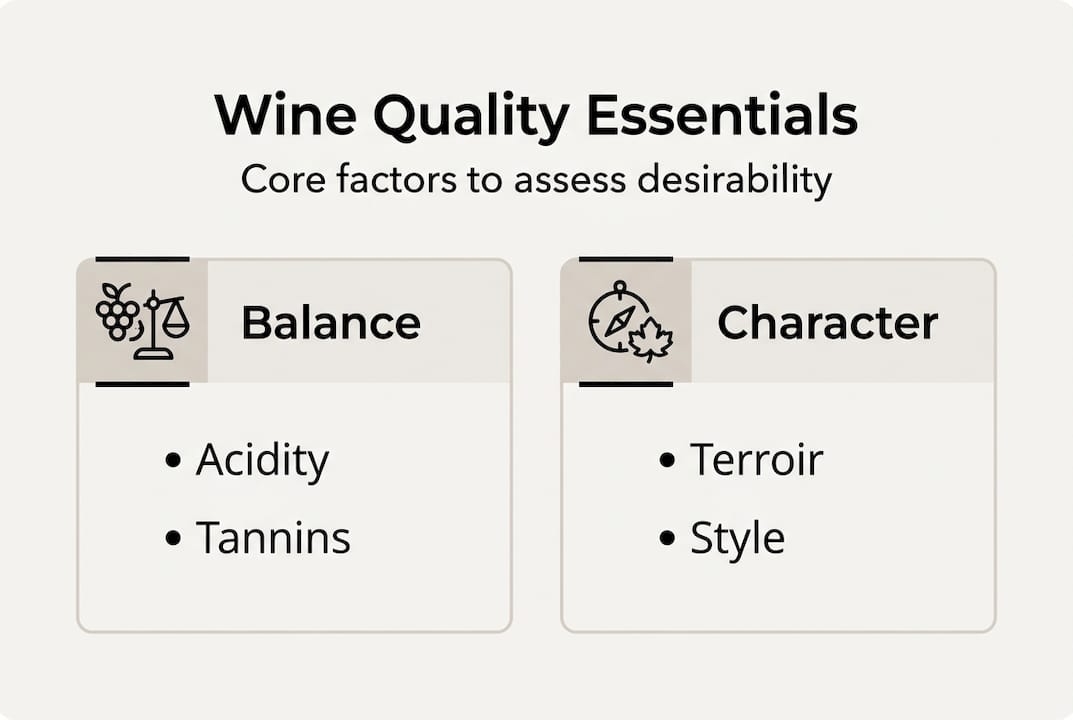
Winemaking style matters enormously too. Traditional methods, like extended maceration, wild yeast fermentation, and ageing in old oak, tend to produce wines with genuine character. They reflect the producer’s hand and the land beneath the vines. Modern techniques can be brilliant when used with intention, but wines made purely for commercial palatability often sacrifice complexity for approachability. The best producers know when to intervene and when to step back.
Structure for ageing is another major driver of desirability, especially for collectors. Wine vintage qualities play a big role here. Phenolic content, which includes tannins and anthocyanins, acts as a natural preservative. Wines with strong phenolic structure don’t just age well; they evolve in fascinating ways, developing tertiary flavours like leather, earth, dried fruit, and spice that simply don’t exist in the wine when it’s young. That transformation is part of what makes cellar-aged wine examples so compelling.
Terroir is the final piece. It’s the French concept that captures everything about where a wine comes from: the soil composition, the climate, the elevation, the aspect of the slope. Terroir is why a Pinot Noir from Burgundy tastes different to one from the Yarra Valley, even when made by equally skilled winemakers. It’s the irreplaceable fingerprint of a place.
“High-quality intrinsic factors like grape variety balance, winemaking style, structure for ageing, and terroir drive desirability for enthusiasts seeking premium selections.”
Here’s a quick breakdown of what to look for:
- Balance: Acidity, tannin, fruit, and alcohol in harmony
- Winemaking integrity: Traditional or intentional modern methods
- Phenolic structure: Signals ageing potential and long-term value
- Terroir: Unique regional character that can’t be manufactured
These aren’t abstract concepts. They’re the practical checklist you use when you’re standing in a bottle shop or scrolling through a wine deal at midnight.
How expert scoring and ratings indicate value
Once you understand intrinsic quality, the next tool in your kit is expert scoring. Critics use structured systems to quantify what they taste, and those scores carry real weight in the market.

The most widely recognised system is the 100-point scale. Wine Spectator, one of the most respected voices in the industry, uses it to rate wines across five tiers. A score of 95 to 100 means classic, a truly extraordinary wine. Scores from 90 to 94 indicate outstanding quality, wines with superior character and style. The scoring scale also recognises 85 to 89 as very good, 80 to 84 as good, and anything below 80 as below average. For collectors focused on value, the 90 to 94 band is often the sweet spot. These are genuinely excellent wines that haven’t attracted the price premiums of the 95-plus tier.
Here’s a simple comparison of score ranges and what they signal:
| Score range | Rating descriptor | Collector relevance |
|---|---|---|
| 95 to 100 | Classic | High prestige, often overpriced |
| 90 to 94 | Outstanding | Best value for quality seekers |
| 85 to 89 | Very good | Solid everyday drinking |
| 80 to 84 | Good | Functional, limited complexity |
| Below 80 | Below average | Generally avoid |
But here’s where it gets interesting. Understanding wine scoring means recognising the nuances that raw numbers can’t capture. A wine rated 91 and a wine rated 89 are not necessarily meaningfully different in quality. Scores compress at the high end because the quality gap between good and great wines narrows as you climb the scale. Two points can reflect a tasting condition, a critic’s preference, or even the temperature of the room.
Blind tasting helps reduce bias, but even blind assessments are influenced by context. Expert score nuances reveal that vintage conditions and producer reputation still inform how a wine is perceived, even when the label is hidden. This means a wine from a less famous producer in a less celebrated vintage can score very close to a prestigious bottle, and cost you a fraction of the price.
Pro Tip: Don’t fixate on a single score from a single critic. Cross-reference two or three sources and look at the tasting notes. The notes often reveal more about whether a wine suits your palate than the number does.
Here’s a numbered breakdown of how to use scores smartly:
- Identify wines scoring 90 or above from critics you trust
- Check wine vintage ratings for context on the year
- Compare scores across multiple critics to spot consensus
- Read tasting notes to assess style fit
- Look for high-scoring wines from lesser-known producers where price hasn’t caught up to quality
Advanced rating systems: finding underpriced gems
Scores from individual critics are useful. But what if you could use statistical analysis to identify wines where quality clearly outpaces price? That’s exactly what advanced rating systems do.
Researchers have applied methods like ANOVA (analysis of variance) and MSD (minimum significant difference) to large panels of expert tasters. The goal is to create what are called equivalence classes: groups of wines that are statistically indistinguishable in quality from one another. Advanced rating systems use these statistical methods to identify underpriced wines relative to their quality tier.
Here’s why this matters. Within an equivalence class, all wines share a similar quality level. But their prices can vary dramatically. A wine at the lower end of the price range within its class delivers the same sensory experience as one priced twice as high. That gap is your opportunity.
Let’s look at a simplified example of how equivalence classes might work in practice:
| Equivalence class | Quality tier | Price range (AUD) | Value opportunity |
|---|---|---|---|
| Class A | Outstanding (90 to 94) | $30 to $120 | High: wide price spread |
| Class B | Very good (85 to 89) | $18 to $60 | Moderate: some gems present |
| Class C | Classic (95 to 100) | $80 to $500+ | Low: premiums are real |
The practical takeaway is that Class A wines offer the most fertile ground for finding underpriced gems. A $35 bottle sitting in the same equivalence class as a $110 bottle is not a compromise. It’s a find.
Pro Tip: When selecting rare wines, look for producers in emerging regions where land costs are lower and name recognition hasn’t inflated retail prices yet. The quality can be identical to established names at a fraction of the cost.
For collectors thinking about wine investment benefits, equivalence class thinking also applies to long-term value. Underpriced wines within a high-quality class tend to appreciate as the market catches up to their quality. Buying smart now means drinking well later, or selling at a tidy profit.
Applying desirability principles: beyond prestige labels
Now you’ve got the tools. The question is how to use them in the real world, where you’re making actual purchase decisions.
Start with the intrinsic checklist. Before you look at the price or the label, ask: does this wine show balance? Is there evidence of thoughtful winemaking? Does the region have a track record for producing wines with structure? These questions cut through the noise fast.
Next, use scoring as a filter, not a final answer. Wines scoring 90 or above from credible critics deserve attention. But as evaluating wine quality and scores makes clear, the difference between a 91 and an 89 may not be statistically significant. Don’t pay a 30% price premium for two points.
Look hard at less-celebrated regions and producers. Boutique wineries in areas like the Clare Valley, Heathcote, or even parts of South Australia’s Riverland are producing wines with serious intrinsic quality. They just don’t have the marketing budgets of the big names. That’s your advantage.
Here’s a practical list of strategies to apply right now:
- Cross-reference scores from at least two respected critics before buying
- Read tasting notes to assess whether the wine’s style suits your palate
- Seek out equivalence class thinking by comparing similarly rated wines at different price points
- Explore emerging regions where quality is rising faster than reputation
- Prioritise structure in wines you plan to cellar, and balance in wines you plan to drink soon
Building a smart selection process also means thinking ahead. Building a wine portfolio is about diversity, not just prestige. Mix high-structure agers with ready-to-drink gems. And when rare opportunities arise, knowing how to evaluate them quickly means you can act before the deal disappears. Accessing premium bottles at the right moment is as much about preparation as it is about luck.
Our surprising take on wine desirability
Here’s the honest truth: the wine industry has spent decades convincing you that desirability is something that gets assigned from the top down. Famous critic gives a score. Famous chateau releases a vintage. Price goes up. You feel lucky to afford it.
That’s a story designed to benefit the people selling the wine, not the people drinking it.
Real desirability is multidimensional. It lives in the balance of the wine, the honesty of the winemaking, the character of the terroir, and yes, the context in which you drink it. A $40 bottle that scores 92 and comes from a producer you’ve never heard of can absolutely outshine a $200 bottle with a famous name.
Savvy collectors already know this. They use the tools covered here, intrinsic assessment, smart score interpretation, and equivalence class analysis, to consistently find wines that punch well above their price. Wine curator insights show that the best finds almost always come from looking sideways, not upward.
Chase quality. Let the prestige chasers overpay.
Explore premium selections with FU Wine
You’ve now got a proper framework for evaluating wine on its actual merits. Balance, structure, terroir, smart score interpretation, and equivalence class thinking. These are the tools that separate the savvy from the swindled.
At FU Wine, we do the hard work of sourcing wines that tick every box on that checklist, and then make them available at prices that would make a traditional wine merchant wince. Our premium wine collections feature rare, high-scoring, and cellar-worthy bottles sourced directly, cutting out the middlemen and the markups. Every bottle is a small rebellion against overpriced mediocrity. Come find your next favourite wine without paying for someone else’s prestige.
Frequently asked questions
Does a higher wine score always mean a better wine?
Not always. Scores above 90 indicate strong quality, but the difference between 91 and 89 may not be statistically significant, and intrinsic factors like balance and terroir can make a slightly lower-rated wine just as satisfying.
Can lesser-known wineries produce highly desirable wines?
Absolutely. Lesser-known producers often deliver exceptional value when their wines show strong balance, authentic terroir, and solid ageing structure. Intrinsic factors drive desirability, not brand recognition.
How can collectors spot underpriced premium wines?
Savvy collectors use statistical rating methods and equivalence class analysis to identify wines where the price hasn’t caught up to the quality rating yet.
Which intrinsic qualities matter most for selecting wine?
Balance among acidity, tannin, and fruit; phenolic structure for ageing; winemaking integrity; and terroir are the core indicators. These factors consistently separate genuinely desirable wines from overpriced ones.