

Wine auction secrets: smarter bidding for premium bottles
TL;DR:
- Online and timed auctions have made rare wines more accessible to everyday collectors.
- Buyers face additional costs like premiums, GST, and shipping, requiring careful budget planning.
- Provenance, authenticity checks, and working with reputable auction houses are essential for value and safety.
Think wine auctions are only for millionaires with velvet smoking jackets and a butler on speed dial? Think again. The auction world has cracked wide open, and everyday collectors are sliding in through the side door, picking up extraordinary bottles at prices that would make a traditional wine merchant choke on their Burgundy. Online and timed auctions have dramatically lowered the entry barriers, putting rare, cellar-worthy wine within reach of anyone willing to do a little homework and bid smart.
Table of Contents
- The basics: What happens at a wine auction?
- What you really pay: Understanding costs and commissions
- How to spot value: Provenance, authenticity, and what to check
- Winning strategies: Bidding tactics and affordable access
- Our take: Why modern wine auctions aren’t just for millionaires
- Ready to discover premium wine for less?
- Frequently asked questions
Key Takeaways
| Point | Details |
|---|---|
| True costs matter | Factor in commissions and buyer’s premiums so you don’t overpay for your auction bottle. |
| Check provenance | A wine’s ownership and storage history directly impact value and trustworthiness. |
| Smart strategies win | Setting a max bid and targeting younger vintages can secure premium bottles affordably. |
| Risk isn’t zero | Counterfeit bottles and ‘as is’ sales mean inspection and reputable sellers are crucial. |
The basics: What happens at a wine auction?
Let’s kill the mystique first. A wine auction is simply a marketplace where bottles are sold to the highest bidder. That’s it. No secret handshakes. No dress code. No invitation from a duke.
Here’s the language you need to know before you place your first bid.
- Lot: A single item or group of bottles sold together. Could be one bottle of aged Penfolds Grange or a case of mixed Bordeaux.
- Hammer price: The final bid amount when the auctioneer’s hammer falls. This is not what you actually pay.
- Reserve: The minimum price a seller will accept. If bidding doesn’t reach it, the lot is passed in unsold.
- Buyer’s premium: A percentage added on top of the hammer price. This is how auction houses make their money.
The process itself follows a pretty clean sequence. First, the auction house publishes a catalogue, usually online weeks in advance. You browse lots, read descriptions, and research what interests you. Then comes pre-bidding, where many platforms let you register your maximum bid before the auction even starts. The main event, whether live in a saleroom or via a timed online format, is where bidding plays out in real time or over several days. Once you’ve won, payment terms typically run seven to fourteen days, followed by collection or shipping.
The premium wine market trends show just how dramatically this space has shifted. In 2025, iDealwine sold over 300,000 bottles, a volume jump of 18.5% year on year, while average prices per bottle actually fell. Christie’s also reported doubling its year-on-year results in early 2025. More volume, lower average prices, and easier digital access. That’s a buyer’s market.
| Auction format | Bidding style | Entry barrier | Best for |
|---|---|---|---|
| Live saleroom | Real-time, in person or streamed | Higher | Blue-chip, rare bottles |
| Online timed | Bids over days, anywhere | Lower | Everyday collectors, younger vintages |
| Silent auction | Sealed bids submitted | Variable | Charity, boutique events |
| Retail auction | Fixed-price drops | Minimal | Flash deal hunters |
Pro Tip: Start with timed online auctions. You can browse at your own pace, research each lot before bidding, and there’s no adrenaline-fuelled saleroom pressure to push you past your budget.
What you really pay: Understanding costs and commissions
Here’s where a lot of newcomers get burned. You fall in love with a lot, win it at what feels like a bargain hammer price, and then the invoice arrives. Suddenly that “deal” looks a lot less exciting.
The true cost of any auction purchase is the hammer price plus the buyer’s premium, plus GST, plus any shipping or insurance. The buyer’s premium typically adds 19.5 to 25% on top of the hammer price, and that percentage is applied before GST is calculated. So a bottle you win for $200 at hammer could realistically cost you $255 to $265 by the time it lands on your doorstep.
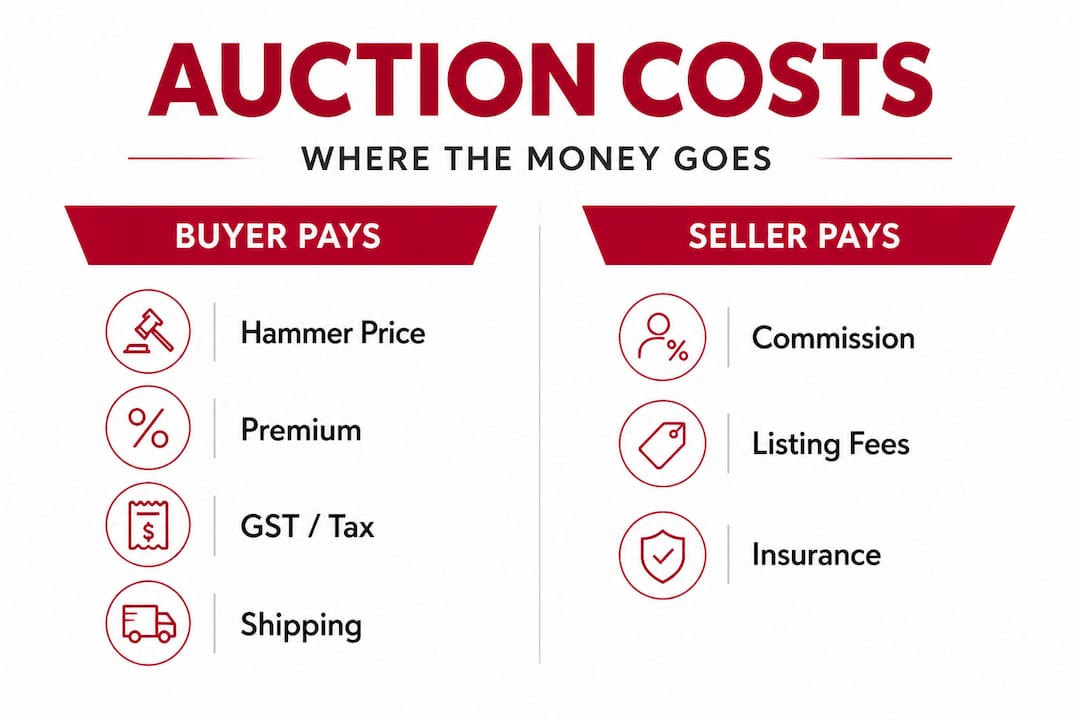
Understanding how to snag premium bottles smart starts with building your real budget before you ever place a bid, not after.
Here’s how to do it properly:
- Find the estimate. Every lot has a pre-sale estimate range. This tells you what the house expects it to sell for.
- Add the buyer’s premium. Apply the house’s premium rate (check their website, it varies) to your maximum hammer price.
- Add GST. In Australia, GST applies to the buyer’s premium component, adding another 10% on that portion.
- Factor in freight. Wine shipping isn’t cheap, especially for temperature-controlled transport. Get a quote before bidding.
- Set your walk-away number. This is the total you’re willing to spend. Work backwards to find the maximum hammer price you can bid.
Here’s a quick comparison of typical commission structures across major auction formats:
| Auction house type | Buyer’s premium | Seller’s commission | GST applied |
|---|---|---|---|
| Major international house | 22–25% | 10–15% | Yes, on premium |
| Boutique specialist | 19.5–22% | 8–12% | Yes, on premium |
| Online platform | 15–20% | 5–10% | Yes, on premium |
| Charity/private auction | Variable | Variable | Varies |
The seller pays a commission too, typically in a similar range to the buyer’s premium. This means auction houses are double-dipping on every transaction, which is perfectly fine so long as you know the game going in.
How to spot value: Provenance, authenticity, and what to check
Once you know the costs, the next challenge is making sure what you’re buying is actually worth buying.
Provenance is the ownership and storage history of a wine. It’s the single most important factor in determining whether a lot is a bargain or a very expensive mistake. A bottle from a perfectly temperature-controlled private cellar is a very different proposition from one that spent a decade in someone’s garage in Queensland.
When you’re evaluating a lot, here’s what to look at closely:
- Ullage: The gap between the wine and the cork or capsule. A high fill level means minimal evaporation and good storage. Low ullage in an old bottle is a warning sign.
- Labels: Faded, stained, or torn labels can signal poor storage conditions. Some collectors accept this for very old bottles, but it affects resale value.
- Capsules: The foil cap over the cork should be intact and free of significant corrosion. Any breaching raises authenticity questions.
- Lot description: Look for language like “ex-chateau,” “single-owner collection,” or “direct from producer.” These phrases signal stronger provenance and often command a price premium for good reason.
“Ex-chateau or single-owner collections consistently attract premium bids precisely because buyers trust the unbroken chain of custody.” This is not snobbery. It’s risk management.
The darker side of the auction world is counterfeits. Famous fraud cases involving Rudy Kurniawan and Hardy Rodenstock exposed just how sophisticated wine fraud can be. Counterfeit risks are real, particularly for very old or extremely high-value bottles. Most auction lots are sold “as is,” with no quality guarantee. This is the standard across the industry, not the exception.
Pro Tip: Before bidding on anything over a few hundred dollars, attend the pre-sale viewing if one is offered. Run your eye over the actual bottle. Read the lot notes carefully. If the auction house is reputable, any known faults will be disclosed. If they’re vague, that vagueness is information in itself.
Protecting yourself means sticking to reputable houses, understanding what “as is” actually means, and learning to spot genuine wine value through education rather than gut feel alone. You can also use independent resources to cross-reference auction estimates against recent market pricing, which helps flag lots that are either suspiciously cheap or quietly overpriced. Understanding how wine value is determined gives you a serious edge when reading a catalogue.
Winning strategies: Bidding tactics and affordable access
Knowing what to look for and what to pay paves the way for making winning moves at the auction. Now let’s talk tactics.
The most common mistake new auction bidders make is treating it like a competition. It’s not. You’re not there to beat other bidders. You’re there to acquire wine you want at a price that makes sense. That shift in mindset changes everything.
Here’s how to approach it:
- Set your maximum bid before you look at the catalogue. Decide what each lot is worth to you. Not what the catalogue says it’s worth. What you’d actually pay. This prevents emotion from taking the wheel.
- Use absentee bidding whenever possible. Most platforms and auction houses allow you to submit your maximum bid in advance. The system will bid on your behalf up to that number. You stay rational. The algorithm does the work.
- Research past results. Every reputable auction house publishes historical results. Knowing what a comparable lot sold for last season gives you a real reference point, not just the house’s estimate.
- Target younger vintages. Older blue-chip wines get the glamour and the fierce bidding wars. A well-regarded wine from a recent but excellent vintage is often underestimated and far more accessible.
- Explore smaller and specialist houses. The big names attract the big crowds. Boutique auction houses, regional specialists, and online-only platforms often have less competition on individual lots, which means better access to premium bottles at friendlier prices.
Bidding strategies like setting a firm maximum and using absentee options aren’t just good advice, they’re essential discipline in a room (or on a screen) designed to make you spend more. Auction fever is real. The moment you start bidding “just a little more” to beat someone, you’ve left the building mentally.
The affordable premium access insight that smart collectors already know: online and timed auctions, combined with a focus on non-blue-chip wines and smaller houses, is where the real value lives right now.
| Access point | Why it works | Best wine types |
|---|---|---|
| Timed online auction | Low barrier, browse from home | Younger vintages, regional gems |
| Boutique specialist | Less competition, niche expertise | Single-producer, cellar releases |
| Charity auction | Unique lots, often undervalued | Mixed cases, local rarities |
| Flash deal platforms | Speed and scarcity create urgency | Premium overstock, direct releases |
Pro Tip: Register with three or four different auction platforms and set up lot alerts for producers or regions you love. You’ll start to develop a feel for pricing patterns quickly, and you’ll be ready to pounce when a genuine opportunity appears.
Explore the top auction strategies that savvy collectors use, and connect them with a solid understanding of wine distribution for collectors to see the full picture of where value hides in the supply chain.
Our take: Why modern wine auctions aren’t just for millionaires
Here’s the uncomfortable truth the old guard doesn’t want to talk about. The gatekeeping that made wine auctions feel exclusive was never really about quality. It was about access control. Limit who can play, and you limit competition. Limit competition, and prices go where insiders want them.
Technology has blown that model up. Beautifully.
The market has had a challenging run through 2022 to 2024, with corrections across many blue-chip categories. But 2025 is showing genuine green shoots, particularly driven by a wave of younger buyers who are reshaping what auction demand looks like. These buyers prefer younger, more reliable vintages. They’re comfortable bidding online. They’re less interested in collecting for status and more interested in drinking well. That’s a cultural shift, and it’s permanent.
Blockchain and digital provenance tracking are starting to appear in the more forward-thinking corners of the auction world. The idea is simple: a verified, tamper-proof record attached to a bottle that traces every owner and storage condition since bottling. Single-owner sales with compelling stories already attract premiums because trust is genuinely valuable. Digital verification takes that trust to a whole new level.
What this means for you as a collector is that the tools, the access, and the market conditions are aligning in your favour. The traditional gatekeepers are losing their grip. Smart buyers who do their homework and stay disciplined are finding opportunities that simply didn’t exist a decade ago. Every bottle is a small rebellion against overpriced mediocrity. We’re here for it.
Ready to discover premium wine for less?
The auction world has never been more accessible, and the opportunity to build a genuinely impressive cellar without paying inflated retail prices is very real. But you don’t have to wait for the next auction catalogue to drop to start drinking better.
At FU Wine, we’ve built a whole world around the same principle that smart auction buyers already live by: premium wine should be priced for people who love wine, not for people who love showing off. Our curated premium wines collection brings together rare bottles, limited releases, and high-scoring vintages at prices that would make a traditional merchant weep into their crystal decanter. Flash deals, rotating stock, and insider-level access without the insider price tag. That’s the FU way. Jump in and see what’s waiting for you.
Frequently asked questions
What’s the difference between a live and an online wine auction?
A live auction happens in real time, either onsite or via a live stream, while an online timed auction allows bids over several days from anywhere and typically has much lower entry barriers for new collectors.
How do I verify a wine’s authenticity before bidding?
Check the lot’s provenance documentation, inspect bottle visuals including labels, capsule, and ullage level, and favour established auction houses that vet their collections thoroughly before listing.
Can I get a refund if there’s an issue with an auction bottle?
Most wine auction sales are final, with bottles sold “as is” and no guarantee of condition or authenticity, which is exactly why pre-sale inspection and buying from reputable houses matters so much.
What’s the safest way to avoid overbidding at auction?
Set your maximum bid firmly before the auction begins, stick to it without exception, and use absentee bidding options to remove the emotional pressure of real-time competitive bidding.
Recommended
- How wine deals work: Snagging premium bottles smart – FU Wine
- Unlock wine discounts: Top strategies for premium bottles – FU Wine
- Wine allocation explained: Unlock premium bottles and real value – FU Wine
- Unlock exclusive wine access: rare bottles and savings – FU Wine
- Discover what makes French boutique wineries unique – Res Fortes