

Why price does not equal quality in wine
TL;DR:
- Wine price does not reliably indicate quality because marketing and bias influence ratings more than taste.
- Knowing the factors behind wine pricing helps consumers focus on what truly matters in the glass.
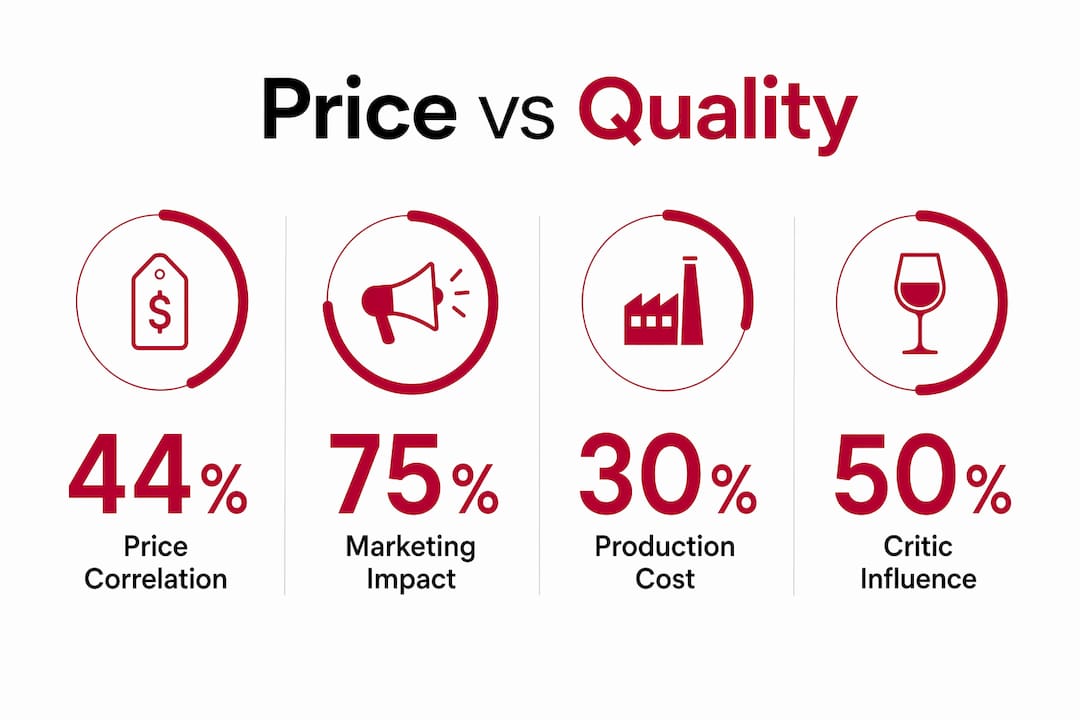
Price does not equal quality in wine. That is not a hot take. It is a data point. Research shows a moderate correlation of 0.44 between wine price and professional quality ratings. That number tells you price is a weak predictor at best. Yet the wine industry has spent decades convincing you otherwise, and it has worked brilliantly. The concept of price-quality inference is the industry term for this bias. It describes how consumers automatically assume a higher price signals better quality. Understanding why price does not equal quality in wine is the first step to drinking better without paying more.
What factors actually drive wine prices beyond quality?
Wine pricing is layered, and most of those layers have nothing to do with what is in the bottle. Production costs like land, labour, and barrel ageing do contribute. But marketing, distribution, and brand overheads can inflate retail prices well beyond actual input costs. Michael Fridjhon, one of South Africa’s most respected wine critics, argues that gullible consumers allow producers to charge premiums based on prestige rather than substance.
The components behind wine pricing stack up fast. Land in Burgundy or Napa Valley costs a fortune. Critic scores from publications like Wine Spectator or Robert Parker’s Wine Advocate carry enormous weight. Scarcity, whether real or manufactured, pushes prices up further. Packaging, bottle weight, and label design all signal luxury before you have even pulled the cork.
Here is what you are often paying for above $60 a bottle:
- Prestige and brand equity. Names like Penfolds Grange or Château Pétrus carry decades of reputation. You pay for the story as much as the wine.
- Critic scores and legacy ratings. A 98-point score from a major publication can double a wine’s price overnight, regardless of whether the current vintage justifies it.
- Scarcity and allocation systems. Limited releases create urgency. Producers and distributors use allocation models to control supply and inflate demand.
- Overhead recovery. Cellar doors, tasting rooms, export logistics, and marketing campaigns all get baked into the retail price.
- Packaging signals. Heavier bottles and embossed labels cost more to produce and more to buy. They do not make the wine taste better.
Pro Tip: Wines under $20 often reflect reliable quality from a producer’s reputation and farming philosophy. The German Wine Authority notes that above $60, you are frequently paying for prestige or investment value rather than sensory quality.
The disconnect between production cost and retail price is real and well documented. Knowing what drives expensive wine prices lets you filter out the noise and focus on what actually matters in the glass.
Does price indicate quality in wine? What the data says
The data on wine price vs quality is clear, and it is not flattering for the premium end of the market. Price accounts for 78% of rating variation in professional assessments. That variation is driven largely by marketing and psychological bias, not by sensory quality alone. Critics taste with knowledge of price. That knowledge shapes their scores.
Vintage year and price are the two strongest predictors of quality ratings in data science models. Country of origin and wine type matter, but less so. The models show moderate predictive accuracy at best. That tells you no single variable, including price, reliably predicts how good a wine will taste.
| Factor | Influence on quality rating | What it actually reflects |
|---|---|---|
| Price | Very high (78% of variation) | Marketing, prestige, and bias |
| Vintage year | High | Climate and growing conditions |
| Country of origin | Moderate | Regional style expectations |
| Wine type | Lower | Consumer category preferences |
| Producer reputation | Variable | Farming and winemaking philosophy |
“Critic scores and ratings often reflect price-influenced expectations rather than purely sensory attributes. Score inflation and brand legacy can cause highly rated wines to carry prices not justified by the current vintage quality.” — German Wine Authority
The implication is significant. When a critic scores a wine at 95 points, part of that score reflects what they already know about the producer, the price, and the vintage reputation. Blind tasting studies consistently show that scores compress when price information is removed. Understanding how critic scores affect your buying decisions is one of the most useful skills a wine drinker can develop.
Value-for-money wines exist at every price point below $40. They outperform expectations precisely because they are not priced for prestige. They are priced for what is in the bottle.
What does wine quality actually mean?
Wine quality is a contested, multidimensional concept. It is not a single score or a fixed standard. Quality in wine is shaped by the absence of faults, balance, complexity, and nuance, and each of those attributes means something different depending on who is doing the tasting.
Expert tasters actively seek subtle complexity and even acceptable flaws. A slight brett character or a touch of volatile acidity can add intrigue for a connoisseur. For a casual drinker, those same attributes read as defects. Expert tasters value nuance and balance, including characteristics that mass-market wines deliberately engineer out. Mass-market wines prioritise smoothness and consistency because those attributes poll well with broad audiences.
This divergence matters for how you shop. Here is a practical framework for thinking about quality on your own terms:
- Define what you enjoy. Smoothness, freshness, fruit intensity, or earthy complexity. None of these is objectively superior. Your palate is the authority.
- Separate fault from preference. Cork taint, oxidation, and excessive volatile acidity are genuine faults. Everything else is style. Do not confuse unfamiliar with bad.
- Assess balance first. A well-balanced wine, where fruit, acid, tannin, and alcohol work together, delivers more pleasure than a technically impressive but unbalanced bottle at three times the price.
- Freshness signals care. A fresh, lively wine reflects good farming and careful winemaking. It does not require an expensive appellation to achieve.
- Trust your repeat experience. If you return to a wine, it is quality for you. That is the only metric that matters for everyday drinking.
Pro Tip: The German Wine Authority recommends that everyday drinkers focus on balance and freshness rather than prestige or price. Those two attributes predict enjoyment more reliably than any score or label.
The placebo effect in wine tasting is well established. Consumers consistently rate the same wine higher when told it is expensive. Bottle weight, label design, and packaging cues all influence perceived quality before the wine touches your lips. That is not a character flaw. It is human neuroscience. Knowing it exists lets you work around it.
How can you identify quality wines without relying on price?
Spotting a quality wine without leaning on the price tag is a learnable skill. It requires shifting your attention from signals designed to impress to signals that actually reflect what is in the bottle.
Focus on the producer’s farming philosophy first. Producers who farm with care, whether through organic, biodynamic, or low-intervention practices, tend to make wines that reflect their terroir honestly. That honesty shows up in the glass as complexity and freshness. It does not always show up in the price.
Use the label as a starting point, not a verdict. Appellation information, vintage year, and producer name give you context. A wine from a well-regarded but lesser-known appellation, like Mencia from Bierzo in Spain or Assyrtiko from Santorini in Greece, can deliver extraordinary quality at a fraction of the price of a Burgundy or Barossa icon.
Be sceptical of expensive packaging. Heavy bottles and elaborate labels add cost without adding flavour. Producers who spend money on glass and foil are often spending less on what goes inside. The relationship between wine value and fair pricing is rarely reflected in the packaging.
Here is what to look for when hunting for affordable wines that taste good:
- Regional underdogs. Wines from emerging or overlooked regions often offer outstanding quality because producers there compete on taste, not reputation.
- Négociant wines from respected houses. Entry-level releases from quality-focused producers often share the same winemaking philosophy as their flagship bottles.
- Older vintages at clearance prices. A cellar-cleared 2015 from a good producer can outperform a flashy new release at twice the price.
- Wines with modest scores but strong balance. A 90-point wine with genuine freshness and balance will drink better than a 95-point wine built for the tasting note rather than the table.
Learning to spot a genuine wine value buy takes practice, but the payoff is real. You drink better, spend less, and stop funding someone else’s marketing budget.
Key takeaways
Price is an unreliable proxy for wine quality because marketing, prestige, and psychological bias account for the majority of price variation, not sensory attributes.
| Point | Details |
|---|---|
| Weak price-quality link | A correlation of 0.44 between price and professional ratings shows price is a poor quality predictor. |
| Bias drives ratings | Price accounts for 78% of rating variation, mostly due to expectation and marketing rather than taste. |
| Quality is subjective | Balance, freshness, and personal preference predict enjoyment more reliably than price or critic scores. |
| Placebo effect is real | Consumers rate identical wines higher when told they are expensive, confirming perception shapes experience. |
| Value wines exist | Affordable wines from lesser-known regions and producers regularly outperform prestige bottles on taste alone. |
The price illusion is the industry’s best trick
I have tasted a lot of wine. Some of the most memorable bottles I have had cost less than $25. Some of the most forgettable cost over $150. That is not a coincidence. It is the predictable result of an industry that has spent generations conflating price with worth.
The uncomfortable truth is that most expensive wine is priced for reasons that have nothing to do with what you taste. Overhead recovery, brand legacy, critic relationships, and scarcity theatre all push prices up. The wine inside the bottle is often only one part of the equation, and sometimes not the biggest part.
What I have found is that the drinkers who get the most out of wine are the ones who trust their own palate. They use factors affecting wine prices as context, not as a verdict. They know that a $30 Grenache from McLaren Vale can be as thrilling as a $200 Châteauneuf-du-Pape. They are not anti-quality. They are anti-pretension.
The joy of wine is in the glass. Not on the label. Not in the score. Develop your palate, learn what you love, and stop letting price do your thinking for you. That is the most liberating thing you can do as a wine drinker.
— Damien
Wine that earns its price tag
FU Wine was built on exactly this idea. Premium wine should not come with inflated, pretentious pricing. Every bottle in the FU Wine catalogue is there because it earns its place on taste, quality, and value, not because of a flashy label or a famous postcode.
FU Wine sources rare, high-scoring, and cellar-aged bottles at prices that make the wine industry deeply uncomfortable. Think 30–70% below traditional retail on wines that genuinely deserve your attention. No clearance rubbish. No bulk filler. Just quality bottles at prices that make sense. Browse the FU Wine collection and find out what wine tastes like when the price actually reflects what is in the glass.
FAQ
Does a higher price mean better wine quality?
No. Research shows a correlation of only 0.44 between price and professional quality ratings. Price reflects marketing, prestige, and overheads as much as it reflects sensory quality.
Why do expensive wines get higher critic scores?
Critic scores often reflect price-influenced expectations rather than purely sensory attributes. When tasters know a wine is expensive, their scores tend to rise, regardless of what is in the glass.
Can affordable wines taste as good as expensive ones?
Yes. Balance, freshness, and producer philosophy predict enjoyment more reliably than price. Wines from lesser-known regions regularly outperform prestige bottles in blind tastings.
What is the placebo effect in wine tasting?
The placebo effect in wine causes consumers to rate the same wine higher when told it costs more. Bottle weight and label design reinforce this effect before the wine is even tasted.
How do I choose a quality wine without using price as a guide?
Focus on balance, freshness, and producer reputation. Use vintage information and appellation context as starting points. Learn to identify quality wine by what you taste, not what you paid.