

Why choose premium discount wines: value meets quality
TL;DR:
- Premium discount wines are high-quality bottles sold at lower prices due to business decisions like vintage rotation or overstock, not quality issues.
- These wines often offer better sensory experience and genuine craft at a fraction of full retail prices, especially from lesser-known regions.
Premium discount wines are high-quality bottles sold below their usual retail price, giving you access to genuine craft winemaking without the inflated cost. This is not a niche concept for collectors. The demand for premium drinking experiences has grown 30% in the year to March 2026, which tells you the market has shifted. People want quality. They just refuse to overpay for it. If you’re asking why choose premium discount wines, the short answer is this: you get the taste, the craft, and the psychological satisfaction of a premium bottle, at a price that doesn’t make you wince.
Why choose premium discount wines over full-price bottles
The industry term for this category is “premiumisation at value,” and it describes exactly what’s happening in the Australian wine market right now. Consumers are trading up in quality but trading smart on price. Premium discount wines sit in that sweet spot where real winemaking craft meets opportunistic buying.
The sensory quality of wine generally peaks between $15 and $40. Above $50, you’re mostly paying for branding, scarcity, and prestige rather than anything your palate can actually detect. That’s not an opinion. That’s the price-quality relationship breaking down in real time. When a premium bottle that normally retails at $80 drops to $35 through a clearance or vintage rotation, you’re landing inside that sensory sweet spot and getting the craft that justified the original price.
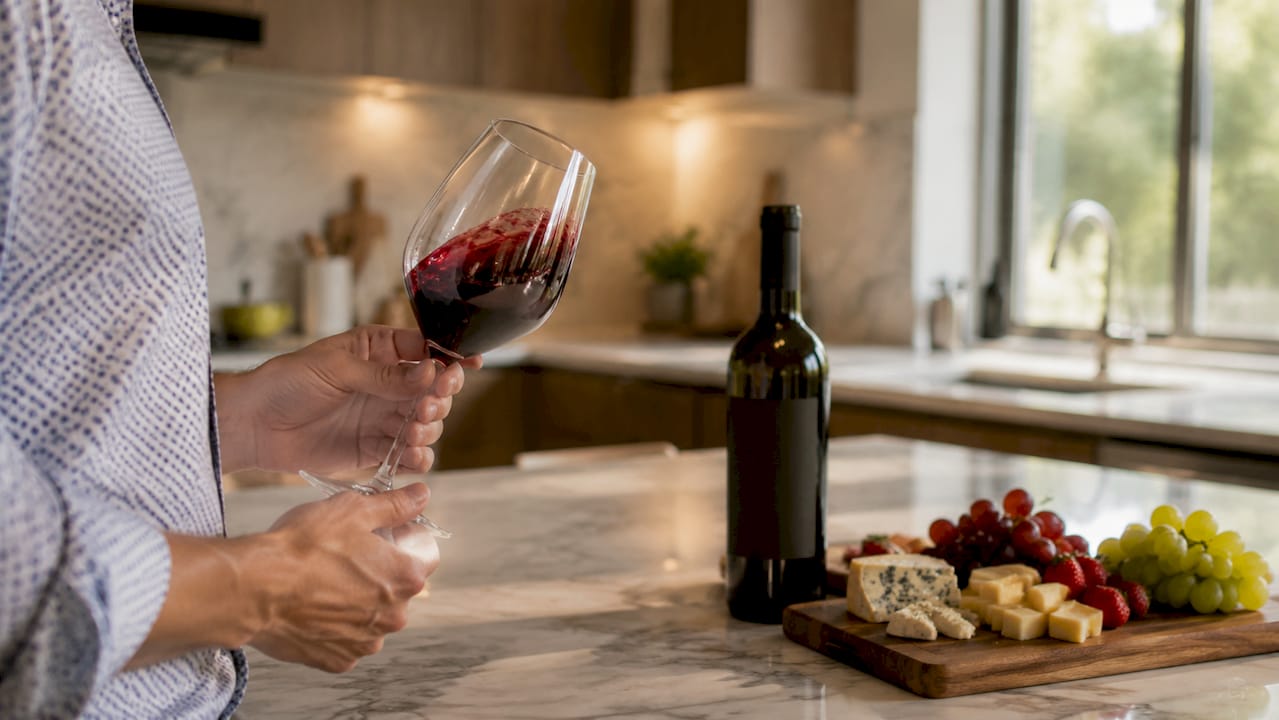
Neuroscience adds another layer. Knowing a wine is premium triggers increased activity in the brain’s pleasure centres, which means you genuinely enjoy it more. Buying a discounted premium bottle gives you both the real sensory quality and that psychological lift. You’re not just saving money. You’re drinking better.
What actually makes a wine premium?
Premium wine status is built on production decisions that cost real money and take real time. Understanding those decisions helps you spot genuine value when you see it.
The foundations of premium winemaking include:
- Hand harvesting rather than machine picking, which protects grape integrity and allows selective picking at peak ripeness
- Low yields per vine, which concentrates flavour and complexity in each berry
- Small-batch fermentation, giving the winemaker precise control over the final profile
- Extended barrel ageing, which builds texture, tannin structure, and the kind of finish that lingers
- Terroir expression, meaning the wine genuinely reflects its soil, climate, and geography rather than being engineered for consistency
These are labour-intensive methods that justify premium pricing at the production level. The problem is that by the time a bottle reaches retail, you’re also paying for marketing budgets, distributor margins, and brand prestige. None of those add anything to your glass.
Pro Tip: When evaluating a premium wine, look for specific production details on the label or producer’s website: barrel ageing duration, yield per hectare, and harvest method. These are the markers of genuine craft, not just clever packaging.
The price-quality sweet spot sits firmly in the $15–$40 range. Beyond that, diminishing sensory returns accelerate fast. A $120 bottle is not three times better than a $40 bottle. It’s often just rarer, or better marketed.
Why are premium wines discounted? it’s not what you think
The biggest misconception in wine buying is that a discount signals a problem with the wine. It almost never does. Discounts are business decisions, not quality verdicts.
Here are the most common reasons a premium wine ends up on sale:
- Vintage rotation. Retailers need to clear current stock to make room for the incoming vintage. The wine in the clearance bin might be older, which in premium wine terms often means better.
- Overstock and allocation surplus. Producers sometimes release more than the market absorbs in a given window. Excess stock gets moved through discounting.
- Seasonal promotions. End-of-year, pre-Easter, and mid-year sales are retail mechanics, not quality signals.
- Cellar clearances. Boutique producers occasionally clear aged stock to free up cellar space. These are often the most exciting finds.
- Distributor changes. When a producer switches distributors, existing stock is often discounted to clear the pipeline.
Discounts are frequently business decisions made at the retail or distribution level, with no connection to what’s inside the bottle. Savvy buyers who understand this access reputable producers at prices that would otherwise be out of reach.
Pro Tip: If you see a wine from a producer you recognise at a significant discount, check the vintage year. If it’s a year or two older than the current release, that’s often a sign of cellar clearance stock, which can be superior in quality, not inferior.
Discounted premium wines often come from older vintages cleared quickly to make room for new releases. Age and quality can be superior in these cases. That’s the opposite of what most casual buyers assume.
Premium discount vs cheap mass-market: what’s actually different?
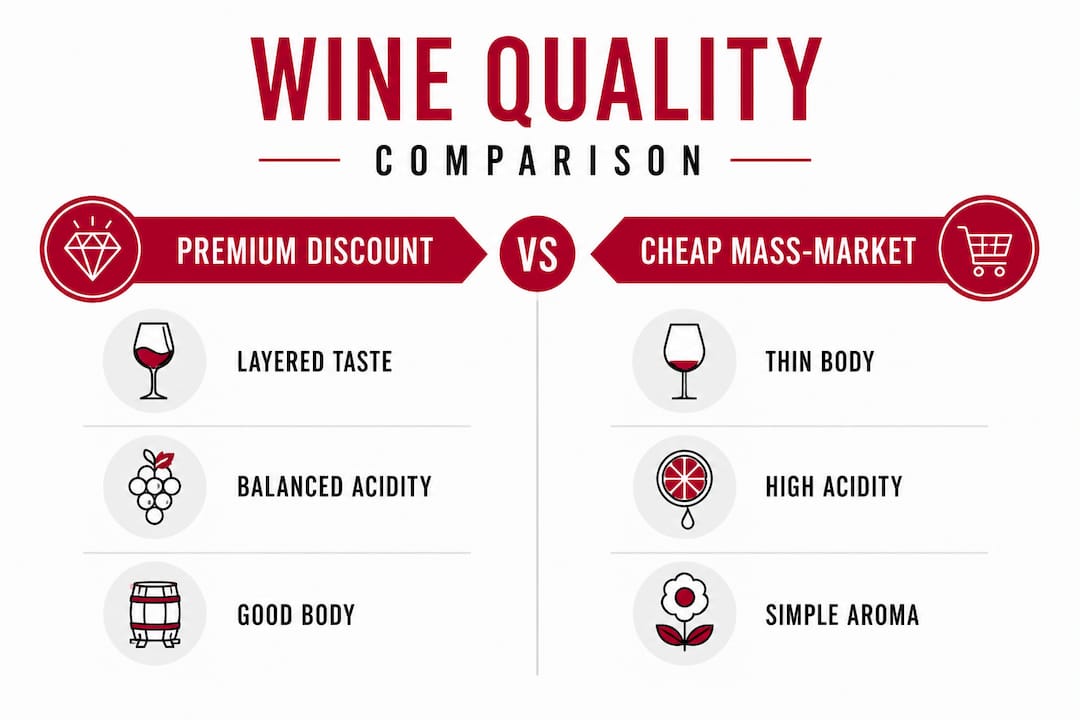
This is where the rubber meets the road. Not all affordable wines are equal, and the gap between a discounted premium bottle and a cheap mass-market wine is significant.
Cheap, mass-market wines are typically more acidic, thinner in body, and lack the aromatic complexity that makes wine genuinely enjoyable. That’s a direct result of industrial farming, high yields, and large-scale production methods designed for consistency and volume, not character.
| Attribute | Premium Discount Wine | Cheap Mass-Market Wine |
|---|---|---|
| Taste complexity | Layered, with distinct fruit, earth, and spice notes | Flat, often one-dimensional |
| Aroma profile | Developed through barrel ageing and terroir | Simple, sometimes artificial |
| Finish | Long and evolving | Short, often sharp or acidic |
| Production method | Hand-harvested, small-batch, barrel-aged | Machine-harvested, industrial-scale |
| Ageing potential | Often improves with time | Designed for immediate consumption |
| Sustainability | Frequently from boutique, low-intervention producers | Often from large industrial operations |
The psychological dimension matters too. Perceived premium status genuinely enhances enjoyment. When you know a wine was crafted with intention, from a respected producer, your brain responds differently than it does to a $10 supermarket bottle. Buying a discounted premium wine gives you that response at a fraction of the original price.
The common misconception is that price and taste are always correlated. They’re not. What you’re avoiding with a premium discount selection is the industrial shortcut, not the prestige markup.
How to find and choose quality discount wines
Finding genuine value in the discount wine selection requires a bit of know-how. Here’s what actually works:
- Know your producers. Build a short list of winemakers and regions you trust. When their bottles appear at a discount, you already know the quality baseline.
- Use wine scores as a filter, not a bible. A 90+ point score from Wine Spectator, James Halliday, or Robert Parker confirms quality. It doesn’t mean you need to pay full price to enjoy it.
- Look at lesser-known regions. Wines from McLaren Vale, the Grampians, or Clare Valley often deliver the same craft as their more famous counterparts at lower prices, simply because the postcode isn’t as fashionable.
- Explore blends. Single-varietal wines from famous appellations carry a prestige premium. A well-made Shiraz Grenache blend from a boutique South Australian producer can outperform a single-varietal at twice the price.
- Store correctly. A discounted premium bottle deserves proper storage. Keep it at a consistent 12–14 degrees Celsius, away from light and vibration. A wine that’s been stored well will always outperform one that hasn’t, regardless of price.
- Serve at the right temperature. Reds at 16–18 degrees, whites at 8–12 degrees. Temperature affects aroma release and perceived flavour more than most people realise.
Wine consumers are increasingly focused on provenance, sustainability, and intentional drinking rather than volume. That cultural shift works in your favour when buying discounted premium wines. You’re already aligned with where the market is heading.
Pro Tip: Sign up for flash sale alerts from specialist wine retailers. The best discounted premium bottles sell fast. Being first on the list is the difference between scoring a $90 Barossa Shiraz for $38 and missing out entirely.
Key takeaways
Premium discount wines deliver genuine craft quality at accessible prices, making them the smartest choice for anyone who values what’s in the glass over what’s on the price tag.
| Point | Details |
|---|---|
| Sensory quality peaks at $15–$40 | Above $50, you pay for branding and scarcity, not better taste. |
| Discounts reflect business decisions | Vintage rotation, overstock, and cellar clearances drive discounts, not quality flaws. |
| Premium craft is real and detectable | Hand harvesting, low yields, and barrel ageing produce complexity that mass-market wines cannot replicate. |
| Psychological enjoyment is genuine | Knowing a wine is premium increases brain pleasure response, even at a discounted price. |
| Lesser-known regions offer the best value | Boutique producers from regions like Clare Valley and the Grampians deliver premium quality without the prestige markup. |
The honest truth about buying smart
I’ve been drinking and writing about wine for a long time, and the most liberating realisation I’ve had is this: the wine industry’s pricing structure is not designed to help you drink well. It’s designed to sell you a story.
The bottles I’ve enjoyed most over the past decade have rarely been the most expensive ones on the table. They’ve been the ones I found through a flash sale, a cellar clearance, or a tip from someone who actually knew the producer. A Coonawarra Cabernet Sauvignon I picked up for $28 during a vintage rotation sale a few years back was genuinely one of the best reds I’ve had. The original retail was $75. Nothing changed in the bottle. The price changed.
What I’d caution against is the opposite mistake: assuming every discounted wine is a find. Some cheap wines are cheap for a reason. The skill is in knowing your producers, understanding why the discount exists, and recognising the difference between a cellar clearance gem and a bulk wine dressed up in a fancy label.
The benefits of premium wines are real. The craft is real. You just don’t need to pay the full retail markup to access it. That’s not a compromise. That’s drinking smart.
— Damien
Drink better for less with FU wine
FU Wine was built for exactly this. No pretension, no inflated markups, no gatekeeping. Just genuinely good wine at prices that make sense.
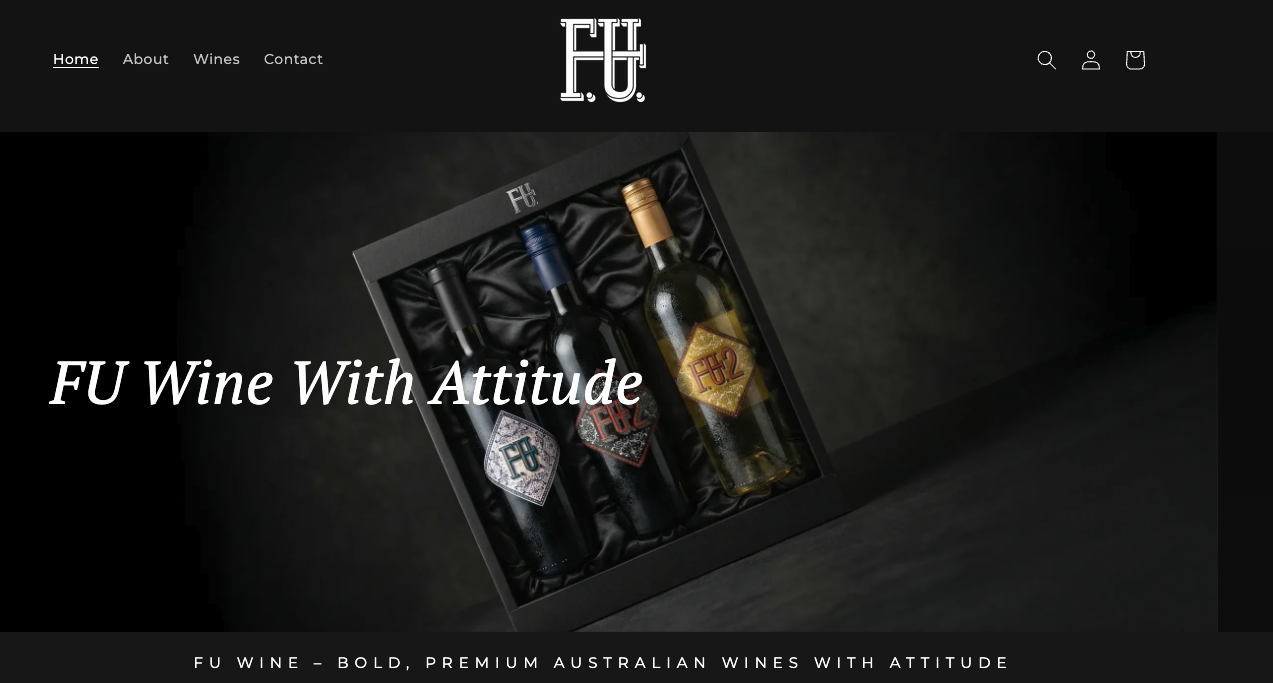
FU Wine sources premium bottles including limited releases, cellar-aged stock, and high-scoring vintages, and makes them available at aggressive discounts of 30–70% below traditional retail. These are not clearance wines. They’re the kind of bottles that sell out fast when people find out about them. The model is simple: flash deals, rotating stock, and insider access without the insider price tag. If you’re ready to stop overpaying and start drinking well, FU Wine is where you start.
FAQ
What are premium discount wines?
Premium discount wines are high-quality bottles from reputable producers sold below their standard retail price, typically due to vintage rotation, overstock, or cellar clearances rather than any quality issue.
Does a discount mean the wine has a problem?
No. Discounts are commercial decisions made by retailers and distributors to manage inventory. The wine inside the bottle is unchanged.
What is the best price range for quality wine?
The sensory sweet spot sits between $15 and $40. Above $50, most of the price reflects branding and scarcity rather than taste improvements.
Are older vintage wines on clearance worth buying?
Yes. Discounted older vintages are often superior in quality because additional bottle age has allowed the wine to develop further complexity and integration.
How do i find genuine premium wine deals in australia?
Sign up for flash sale alerts from specialist retailers, focus on boutique producers from regions like McLaren Vale, Clare Valley, and the Grampians, and use wine scores from James Halliday or Wine Spectator as a quality filter before buying.