

What is no-label wine? Quality, price, and truth
TL;DR:
- No-label wine is quality wine sold without a branded front label, often to manage surplus or protect brand value.
- It can offer estate-level quality at a lower price, with legality and transparency depending on regulations and retailer honesty.
No-label wine is wine sold without the producer’s branded front label, typically to offer quality product at a lower price by stripping away the marketing signals that inflate cost. In Australia and globally, this practice goes by several names: cleanskin wine, NDA wine, or private-label wine. The core idea is the same regardless of what you call it. A producer makes wine, decides not to attach their famous name to it, and sells it at a fraction of the usual retail price. That’s the no-label wine meaning in plain terms, and it’s a far more common practice than most drinkers realise.
What is no-label wine and why does it exist?
No-label wine is defined as any bottled wine released to market without the winemaker’s or estate’s branded front label attached. The industry terms you’ll encounter most often are “cleanskin” in Australia, “NDA wine” in the United States, and “private-label wine” in retail contexts globally. All three describe the same fundamental concept: quality wine deliberately separated from its origin branding.
The definition of no-label wine matters because it shapes your expectations as a buyer. This is not reject wine. It is not the stuff that failed quality checks. No-label inventory often arises from logistics rather than quality failure, facilitating brand protection for the producer. Think of it as the wine world’s version of a designer outlet: same product, different packaging story.
Australia has a particularly strong cleanskin culture. Producers in the Barossa Valley, McLaren Vale, and Margaret River regularly release cleanskins when they have surplus from a strong vintage or when a wine doesn’t fit neatly into their existing range. The wine inside the bottle is often identical to, or sourced from the same fruit as, their labelled releases.
Why do producers sell no-label wines?
Producers sell no-label wines for several distinct commercial and philosophical reasons. Understanding those reasons helps you judge what you’re actually buying.
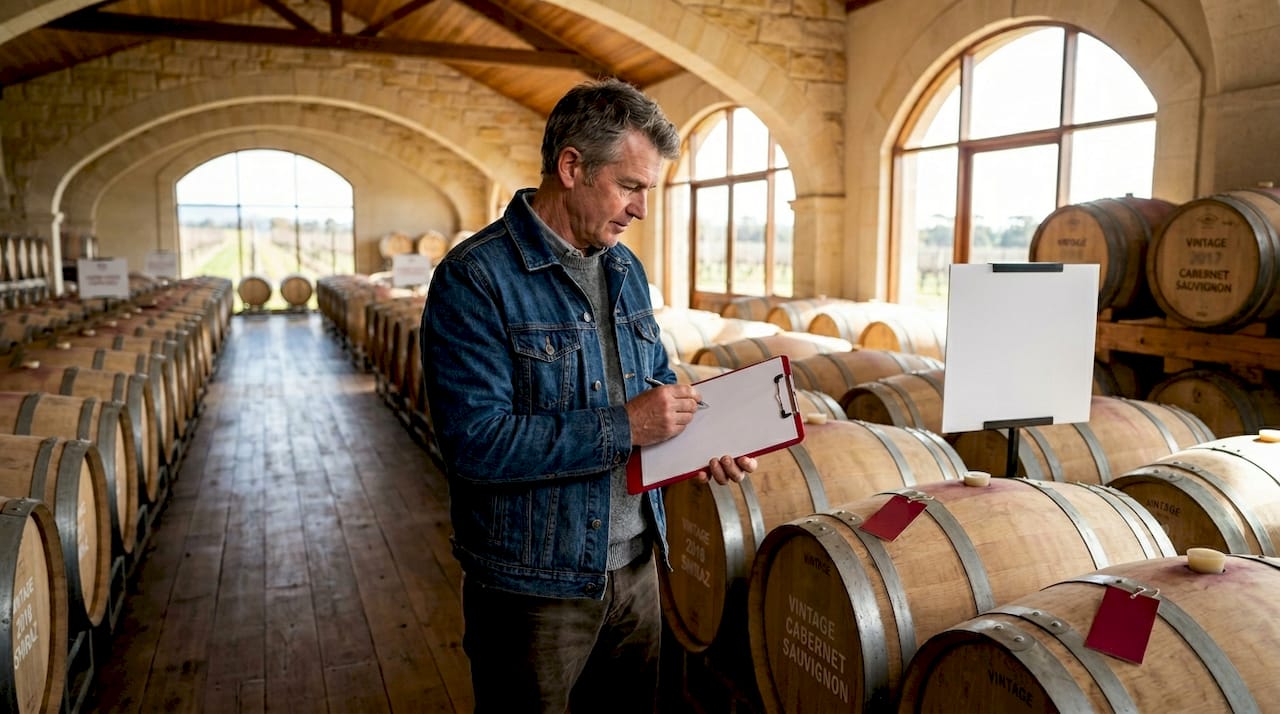
Surplus management is the most common driver. Vintage variability means some years produce more fruit than a winery planned for. Rather than bulk-sell that wine at commodity prices, smart producers bottle it without their label and move it through alternative channels at a profit.
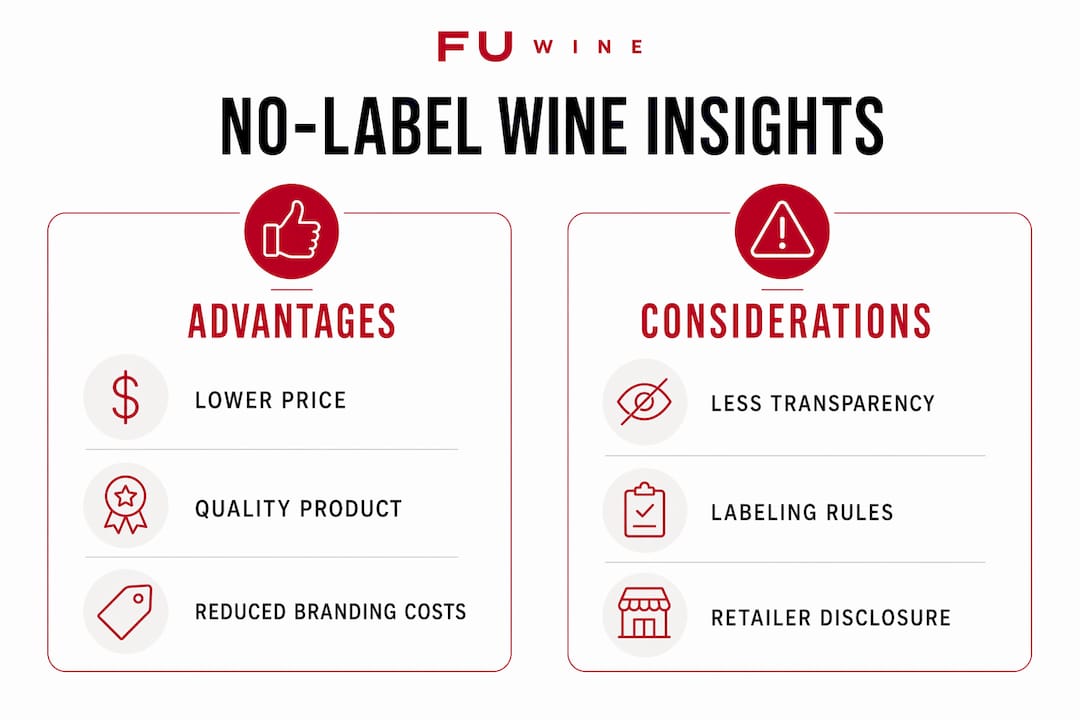
Brand protection is equally important. A prestige producer cannot afford to have their flagship label sitting on a discount shelf at half price. It destroys the perceived value of every other bottle they sell. By releasing surplus or secondary-tier wine as a no-label product, they protect the integrity of their main brand while still recovering value from the inventory.
NDA agreements represent the most formalised version of this practice. NDA wines are sold under nondisclosure agreements, allowing producers to sell surplus or less prestigious vintages under a secret label at discounted prices. A Napa Cabernet typically sold for $250 can appear under an NDA arrangement at $30, with retailers contractually bound to keep the producer’s identity secret. That price gap is real, and it’s the reason savvy buyers actively seek these bottles out.
There is also a fourth, more philosophical reason. Natural wine producers resist labels as a form of compromise and standardisation, embracing a no-label philosophy as a statement of principle. For these producers, the absence of a label is not about surplus. It’s about rejecting the marketing machinery of the conventional wine industry entirely.
- Surplus from strong vintages that exceed planned production volumes
- Brand protection to prevent prestige labels appearing at discount retail prices
- NDA and private-label agreements with retailers seeking exclusive or house wines
- Natural wine philosophy rejecting standardised commercial labelling
Pro Tip: When a retailer offers a no-label wine, ask directly whether it’s a cleanskin from a named producer or a purpose-blended private label. The answer tells you a lot about what’s in the glass.
Does no-label wine mean lower quality?
No-label wine does not mean lower quality. That’s the single most important thing to understand about the no-label wine characteristics that define this category.
The confusion is understandable. We are conditioned to read labels as quality signals. A recognisable name, a gold medal sticker, a prestigious appellation printed in elegant type: these are all extrinsic signals that tell us something is worth drinking before we’ve opened the bottle. Strip those away and the brain fills the gap with doubt.
But removing the front label shifts information asymmetry, requiring consumers to rely on other trust systems. That’s not a flaw in no-label wine. It’s a feature of the buying process that rewards informed consumers. When you know how to read those alternative signals, you gain access to estate-level wine at a fraction of the price.
“No-label wines can offer estate-level quality for significantly less money by removing brand signalling and marketing costs.” The same Napa Cabernet that retails for $250 under its famous label can appear as an NDA wine at $30 from the identical source.
Here’s how to think about quality when evaluating a no-label bottle:
- Ask about the source. A reputable retailer will tell you the region, the vintage year, and ideally the grape variety. That’s the minimum information you need to make a quality judgement.
- Check the vintage. No-label wines from strong vintages in well-regarded regions carry the same fruit quality as their labelled counterparts. Vintage data is your friend here.
- Read tasting notes carefully. Retailer reputation and tasting notes are the primary screening tools consumers use to judge no-label wines. A retailer who provides detailed, honest tasting notes has skin in the game.
- Look for certifications. Organic or biodynamic certifications sometimes appear on no-label bottles even when the producer’s name does not. These are meaningful quality signals.
The risk with no-label wine is not poor quality. The risk is opacity. You need enough information to make a confident decision, and a good retailer provides that without you having to drag it out of them.
What are the labelling rules for no-label wines?
No-label wine still has to meet legal requirements, and those requirements vary significantly by market. Understanding the regulatory context helps you know what disclosures you’re entitled to expect.
In the United States, the Alcohol and Tobacco Tax and Trade Bureau (TTB) governs wine labelling. US regulatory labelling requirements depend on alcohol by volume, with wines under 7% ABV subject to different mandatory disclosures and potentially exempt from front label approval requirements. For standard table wines above 7% ABV, producers must still disclose the country of origin, net contents, alcohol content, and health warnings regardless of whether a branded front label is present.
In Australia, Food Standards Australia New Zealand (FSANZ) sets the baseline. A wine sold without a branded label must still carry the country of origin, standard drink information, allergen declarations (particularly sulphites), and the responsible service of alcohol statement. The producer’s name and address are required on the label in some form, though this is often placed on the back label or capsule rather than the front.
| Market | Minimum required disclosure | Front label approval needed? |
|---|---|---|
| Australia (FSANZ) | Country of origin, standard drinks, allergens, producer address | No formal pre-approval required |
| United States (TTB) | Country of origin, alcohol content, health warning, net contents | Yes, for wines over 7% ABV |
| European Union | Appellation, vintage, alcohol content, allergens, importer details | Varies by member state |
| United Kingdom (post-Brexit) | Country of origin, alcohol content, allergens, responsible drinking | No formal pre-approval |
The practical implication for Australian buyers is this: a legitimate no-label wine sold locally will always carry a back label with the required disclosures. If a bottle has absolutely no labelling whatsoever, that’s a red flag worth investigating before you buy.
How to identify and select authentic no-label wines
Identifying quality no-label wine is a skill, and it’s one worth developing. The absence of a front label doesn’t have to mean the absence of confidence.
Removing front labels necessitates compensating information sources such as tasting reviews, retailer reputation, and any producer information disclosed to reduce consumer uncertainty. That sentence from academic research on wine information asymmetry is the practical playbook for buying no-label wine well.
Start with the retailer. A specialist wine retailer or a curated online wine business that sources no-label and cleanskin wines with genuine care will always be more transparent than a bulk discount outlet. Ask where the wine came from. Ask about the vintage. Ask whether it’s a cleanskin from a named producer or a purpose-blended private label. The quality of the answer tells you as much as the wine itself.
Authenticity verification requires understanding whether a no-label wine is identical to a branded bottling or is a distinct private-label blend, despite legal constraints on disclosure. This distinction matters enormously for value. A cleanskin from a Barossa producer’s flagship block is a very different proposition from a blended private-label wine assembled from multiple sources.
- Buy from retailers who disclose the region and vintage as a minimum standard
- Treat anonymous no-label wines from unknown sources with genuine scepticism
- Use Wine Companion, Vivino, or specialist retailer tasting notes as quality screens
- Understand that NDA wine contracts bind retailers to secrecy on producer identity, so some opacity is legally enforced rather than suspicious
- Prioritise no-label wines from recognised regions: Barossa Valley, Coonawarra, Clare Valley, Margaret River, Yarra Valley
Pro Tip: If a retailer can tell you the region, the vintage, and the grape variety but not the producer’s name, that’s often a sign you’re looking at a genuine NDA or cleanskin arrangement rather than a mystery blend. That level of disclosure is the sweet spot for confident buying.
The natural wine category adds another layer. Natural wine producers who reject standardised labelling as a philosophical statement are usually well documented in specialist wine communities. Their wines appear in dedicated natural wine shops and online retailers who provide extensive producer background. The no-label philosophy here is a feature, not a gap in information.
Key takeaways
No-label wine delivers genuine quality at lower prices when you buy from transparent retailers who disclose region, vintage, and grape variety as a minimum standard.
| Point | Details |
|---|---|
| Definition is clear | No-label wine is quality wine sold without a branded front label, not rejected or inferior product. |
| Commercial reasons vary | Producers use no-label releases for surplus management, brand protection, NDA agreements, or philosophical reasons. |
| Quality can be estate-level | The same fruit and winemaking that produces a $250 bottle can appear in a no-label release at $30. |
| Legal disclosures still apply | Australian and US regulations require minimum disclosures even without a branded front label. |
| Retailer transparency is everything | Region, vintage, and grape variety are the minimum disclosures that separate confident buying from a gamble. |
No-label wine: what I’ve actually learned from buying it
I’ve been buying cleanskins and NDA wines for years, and the single biggest mistake I see enthusiasts make is treating no-label wine as a category rather than a sourcing strategy. It’s not a type of wine. It’s a distribution decision made by a producer, and the quality behind that decision ranges from extraordinary to ordinary depending entirely on who made it and why.
The bottles that have genuinely surprised me have always come from retailers who were upfront about what they knew and honest about what they couldn’t disclose. A retailer who says “I can’t tell you the producer by agreement, but I can tell you it’s a single-vineyard Shiraz from the Barossa, 2021 vintage, and I’ve tasted it against the labelled release” is giving you everything you need. That’s the no-label wine vs branded wine comparison done properly, in real time, by someone with actual knowledge.
What I find genuinely exciting about the category right now is the way digital review signals are balancing the information gap. Platforms like Vivino and the James Halliday Wine Companion mean that even when a producer’s name is under NDA, a wine’s characteristics can be cross-referenced against known regional styles and vintages. You can build a picture without the label doing the work for you.
The future of no-label wine in Australia looks strong. Consumers are increasingly sceptical about paying for wine labels rather than what’s inside the bottle, and producers are responding by making cleanskin and NDA releases a deliberate part of their commercial strategy rather than a last resort. That’s good for everyone who drinks wine seriously.
— Damien
Discover premium no-label wines without the markup
FU Wine was built for exactly this moment. You’ve just learned that no-label and cleanskin wines can deliver estate-level quality at a fraction of the price. FU Wine sources those bottles directly, cutting out the middlemen and the marketing budgets that inflate what you pay at retail. The selection rotates fast, the deals are real, and the wines are the kind of thing you’d normally only access through industry connections. If you’re ready to drink better without paying for someone else’s branding, explore FU Wine’s curated range and see what’s available right now. Every bottle is a small rebellion against overpriced wine.
FAQ
What is the difference between no-label wine and cleanskin wine?
No-label wine and cleanskin wine describe the same concept: quality wine sold without the producer’s branded front label. In Australia, “cleanskin” is the standard industry term, while “no-label” is the broader international description used across markets including the US and UK.
Is no-label wine lower quality than branded wine?
No-label wine is not inherently lower quality. NDA and cleanskin wines often originate from oversupply or vintages that don’t fit a producer’s existing range, not from quality failures. The wine inside can be identical to a labelled release from the same producer.
How can I tell if a no-label wine is worth buying?
Ask the retailer for the region, vintage, and grape variety as a minimum. A reputable seller will provide tasting notes and disclose what they legally can. Retailer reputation and specialist tasting reviews are the most reliable quality screens when the producer’s name is withheld.
Are there legal requirements for no-label wines in Australia?
Yes. Under FSANZ regulations, Australian wines sold without a branded front label must still carry country of origin, standard drink information, allergen declarations, and producer contact details, typically on a back label or capsule.
What is an NDA wine?
An NDA wine is a no-label wine sold under a nondisclosure agreement between a producer and a retailer. The retailer is contractually bound to keep the producer’s identity secret, which is why the wine carries no branded label. These arrangements allow producers to sell surplus at discounted prices without damaging the value of their main label.