

What is high-scoring vintage wine? A collector's guide
TL;DR:
- A high-scoring vintage indicates favorable growing conditions with outstanding aging potential. However, producer skill and proper timing determine if the wine reaches its full quality. Vintage scores are useful guides but do not guarantee bottle performance or value; tasting and producer reputation matter more.
A high-scoring vintage is defined as a harvest year rated highly by recognised critics and publications based on superior growing conditions, signalling wines with outstanding ageing and quality potential. The term “vintage” refers to the year grapes were harvested, while “high-scoring” reflects how well that growing season performed against established criteria. Publications like Wine Spectator and Robert Parker’s Wine Advocate use 100-point rating scales to classify these years, with scores of 95–100 earning the label “Classic.” Understanding what is high-scoring vintage means understanding the difference between a great season and a great bottle. Those two things are related, but they are not the same.
What is high-scoring vintage and how are ratings determined?
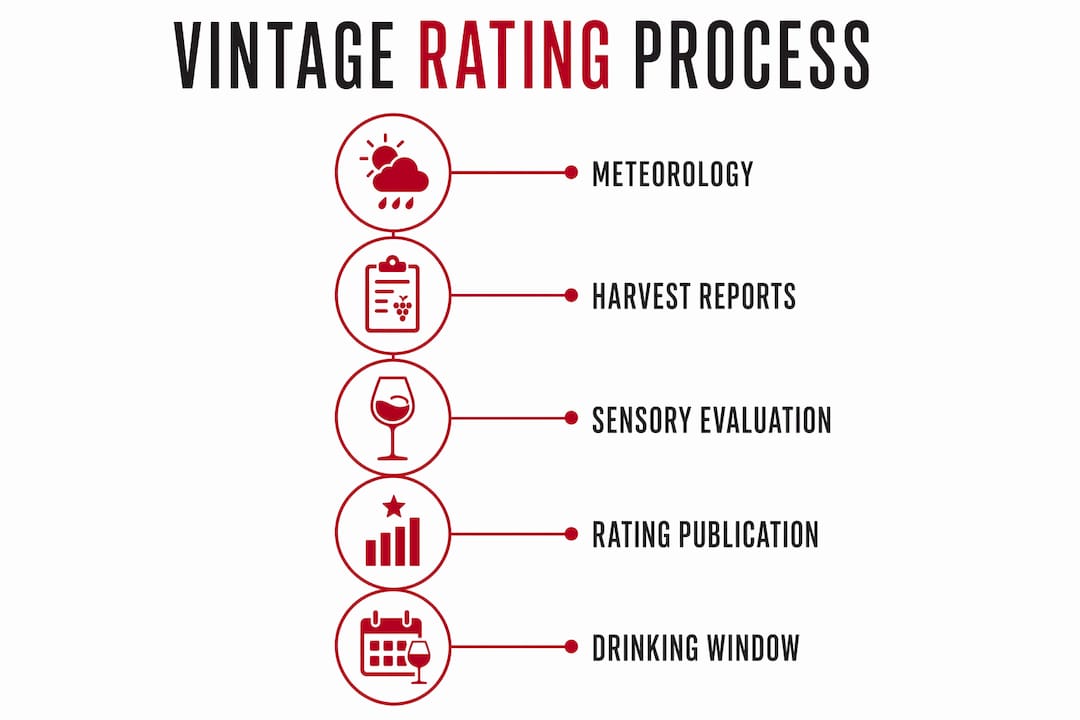
Vintage ratings synthesise three core data streams: meteorological records, harvest reports, and sensory evaluations by tasting panels. Temperature patterns, rainfall timing, and disease pressure during the growing season all feed into the initial assessment. A cool, wet spring followed by a warm, dry summer and autumn typically signals a strong vintage in regions like Burgundy, Bordeaux, and Napa Valley.

Tasting panels then evaluate wines from the region 6 to 36 months post-harvest to capture how the season translated into the glass. This delay matters. A vintage that looked promising in the vineyard can still disappoint if harvest rain diluted the fruit or if fermentation went sideways.
Editorial judgement from experienced critics shapes the final score. This is not a purely algorithmic process. A critic who has tasted Burgundy for 30 years brings pattern recognition that no spreadsheet replicates.
Rating bands on the 100-point scale work like this:
- 95–100: Classic. Exceptional growing conditions with wines showing outstanding ageing potential.
- 90–94: Excellent. Strong conditions producing wines well above average quality.
- 85–89: Very good. Solid season with reliable quality across the region.
- 80–84: Good. Acceptable conditions, though inconsistency is common.
- Below 80: Generally not recommended for cellaring or investment.
Some publications, including those using the 20-point scale common in academic and European circles, compress these bands differently. The 100-point scale dominates collector conversation because it creates finer distinctions at the top end, where the real money moves.
Pro Tip: Never read a vintage score in isolation. Always check when the score was published. Early assessments made 6 months post-harvest can shift significantly once wines have had 2–3 years to develop.
What does a high-scoring vintage mean for wine quality and ageing?
A vintage rating reflects growing conditions across a region. It does not guarantee every bottle produced that year is outstanding. This distinction matters enormously for collectors. Vintage charts estimate regional quality, not the performance of individual producers within that region.
Producer skill is the multiplier. A great vintage can be wasted by poor vineyard management and careless winemaking. Conversely, a skilled producer in a modest vintage can still craft a wine worth cellaring. The vintage score sets the ceiling; the producer determines how close the wine gets to it.
Score thresholds and what they signal
Scores above 95 signal wines with extended ageing potential, often 15–30 years for structured reds from Bordeaux or Barossa Valley Shiraz. Scores below 87 indicate a compressed drinking window, recommending earlier consumption rather than long-term cellaring. The middle band, roughly 88–94, is where most serious wines sit and where the most nuanced decisions happen.
Drink window codes appear alongside scores on most professional vintage charts. These annotations tell you whether a wine is too young to open, at peak drinking maturity, or past its best. Drink window guidance often provides more practical value for collectors than the raw score alone. Knowing a wine is “at peak” in 2026 is more useful than knowing it scored 92 in 2018.
Pro Tip: When assessing a wine for purchase, cross-reference the vintage score with the producer’s track record across multiple years. A producer who consistently performs above the regional average in weaker vintages is worth paying attention to.
| Score range | Vintage classification | Typical ageing guidance |
|---|---|---|
| 95–100 | Classic | Extended cellaring, 15+ years for top reds |
| 90–94 | Excellent | Good ageing potential, 8–15 years |
| 85–89 | Very good | Drink within 5–10 years |
| Below 85 | Good to average | Drink relatively young |
Why does a high-scoring vintage matter for collectors and enthusiasts?
Vintage knowledge directly shapes purchasing decisions, auction bids, and cellaring strategy. When you know a region had an exceptional year, you can set realistic expectations before spending serious money. When you know a year was weak, you can avoid overpaying for wines riding the producer’s reputation rather than the season’s quality.
Vintage variation is most critical in regions where climate swings significantly year to year. Burgundy is the classic example. The difference between a great Burgundy vintage and a poor one can be the difference between a wine that ages 20 years and one that fades in five. Bordeaux, Napa Valley, and the Barossa Valley all show meaningful vintage variation that affects both quality and price.
Practical ways collectors use vintage scores:
- At auction: Vintage scores help you assess whether a lot is priced fairly relative to the season’s quality.
- En Primeur buying: Purchasing Bordeaux futures requires confidence in the vintage before the wine is even bottled. Clear vintage evaluations, as Jane Anson advocates, help consumers make better En Primeur decisions.
- Cellar planning: Knowing which years to hold and which to drink sooner prevents you from opening a wine too early or holding one past its peak.
- Value hunting: Excellent vintages in less fashionable regions often offer outstanding quality at prices well below the headline appellations.
Vintage scores work best when combined with individual wine reviews and producer reputation. A 95-point vintage from a mediocre producer still produces mediocre wine. A curated wine selection that combines vintage data with producer track records gives you a far sharper picture than either signal alone.
Sommelier João Castro puts it plainly: the best way to understand vintage impact is active tasting, study, and repetition. Reading charts is the starting point, not the finish line.
Common misconceptions about vintage ratings
Vintage scores do not guarantee quality in every bottle from that year. This is the most common misunderstanding among newer collectors. A Classic vintage in Burgundy means conditions were exceptional across the region. It does not mean every producer made exceptional wine. Most professional wine reviews cluster between 85 and 96 points, which means the spread within a single vintage can be enormous.
-
Regional scores mask local variation. A vintage chart covers broad appellations. Within Burgundy, a single village can have dramatically different results from its neighbour due to microclimate, soil drainage, and aspect. A regional score of 96 does not mean every Burgundy producer had a 96-point year.
-
Mid-range scores create false price hierarchies. Within the 88–94 range, practical quality differences are often minimal despite significant market price variations. A wine scored 94 is not necessarily twice as enjoyable as one scored 88. Scores act as directional guides, not precise hierarchies.
-
Climate change is shifting vintage reliability. Warmer growing seasons across Europe and Australia have compressed the traditional “great vintage” cycle. Regions that once produced one exceptional vintage per decade now produce strong vintages more frequently. This changes how you should weight historical vintage charts against current releases.
-
Vintage matters less for everyday wines. Vintage is less critical for wines intended for immediate consumption. It becomes crucial only when you are buying for ageing potential or investment. Paying a premium for a high-scoring vintage in a wine designed to be drunk young is money wasted.
-
Drink window guidance beats raw scores for timing. The single most underused piece of information on a vintage chart is the maturity code. Knowing a wine is past peak is more valuable than knowing it once scored 93.
Key takeaways
A high-scoring vintage signals exceptional growing conditions, but producer skill and drink window timing determine whether that potential ends up in your glass.
| Point | Details |
|---|---|
| Vintage score reflects conditions, not bottles | Regional ratings estimate growing season quality, not individual producer or bottle performance. |
| Scores of 95–100 signal Classic status | These vintages produce wines with the greatest ageing potential and are most sought by collectors. |
| Drink window codes are underrated | Maturity annotations on vintage charts often provide more practical guidance than raw scores alone. |
| Producer skill is the multiplier | A great vintage can be wasted by poor winemaking; a skilled producer can excel even in modest years. |
| Mid-range scores have compressed value gaps | Practical quality differences between 88 and 94-point vintages are often minimal despite price variation. |
Vintage scores are a starting point, not a verdict
Here is what 15 years of tasting and collecting has taught me: the collectors who get the most out of vintage charts are the ones who treat them as a conversation starter, not a final answer.
I have opened bottles from so-called “Classic” vintages that were flat and tired because the producer had a rough harvest or the wine was stored badly. I have also opened bottles from modest vintages that sang in the glass because the winemaker knew exactly what they were working with and played to the season’s strengths. The score on the chart did not predict either outcome.
What I pay most attention to now is producer consistency across vintages. A winemaker who delivers quality in a 90-point year and a 85-point year is telling you something important about their craft. That consistency often matters more than chasing the highest-rated seasons. Producer consistency across vintages can override vintage score influence, especially with highly skilled winemakers.
The other thing I would tell any collector is to use the drink window codes religiously. I have seen too many people hold wines past their peak because the vintage scored 97 and they assumed it would keep improving forever. Wine does not work that way. Every bottle has a window, and the chart tells you roughly where that window sits.
My honest advice: taste widely across vintages, keep notes, and build your own reference points. A wine club that exposes you to different regions and years accelerates that learning faster than any chart. Scores are a map. Your palate is the compass.
— Damien
High-scoring vintages worth exploring at Com
Com (FU Wine) was built on one idea: premium wine should not cost a premium price. That includes wines from genuinely high-scoring vintages, not just bottles with impressive labels.

The Com selection includes cellar-worthy bottles and investment-grade wines sourced through direct relationships and opportunistic buying. You get access to quality wines from standout years at prices that make the traditional wine trade look embarrassing. Flash deals rotate regularly, so the best bottles do not hang around. If you want to put your vintage knowledge to work without paying retail markup, this is where to start.
FAQ
What score makes a vintage “high-scoring”?
A vintage scoring 90 or above on the 100-point scale is broadly considered high-scoring, with 95–100 classified as Classic by publications like Wine Spectator. Scores of 85–89 are rated very good but fall below the premium collector threshold.
Does a high-scoring vintage guarantee a great bottle?
No. Vintage scores reflect regional growing conditions, not individual bottle quality. Producer skill and vineyard management significantly affect whether a wine realises the potential of its vintage.
How long after harvest are vintage scores released?
Vintage scores are typically released 6 to 36 months post-harvest to allow tasting panels enough time to assess how the season has translated into the wines.
Which wine regions show the most vintage variation?
Burgundy, Bordeaux, and Napa Valley show the most significant vintage variation, making vintage charts particularly valuable for collectors buying wines from these regions. The Barossa Valley in Australia also shows meaningful year-to-year variation for Shiraz.
Are drink window codes more useful than vintage scores?
For practical cellaring decisions, yes. Drink window annotations tell you when to open a wine, which is often more useful than knowing how the growing season rated years earlier.