

What is a limited wine release? A collector's guide
TL;DR:
- A true limited wine release involves finite, non-restockable quantities driven by specific vineyard or winemaking choices.
- Their genuine scarcity is confirmed through producer transparency, numbered bottles, and secondary market premiums, distinguishing them from marketing labels.
You’ve seen the words “limited release” on a wine label and wondered if it actually means something or if someone in marketing just got creative with a font. It’s a fair question. What is a limited wine release, exactly, and why should you care? The short answer is that it can mean everything or nothing, depending on who’s making the wine and how honest they’re being. This guide cuts through the noise so you know what to look for, what to avoid, and why the real thing is genuinely worth your attention.
Table of Contents
- Key takeaways
- What a limited wine release actually means
- Spotting the real thing versus clever marketing
- Limited releases versus cult wines: understanding the difference
- Why limited releases matter for collectors and investors
- My honest take after years in the cellar
- Find genuine limited releases at FU Wine
- FAQ
Key takeaways
| Point | Details |
|---|---|
| Scarcity is structural | A true limited release is finite and won’t be restocked, creating real collector value. |
| No legal definition exists | “Limited” is a marketing term with no regulatory backing, so producer transparency matters. |
| Winemaking choices define quality | Genuine limited releases reflect distinct block selection, ageing, and production decisions. |
| Verification separates hype from reality | Lot numbers, numbered bottles, and allocation rules confirm authenticity. |
| Secondary market prices tell the truth | A persistent gap between release price and resale value signals real scarcity and demand. |
What a limited wine release actually means
Let’s start with the foundation. A limited wine release is a wine produced and sold in a finite supply that won’t be restocked once it sells out. That structural scarcity is the whole point. It’s not a wine that just happens to be hard to find at your local bottle shop. It’s a wine where the producer has made a deliberate decision to cap production, and when it’s gone, it’s gone.
The reasons for that cap are what make things interesting.
Most genuine limited releases come from small-lot sourcing and specific winemaking decisions. Think a single vineyard block with unusual soil composition, or a particular harvest that produced fruit of exceptional quality. Wente Vineyards, for example, produces a limited Meritage sourced from select blocks with 20 months of barrel ageing. That’s not a production decision made for volume. It’s made for character.
What those distinct choices look like in practice:
- Specific block selection: Only fruit from a defined vineyard section, not blended across the whole estate
- Special ageing programmes: Extended time in barrel or bottle that isn’t viable at commercial scale
- Unique varietals or blends: Experimental or heritage varieties with very small plantings
- Exceptional vintage conditions: A single year where the fruit was extraordinary enough to justify a separate bottling
- Micro-batch production: Quantities so small that standard production lines aren’t economical
Here’s the catch. The term “limited release” has no legal regulatory category in the United States or Australia. Any winery can print it on a label. So the word itself proves nothing. What proves something is the context around it.
Pro Tip: When a producer publishes the number of cases or bottles produced alongside a release, that transparency is itself a signal of credibility. Vague language like “exclusively crafted” without any quantity information should prompt scepticism.
Spotting the real thing versus clever marketing
Not all bottles wearing the “limited” badge earned it. Plenty of large commercial producers attach the phrase to wines distributed across thousands of retail outlets nationally. If you can walk into any bottle shop in the country and find it on the shelf in six months, the scarcity claim deserves scrutiny.
Genuine limited releases come with concrete evidence. Here’s what to look for:
- Numbered bottles: Sequential numbering on the label (e.g. “Bottle 347 of 1,200”) confirms a hard cap
- Lot codes and batch documentation: Provenance and lot numbers distinguish a truly finite run from a repeated release with the same name
- Direct allocation rules: Mailing list access, per-customer purchase limits, or cellar door exclusivity signal constrained distribution
- Winery release sheets: Technical documents specifying vineyard block, volume produced, and ageing protocol add traceability
- Retail footprint: A genuinely scarce wine won’t be in mass distribution. Narrow channel availability supports the claim.
Producer transparency is everything here. Genuine scarcity requires concrete producer disclosures rather than label claims alone. If a producer can’t or won’t tell you how many cases were made, that’s a red flag. If they’re happy to share the lot number and release sheet, you’re probably looking at the real thing.
The secondary market is your fact-checker. Compare the winery’s release price to what the wine fetches at auction or on resale platforms. A persistent price premium between release and resale tells you the market believes supply is genuinely tight. No premium? Probably not as limited as the label suggests.
Limited releases versus cult wines: understanding the difference
These two categories get confused constantly, and the confusion matters because they carry very different collector implications.
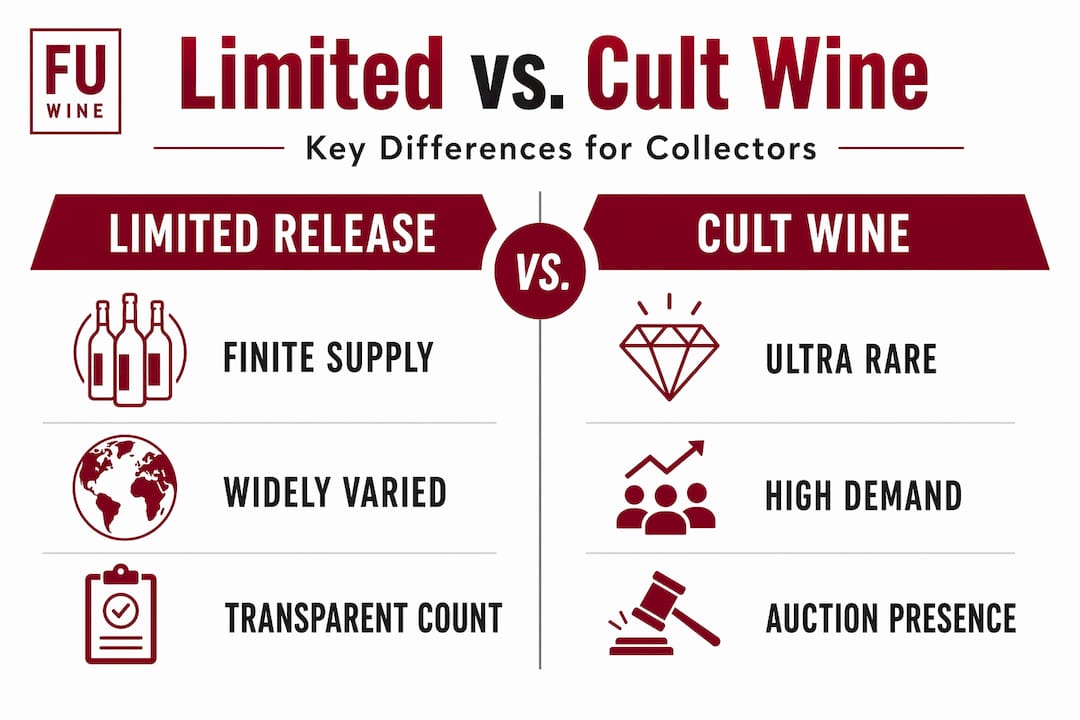
A cult wine is a specific designation within the collector world, built on four pillars: micro-production (typically under 1,000 cases annually), allocation through direct mailing lists with waitlists measured in years, exceptional critic scores, and secondary market prices that dwarf the original release price. Screaming Eagle from Napa Valley is the textbook example. The wine has fewer than 500 cases produced annually and resells for multiples of its release price.
A limited release wine can be many things, only some of which rise to cult status. Here’s how the two categories compare:
| Category | Production scale | Distribution method | Secondary market premium | Collector demand |
|---|---|---|---|---|
| Cult wine | Under 1,000 cases | Mailing list allocation only | Very high (often 5x or more) | Extreme, multi-year waitlists |
| True limited release | Varies, usually under 5,000 cases | Cellar door, select retailers | Moderate to high depending on producer | Strong, release-driven urgency |
| Small production wine | Under 10,000 cases | Broader but still selective | Low to moderate | Growing, quality-focused |
| Marketing “limited” | Unrestricted | National retail channels | Minimal to none | Manufactured urgency, low repeat demand |
Small production wines typically mean fewer than 10,000 cases annually and reflect an intimate winemaking philosophy focused on connection to place. That’s a meaningful category but not inherently scarce in the collector sense.
The real overlap between limited releases and cult wines is in the middle tier: boutique producers making fewer than 2,000 cases of a specific wine, sold through tight channels, with a genuine following. Those wines carry genuine collector value and are worth chasing.
Pro Tip: Before buying a limited release for investment potential, check whether the wine has a secondary market presence at all. If no one is trading it, rarity alone won’t protect your money.
Why limited releases matter for collectors and investors
So why does any of this matter beyond the thrill of the chase? The value framework for collectible wines rests on a combination of scarcity, access constraints, and winemaking distinctiveness. Limited releases tick those boxes in ways that commercial wines simply cannot.
Here’s how to approach them practically:
-
Understand the scarcity source. Is the wine limited because of a single exceptional vintage? A specific vineyard block? Or just a production decision? The first two have genuine re-release impossibility baked in. The third might reappear next year with a different number on the bottle.
-
Evaluate the winemaking rationale. The wines worth holding are those where the distinct winemaking choices create a wine that couldn’t exist in another form. Special barrel programmes, extended ageing, and unique blending are features that translate to character in the glass and value in the cellar.
-
Verify the allocation structure. How was the wine sold? Allocation and access constraints dramatically influence secondary market behaviour. A wine sold exclusively through a producer mailing list carries more credibility than one available through standard retail channels.
-
Cross-reference the secondary market. Pull auction results. Check resale platforms. If the wine is trading above release price consistently, the market is confirming the scarcity claim independently.
-
Think about your holding horizon. Limited releases intended for drinking in the next two to three years are a different proposition to those built for decade-long cellaring. Know which you’re buying before you commit.
The collector’s real edge is in finding limited releases before the broader market recognises them. That means building relationships with boutique producers, staying on mailing lists, and knowing how to access hard-to-find wines before the secondary market prices them beyond reach.
My honest take after years in the cellar

I’ve bought a lot of wines labelled “limited.” Some turned out to be genuine finds that I’m glad I cellared. Others were well-dressed commercial releases that I should have walked past.
The single biggest lesson I’ve learned: the word “limited” tells you almost nothing on its own. What tells you something is the producer’s willingness to back the claim with numbers. When a winemaker publishes the lot size, the vineyard block data, the barrel programme, and the allocation rules, that transparency is worth more than any marketing copy. It signals a producer who knows their wine can stand on its own merit without vague claims.
The second thing I’d tell any serious collector: don’t confuse scarcity with quality. I’ve tasted genuinely limited wines that were mediocre. The finite supply doesn’t make the wine good. What makes it good is whether the winemaking choices that drove the limited production actually produced something exceptional. Check the technical sheet before you check the price tag.
What I’ve found is that the best limited releases tend to come from producers who barely mention the word “limited” at all. They talk about the block, the vintage, the ageing decision. The scarcity is a natural consequence of those choices, not a selling point manufactured after the fact. That quiet confidence in the wine itself is the most reliable signal I’ve encountered.
Balance matters too. Some bottles are worth drinking now with people you love. Not every limited release needs to be locked in a cellar waiting for its moment. Life is too short for ordinary wine, but it’s also too short to never open the special ones.
— Damien
Find genuine limited releases at FU Wine
If you’ve spent any time trying to find limited release wines through traditional channels, you already know the frustration. Mailing list waitlists, cellar door exclusivity, retail mark-ups that make the whole exercise feel like a tax on enthusiasm. FU Wine exists because that system is broken and we’re done pretending otherwise.
FU Wine sources genuinely rare and limited bottles, including allocation releases, boutique producer runs, and high-scoring vintages, and makes them available at prices that don’t insult your intelligence. Often 30 to 70 percent below standard retail. No gatekeeping. No pretension. Just seriously good wine at prices that make sense.
Browse the current limited wine collection and see what’s available before it sells out. Because with genuine limited releases, that’s always the right time to look.
FAQ
What is a limited wine release?
A limited wine release is a wine produced in a finite quantity that won’t be restocked once sold out. True limited releases are defined by capped production, often driven by specific vineyard sourcing or unique winemaking decisions, rather than simply a marketing label.
Why are limited release wines valuable?
Limited release wines carry value because genuine scarcity, combined with distinctive winemaking choices, creates desirability that can’t be replicated. When supply is genuinely constrained, demand exceeds availability and secondary market prices often exceed the original release price.
How do I know if a limited wine is genuinely scarce?
Look for numbered bottles, lot documentation, producer-published case quantities, and narrow distribution channels. A secondary market price premium above the original release price is the most objective confirmation of real scarcity.
What is the difference between a limited release and a cult wine?
Cult wines are a subset of limited releases with typically under 1,000 cases produced annually, allocation-only distribution through mailing lists, and significant secondary market premiums. A limited release wine can share some of those traits without meeting all the criteria for cult status.
Is “limited edition wine” the same as “limited release wine”?
The terms are often used interchangeably, but neither has a legal definition. Both signal finite production in theory. The same scrutiny applies: look past the label to the producer’s transparency about lot size, distribution, and winemaking rationale to judge whether the claim is genuine.