

Vintage wine: quality, rarity and value explained
TL;DR:
- Vintage reflects the season’s growing conditions, influencing wine flavor, ageability, and value.
- Balanced vintages usually produce complex, age-worthy wines, while extreme years carry more risk.
- Savvy collectors look beyond ratings, considering producer skill, storage, and regional nuances for better value.
Most wine lovers assume that a premium label or famous region is enough to guarantee a great bottle. It’s not. The real driver of quality, rarity, and long-term value is something far more nuanced: the vintage. And yet, vintage remains one of the most misunderstood concepts among collectors and enthusiasts alike. Some treat it as a formality printed on the label. Others obsess over it without really knowing why. This article cuts through the noise, explains what vintage actually means, and shows you how to use that knowledge to drink better and buy smarter.
Table of Contents
- What is vintage and why does it matter?
- How vintage affects wine quality, taste and ageability
- Vintage value: Rarity, price and what collectors should know
- Vintage vs. non-vintage: When does vintage matter less?
- Why vintage wisdom beats following ratings blindly
- Find your next vintage with FU Wine
- Frequently asked questions
Key Takeaways
| Point | Details |
|---|---|
| Vintage shapes wine character | Each vintage reflects unique environmental conditions that impact flavour, ageing, and collector value. |
| Balanced vintages boost quality | Years with optimal weather generally produce wines that age better and are more prized by collectors. |
| Non-vintage blends offer consistency | Many producers blend years to maintain style, making vintage less critical for some wines. |
| Smart collectors look beyond ratings | Quality and value are found in lesser-known vintages by focusing on personal taste and proper cellaring. |
What is vintage and why does it matter?
Let’s start at the beginning. In wine, “vintage” simply refers to the year the grapes were harvested. That single number on a bottle is not just a timestamp. It is a record of an entire growing season, captured in liquid form.
Every year is different. Rainfall, temperature, sunlight hours, frost risk, and soil moisture all shift from one season to the next. Those changes directly shape the grapes, which then shape the wine. As Food & Wine explains, vintage is essentially a “snapshot” of that season’s growing conditions, including weather, soil, and other environmental factors, all of which directly affect grape composition and the resulting wine’s style and ageability.
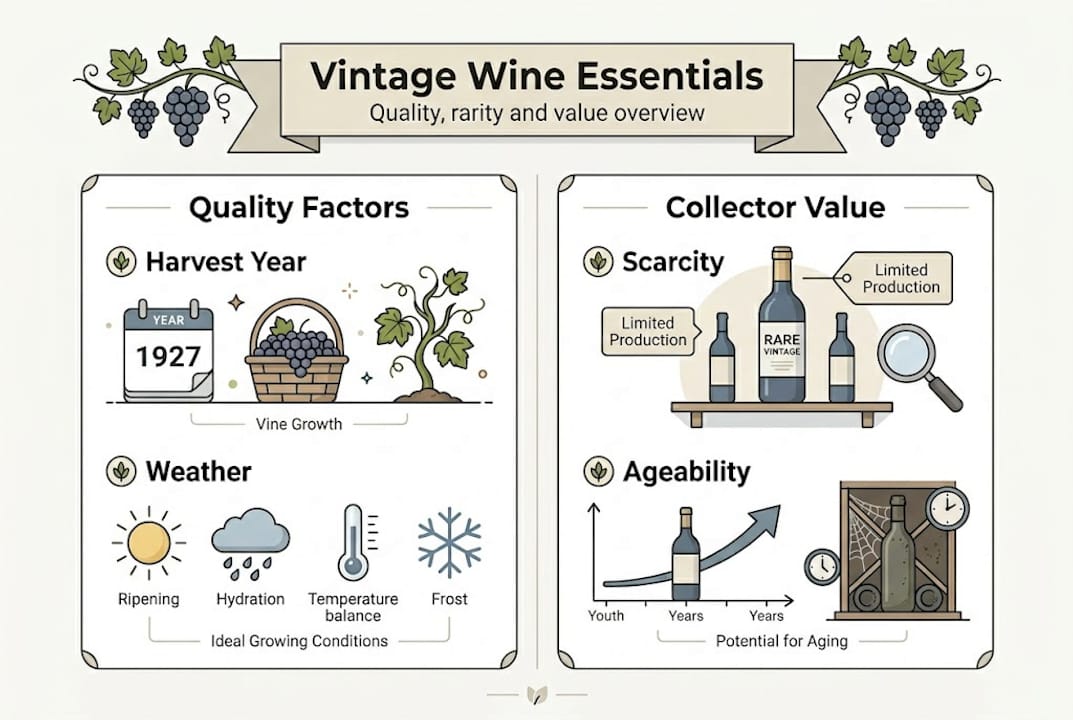
So when you pick up a bottle of Barossa Shiraz from 2016 versus one from 2011, you are not just looking at a five-year age gap. You are looking at two completely different sets of conditions that produced two very different wines, even from the same vineyard.
Here is why that matters for collectors:
- Flavour profile: A warm, dry year tends to produce riper, fuller-bodied wines with higher alcohol. A cool, wet season can result in more restrained, elegant styles with higher acidity.
- Ageability: Grapes harvested in balanced conditions typically develop wines with better structure for long-term cellaring.
- Scarcity: A difficult vintage often means lower yields, which means fewer bottles in circulation.
- Value: Rare, high-quality vintages command serious premiums on the secondary market.
If you want to understand what is a wine vintage at a deeper level, it pays to think of the vintage year as a quality signal, not just a date. For smarter collector choices, knowing how to read that signal is the difference between landing a gem and overpaying for an ordinary bottle.
“Vintage is the harvest year — a snapshot of that season’s growing conditions — and it directly affects grape composition and wine style.”
This is not abstract wine-nerd territory. It has real, measurable consequences for what ends up in your glass and how much you pay for it.
How vintage affects wine quality, taste and ageability
Now that you understand what vintage means, let’s explore its tangible effects on wine quality and collecting.
The science here is pretty compelling. A Cambridge study using Wine Spectator ratings found that extreme or well-balanced growing-season weather creates measurable vintage-to-vintage differences in both quality signals and market prices. In other words, the weather during harvest does not just affect how a wine tastes. It directly moves the needle on what collectors pay.
Think about Bordeaux in 2000, 2005, 2009, and 2010. Those four vintages are widely regarded as exceptional, partly because conditions were near-perfect: warm summers, long dry autumns, balanced ripening. Bottles from those years routinely fetch two to three times the price of bottles from nearby “ordinary” years like 2002 or 2007. That is not snobbery. That is market logic responding to genuine differences in quality and ageability.
Here is a simplified breakdown of how vintage conditions typically shape wine outcomes:
| Vintage condition | Effect on grapes | Resulting wine style |
|---|---|---|
| Warm, dry season | High sugar, low acidity | Bold, ripe, high alcohol |
| Cool, wet season | Lower sugar, high acidity | Lean, elegant, lower alcohol |
| Balanced season | Optimal ripeness and structure | Complex, age-worthy, collectible |
| Extreme heat or frost | Reduced yields, potential defects | Variable quality, lower volumes |
For collectors, the most desirable vintages sit in the “balanced” category. These wines have the structural integrity, acidity, tannin balance, and fruit depth to evolve beautifully over ten, twenty, or even thirty years in the cellar. Wines from extreme years can still be interesting, but they carry more risk.
Practical considerations for buyers:
- Use vintage charts as a reference point, not a rulebook. They summarise broad regional conditions and give you a starting point.
- Consider the grape variety. Some varieties, like Riesling or Pinot Noir, are far more sensitive to vintage variation than robust grapes like Shiraz or Cabernet Sauvignon.
- Look at critical scores across the vintage, not just for one producer. A great vintage lifts all boats; a poor one exposes weaknesses.
You can find some excellent cellar-aged wine examples that illustrate exactly how vintage shapes the ageing trajectory of premium bottles.
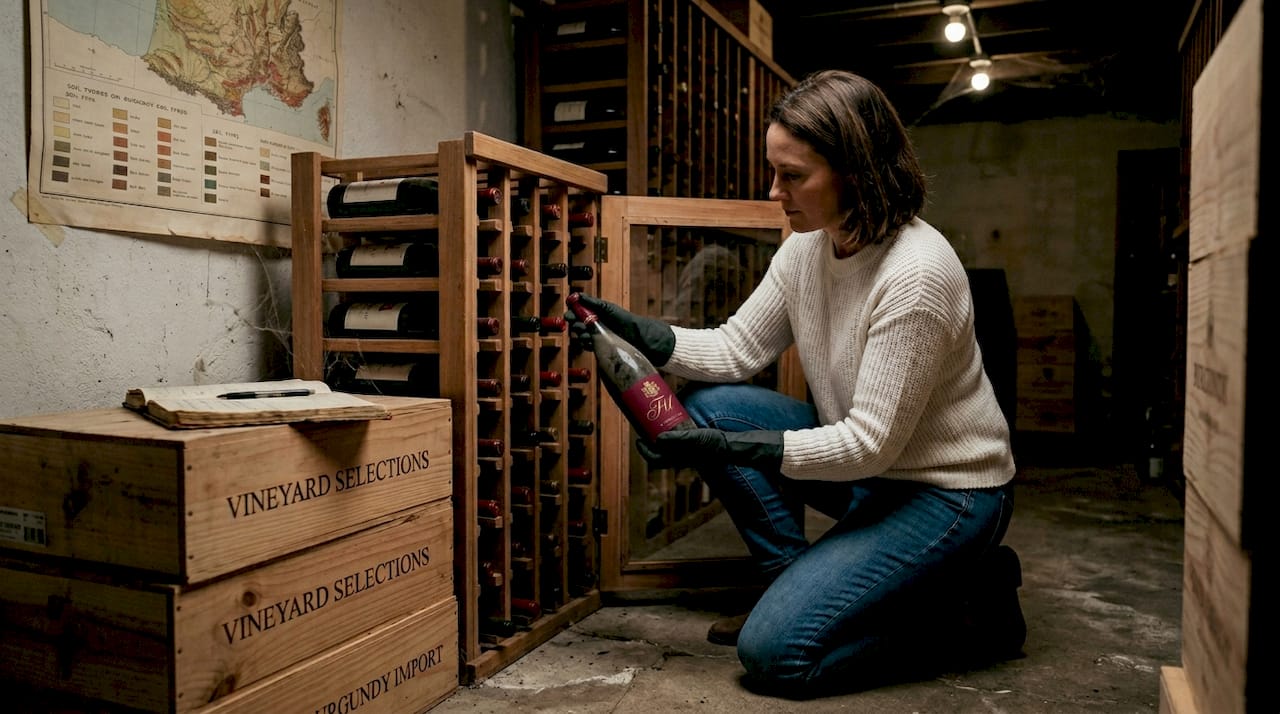
Pro Tip: When assessing a wine for long-term cellaring, prioritise vintages with good natural acidity and firm tannins over those that were simply very ripe. Ripe wines are often delicious young but can fade faster.
The bottom line is that vintage is not just a quality indicator. It is also a time map. It tells you when a wine is likely to be at its peak and how long it can hold there. That information is genuinely valuable when you are deciding whether to open a bottle now or hold it for another five years.
Vintage value: Rarity, price and what collectors should know
Understanding quality and ageability, let’s dive into how vintage influences value, rarity and collector strategies.
Great vintages do not just taste better. They create market scarcity. When conditions are difficult, yields drop, sometimes dramatically. A vineyard that normally produces five hundred cases might produce two hundred in a tough year. Fewer bottles in circulation means higher demand, higher prices, and a longer holding period before the secondary market absorbs the stock.
The same Cambridge study confirms that climate and vintage weather affect both quality signals and prices in measurable ways, reinforcing why collectors who understand vintage dynamics have a genuine edge.
Here is how to approach vintage value strategically:
- Compare vintages within a region before committing. A 95-point wine from a mediocre vintage might be a worse investment than a 91-point wine from a standout year, because the latter has more upside as it ages.
- Look for undervalued “off-years” in premium regions. Not every vintage from Burgundy or the Barossa needs to be legendary. Sometimes a quieter year produces surprisingly elegant wines at a fraction of the price of a celebrated vintage.
- Track auction results for context. Auction hammer prices reveal what the market actually thinks of a vintage, not what a retailer or critic wants you to think.
- Factor in storage history. A bottle from a great vintage that was stored in a warm garage is worth less than the same bottle from a mediocre vintage that was cellared perfectly.
- Avoid emotional bias. Buying a wine purely because the vintage year is your birth year or a significant anniversary is fun, but it is not a collecting strategy.
A comparison of how vintage reputation affects price behaviour:
| Vintage type | Typical market behaviour | Collector risk |
|---|---|---|
| Legendary vintage | High entry price, strong long-term demand | Low quality risk, high price risk |
| Balanced, underrated vintage | Lower entry price, slower appreciation | Moderate risk, strong value potential |
| Difficult vintage | Low price, inconsistent quality | Higher risk, occasional surprises |
| Non-vintage blend | Stable price, no ageing upside | Minimal risk, minimal reward |
Understanding wine value and fair pricing is genuinely empowering for collectors who want to buy well without overpaying for hype. The wine scarcity guide offers practical tools for spotting genuinely rare bottles rather than artificially inflated ones. And if you want to go further, learning how to unlock rare wine without getting burned by retail markups is a skill worth developing.
Pro Tip: Use vintage charts alongside auction price histories. Charts tell you about quality; auction data tells you about real-world demand. Together, they give you a much sharper picture than either source alone.
The collectors who consistently win are the ones who treat vintage knowledge as a tool, not a trophy. It is not about name-dropping the best years at dinner parties. It is about making smarter decisions with your money and your cellar.
Vintage vs. non-vintage: When does vintage matter less?
It’s not just about the vintage label. Sometimes, blending or technique changes the game. Here’s when vintage matters less and what you should know.
Not every great wine comes with a single vintage year on the label. Non-vintage wines, often abbreviated as NV, blend grapes from multiple harvests to achieve a consistent house style year after year. This is standard practice in Champagne, where major houses like Moët & Chandon or Veuve Clicquot deliberately blend across years to protect their signature flavour profile regardless of seasonal variation.
As a BBC report on climate challenges notes, producers can counteract inconsistent vintages, or shift toward non-vintage blends entirely, when climate variability increases. So in regions where weather is becoming less predictable, the NV model is actually gaining traction as a quality tool, not just a cost-cutting measure.
Here is when vintage matters less than you might think:
- Mass-produced wines designed for immediate drinking, where the goal is approachability rather than ageing potential.
- NV Champagne and sparkling wines, where blending across years is a craft in itself and a marker of the house’s skill.
- Fortified wines like Tawny Port or Muscat, where oxidative ageing across multiple years is part of the style.
- Entry-level table wines that are made to be consumed young, regardless of the harvest year.
“Vintage is less about ‘always better’ and more about ‘more or less ageability’: even Wine Spectator’s chart philosophy emphasises that wine can be good in lower-rated years, and drink recommendations are probabilistic, not deterministic.”
This is an important reality check. Vintage ratings are guidance, not gospel. A wine labelled from a so-called “weak” year can still be delicious if the producer managed the season well, if the specific sub-region escaped the worst conditions, or if the wine was made in a style that suits those very conditions. Lighter, fresher wines often shine in cooler years that punish producers aiming for power.
Understanding key wine terms like “vintage variation,” “non-vintage,” and “disgorgement date” gives you the vocabulary to shop with confidence rather than guessing. And getting across wine vintage charts and how they are constructed helps you interpret the data rather than just accept it.
The smart play is to use vintage as one input among many, not as the final word on whether a bottle is worth your time and money.
Why vintage wisdom beats following ratings blindly
Having explored all the angles, let’s go beyond the conventional wisdom and share an insider perspective.
Here is the uncomfortable truth: ratings and vintage charts are tools built for averages. They summarise broad regional conditions and aggregate critic opinions. They are genuinely useful, but they are not designed to describe your specific bottle from your specific producer in your specific cellar.
The collectors who find the real gems are not the ones who chase 100-point vintages. They are the ones who dig a little deeper. They ask which producers outperformed in difficult years. They look at winemakers who have the skill to extract elegance from challenging conditions. They consider storage history, the specific sub-region, and their own palate rather than deferring entirely to a chart or a score.
Some of the most interesting wines we have seen at FU Wine come from years nobody was talking about. A producer who managed canopy and water stress brilliantly in a hot year can deliver a wine that leaves famous-vintage bottles standing. That is not luck. That is craft meeting knowledge.
Premium wine trends in 2026 are also shifting toward exactly this kind of nuanced thinking, where provenance, producer reputation, and cellaring conditions are being weighed alongside vintage charts. The best discoveries often fall completely outside the popular vintage lists, and that is where the real value hides.
Trust your palate. Back it up with research. And stay curious about the years everyone else is ignoring.
Find your next vintage with FU Wine
Ready to put your vintage wisdom into practice? Here is a trusted way to explore and buy with confidence.
FU Wine was built for exactly this kind of collector. Not the one who buys labels. The one who buys knowledge. We source premium and hard-to-find vintages, including cellar-aged bottles, boutique producer runs, and high-scoring years, and make them available at prices that would make traditional retailers very uncomfortable. We are talking 30 to 70 per cent below what you would normally pay.
Every bottle in our rotating collection is chosen because it deserves to be there, not because it fills a quota. Flash deals, limited releases, and insider-access stock rotate constantly. If you love the idea of landing a genuinely great vintage without paying the prestige tax, shop vintage wines and see what is available right now. Life is too short for ordinary wine, and overpriced wine is just ordinary wine in a fancier jacket.
Frequently asked questions
What makes a wine vintage important for collectors?
Vintage indicates the year’s environmental conditions, which shapes flavour, ageing potential, and value, especially for premium and rare wines. As Food & Wine explains, it is a direct snapshot of that season’s growing conditions.
Can a lower-rated vintage still be worth buying?
Yes, even wines from lower-rated years can be enjoyable and sometimes offer better value when aged or stored well. Wine Spectator’s philosophy makes clear that vintage is about ageability, not a binary good-or-bad judgement.
Why are some wines labelled non-vintage?
Non-vintage wines blend grapes from multiple years to achieve consistent style, especially in regions like Champagne or when weather is unpredictable. As the BBC report notes, producers increasingly use NV blending as a direct response to climate variability.
Does every collector need to chase famous vintage years?
No, collectors can find quality and value in less well-known or balanced vintages, especially by considering storage conditions and winemaker skill. Vintage ratings are guidance, not rules, and variation across a region is not necessarily a bad thing for the savvy buyer.