

Unlock rare wine: expert guide to selection and savings
TL;DR:
- Many collectors overpay for rare wine due to industry-inflated perceptions.
- Rarity is defined by scarcity, provenance, and critical scores, not just price.
- Savvy sourcing through auctions and direct channels offers significant discounts and better value.
Most collectors assume that rare wine is expensive by nature. That’s the story the industry sells, and it works brilliantly. But here’s the uncomfortable truth: collectors overpay by up to 68% on top vintages compared to what savvy buyers pay through auctions and specialist distributors. The gap is real, and it’s massive. If you’ve been buying through traditional retail channels, you’ve almost certainly left serious money on the table. This guide breaks down what rare wine actually means in 2026, how to read the market, where to source bottles at real discounts, and how to build a collection that delivers both pleasure and genuine value.
Table of Contents
- What defines a rare wine in 2026?
- Market trends and pricing: How to identify value
- Sourcing rare wine: Where collectors get real discounts
- Building a versatile rare wine portfolio
- What most collectors miss about rare wine selection
- Explore discounted rare wine with FU Wine
- Frequently asked questions
Key Takeaways
| Point | Details |
|---|---|
| Spot genuine rarity | Learn how scarcity, vintage, and independent indices determine a wine’s collectible status. |
| Identify market value | Market trends and tight bid:offer spreads reveal the best buying opportunities for collectors. |
| Source smartly | Auctions, curators, and direct channels help you access rare wines at discounts up to 68%. |
| Build a balanced portfolio | Combine cellar-aged classics and current top-scoring vintages for enjoyment and investment. |
| Avoid emotional traps | Don’t let brand hype or impulse spending cloud your practical wine selection decisions. |
What defines a rare wine in 2026?
Not every expensive bottle is rare. And not every rare bottle is expensive. That distinction matters more now than ever.
Rarity in wine comes down to three things: scarcity, provenance, and critical scores. Scarcity means limited production, whether from a tiny estate, a single exceptional vintage, or a winery that no longer exists. Provenance refers to the verified storage and ownership history of a bottle. A wine stored perfectly in a temperature-controlled cellar is worth far more than the same label kept in a warm garage. Critical scores from respected publications and tasters signal quality and desirability, which directly drives collector demand.
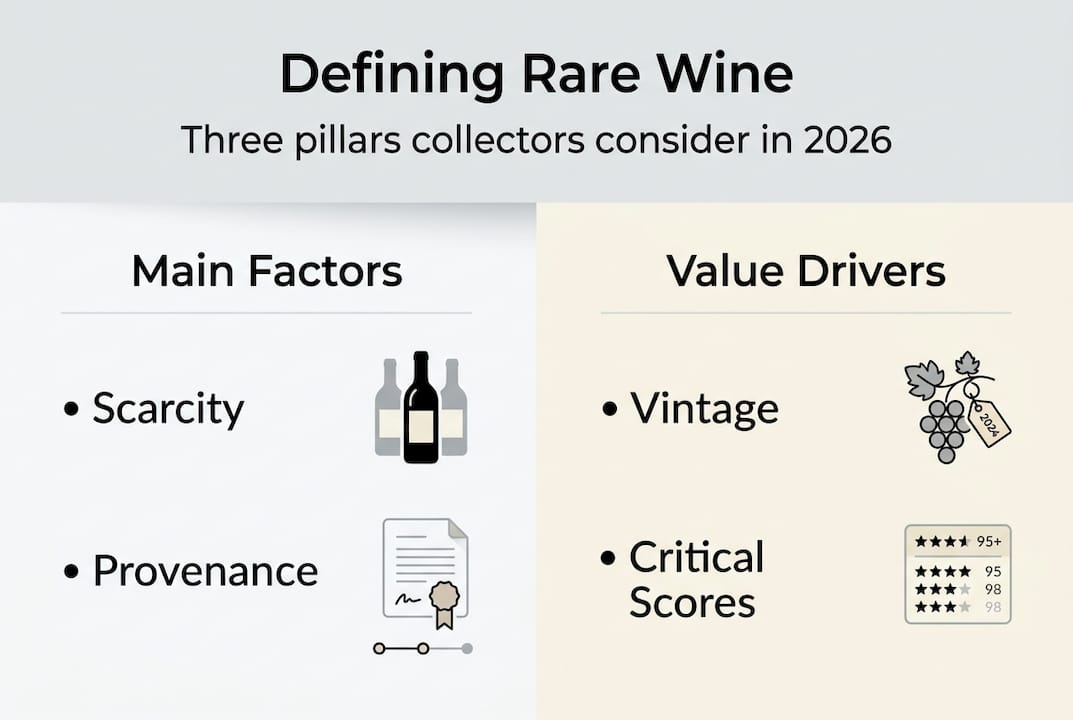
Vintage plays a massive role here. A great growing season produces wines with ageing potential, complexity, and the kind of depth that collectors chase. A poor vintage from the same estate can be virtually worthless on the secondary market. Understanding your wine vintage ratings guide is one of the most practical skills a collector can develop.
Market benchmarks like the Liv-ex Fine Wine 50 index track the performance of the world’s most traded fine wines. According to fine wine market data, the Liv-ex Fine Wine 50 pricing reveals that Cheval Blanc 2023 trades at a significant discount compared to older celebrated vintages, making it a compelling entry point for collectors who understand value. Knowing your wine vintage quality guide helps you navigate these price differences with confidence.
Here’s a quick snapshot of what drives rarity:
- Scarcity: Low production volumes, discontinued estates, or single-vineyard releases
- Provenance: Verified storage history and unbroken ownership chain
- Critical scores: Ratings of 95 points or above from respected critics
- Vintage quality: Exceptional growing seasons with documented ageing potential
- Market demand: Active trading on indices like Liv-ex with tight bid/offer spreads
| Factor | Low rarity signal | High rarity signal |
|---|---|---|
| Production volume | Mass produced | Under 5,000 cases |
| Critical score | Below 90 points | 95 points or above |
| Vintage rating | Average season | Exceptional season |
| Provenance | Unknown storage | Verified cellar history |
| Market activity | Rarely traded | Active on Liv-ex |
Rarity is not a feeling. It’s a set of measurable criteria. Once you know what to look for, you stop paying for mystique and start paying for merit.
Market trends and pricing: How to identify value
Having established what makes wine rare, it’s vital to understand the market forces shaping price and value.

The fine wine market runs on bid/offer spreads, which is the gap between what buyers are willing to pay and what sellers are asking. A tight spread signals healthy liquidity and fair pricing. A wide spread often means a wine is either overvalued or hard to move. Recent market recovery shows tighter spreads across several key Bordeaux vintages, pointing to genuine value opportunities right now.
Price history is your best friend. A wine that traded at $400 five years ago and now sits at $320 might look like a loss. But if the critical score is strong and the vintage is celebrated, that dip is a buying signal, not a warning.
Here’s how recent vintages compare on value:
| Vintage | Approx. price range | Critical score | Value rating |
|---|---|---|---|
| Cheval Blanc 2023 | Lower entry price | 97 points | Excellent |
| Cheval Blanc 2015 | Premium pricing | 98 points | Strong but costly |
| Bordeaux 2019 | Mid-range | 96 points | Very good |
| Bordeaux 2010 | High premium | 99 points | Collector grade |
Historical returns on rare wine investment have outperformed some traditional asset classes, with compounding annual growth rates cited in the 8 to 12 percent range for top-tier collections. That’s not a fluke. It reflects genuine scarcity, growing global demand, and a finite supply that only shrinks as bottles are opened.
Stat to know: Collectors who focus on affordable luxury wine trends in 2026 are finding that recent high-scoring vintages offer entry prices 30 to 50 percent below older equivalents with similar quality profiles.
Pro Tip: Focus on wines with tight bid/offer spreads and recent critical scores above 95 points. These bottles offer the best combination of quality, market confidence, and realistic upside.
Here’s a practical process for spotting value:
- Check the Liv-ex index for current bid/offer spread data on your target wine
- Compare the current price to the wine’s five-year trading history
- Cross-reference the vintage rating with recent critical scores
- Look for wines where price has dipped but scores remain strong
- Prioritise bottles with verified provenance and active secondary market trading
The market rewards patience and knowledge. Impulse buying at retail is how collectors overpay. Reading the signals is how they don’t.
Sourcing rare wine: Where collectors get real discounts
Once you can spot value, the next step is knowing exactly where to source these rare bottles for less.
Traditional retail is the most expensive way to buy rare wine. You’re paying for shop overheads, staff, marketing, and the retailer’s margin on top of the distributor’s margin on top of the importer’s margin. By the time that bottle reaches the shelf, the price has been inflated multiple times over. Savvy sourcing can deliver discounts of up to 68% compared to standard retail pricing.
So where do smart collectors actually buy?
- Specialist auctions: Reputable wine auctions offer authenticated bottles at market-driven prices, often well below retail
- Wine curators: Understanding the role of wine curators means accessing bottles that never reach the public market
- Direct distributor partnerships: Cutting out the middleman through wine distribution for collectors saves significant money
- Private cellar sales: Estate clearances and private collections often surface at below-market prices
- Flash deal platforms: Rotating stock models create urgency and genuine savings on premium bottles
“The best bottle I ever bought came from a cellar clearance, not a bottle shop. Same wine, half the price. Once you know how to look, you can’t unsee it.”
Pro Tip: Register with at least two reputable auction houses and set alerts for your target wines. Auction results also give you real-time market pricing data, which is invaluable for negotiating elsewhere.
Modern supply chain solutions have changed the game entirely. Platforms built around smart rare wine deals use direct relationships with producers, importers, and estate owners to source bottles at prices the traditional retail model simply cannot match. The key is knowing which platforms are genuinely curated and which are just shifting excess stock. Quality and scarcity should always be the filter, not just the discount.
The sourcing game is about relationships, timing, and market intelligence. Get those three right and the savings follow naturally.
Building a versatile rare wine portfolio
With reliable sourcing in place, you can curate a portfolio that delivers both pleasure and profit.
The biggest mistake collectors make is concentrating too heavily in one region or one style. A portfolio built entirely on Bordeaux, for example, is exposed to regional weather events, shifting critic preferences, and market sentiment around a single appellation. Diversification is not just a financial concept. It applies directly to wine.
Here’s a practical framework for building balance:
- Diversify by region: Include Bordeaux, Burgundy, Barossa Valley, Napa Valley, and emerging regions like Priorat or Ribera del Duero
- Mix vintages: Combine celebrated older vintages with recent high-scoring releases for both immediate enjoyment and long-term holding
- Balance grape varieties: Cabernet Sauvignon, Pinot Noir, Chardonnay, and Syrah each behave differently in the market
- Include cellar-aged gems: Exploring top cellar-aged wine examples reveals bottles with extraordinary depth at prices that haven’t caught up to their quality
- Review regularly: Markets shift. A wine that was a strong hold two years ago might now be a smart sell
Common pitfalls to avoid:
- Over-concentrating in trophy labels without checking current market spreads
- Ignoring storage costs, which erode returns over time
- Buying emotionally without cross-referencing rare portfolio insights and market data
- Overlooking the enjoyment factor entirely in pursuit of investment returns
The hospitality wine selection process offers a useful lens here. Professionals who select wine for high-end venues balance prestige, drinkability, and value constantly. Collectors can borrow that discipline. And if you want a structured approach to the whole process, a dedicated guide to building a wine portfolio is worth bookmarking.
Top Bordeaux vintages continue to demonstrate both investment potential and genuine drinking pleasure in 2026, making them a solid anchor for any serious collection.
What most collectors miss about rare wine selection
Let’s be honest about something the industry doesn’t want you to think too hard about. A lot of “rarity” is manufactured. Brands and distributors control release quantities, manage allocation lists, and create artificial scarcity to justify inflated pricing. The wine itself hasn’t changed. The story around it has.
The collectors who consistently win are not the ones with the deepest pockets. They’re the ones with the sharpest eyes. They read bid/offer spread data and understand that narrowing spreads signal genuine market recovery and hidden value. They’re patient. They wait for the right moment rather than chasing hype.
Emotional enjoyment matters too, and don’t let anyone tell you otherwise. A bottle that brings genuine pleasure has real value regardless of what the index says. But the best collectors hold both truths at once. They drink beautifully and buy intelligently. Exploring wine investment wisdom helps you develop that dual perspective without losing the joy of the glass in front of you.
Rarity is real. But it’s also a story. Know the difference.
Explore discounted rare wine with FU Wine
If you’re ready to access rare wines at real value, the next step is simple.
FU Wine was built for exactly this moment. We cut through the noise, the markups, and the gatekeeping to bring you premium, hard-to-find bottles at prices that actually make sense. No pretension. No inflated retail margins. Just quality wine sourced with genuine insider knowledge.
Whether you’re building a serious collection or just want to drink better without overpaying, FU Wine has something worth opening. Our curated range rotates constantly, so the deals are always fresh and the quality never dips. Go ahead and discover rare wines that belong in your cellar, not just on a wishlist. Every bottle is a small rebellion. Join it.
Frequently asked questions
How can I tell if a wine is genuinely rare?
Check scarcity, historical pricing, and critical scores, and look for whether the wine appears in specialist auctions or indices like Liv-ex. Genuine rarity signals include active secondary market trading and scores of 95 points or above.
What’s the best way to avoid retail markups on rare wine?
Buy through auctions, curators, and direct partnerships, and monitor market indices for fair pricing benchmarks. Collectors using these methods can access significant discounts compared to standard retail channels.
Which vintage years offer the greatest value for collectors right now?
Recent vintages like Bordeaux 2019 and Cheval Blanc 2023 offer tight spreads and high scores, often at substantial discounts versus older releases with comparable quality.
Are rare wines a good investment in 2026?
Yes, rare wine collections historically show strong compounding returns, and recent market recovery points to renewed opportunity for patient, informed collectors.
How can I start building a balanced rare wine portfolio?
Select a mix of cellar-aged and recent high-scoring vintages, diversify by region and grape variety, and review your collection regularly for both value and enjoyment. Top vintages and portfolio strategies provide a strong starting framework.