

Get a Faulty Wine Refund in Australia by Keeping Cork and Photos
If the wine you bought is faulty or damaged, the Australian Consumer Law usually gives you a remedy such as a refund, replacement, repair or credit. Contact the seller straight away, keep the bottle (cork included), snap a few photos, and dig up your proof of purchase before you throw anything in the bin.
TL;DR:
- Genuine faults such as cork taint, leaking bottles, or oxidation must be documented with photos and tested before contacting the seller, regardless of retailer policies.
- Major failures allow you to choose between a refund or replacement, while minor issues generally permit repairs or fixes first, with no strict reporting time limit.
- Evidence like photos, proof of purchase, and a sensory description strengthen claims and should be gathered promptly within days of noticing a fault.
- Retailers may request return shipping costs and specific assessment procedures, but their policies do not override your legal rights under the Australian Consumer Law.
- Gifts without receipts can still lead to fault resolution if the fault is visible, but proof of purchase, such as a gift receipt or bank statement, simplifies the process.
Table of Contents
- What does the ACL actually promise you?
- How can you tell if a bottle is genuinely faulty?
- What do retailers actually ask for before refunding you?
- What are the exact steps to take when a bottle tastes wrong?
- Why do some faulty wine claims get knocked back?
- What can you do if the retailer says no?
- Does it matter if you bought the wine online or in-store?
- What if you don’t want a straight refund?
- What if the faulty wine was a gift?
- A trade perspective on getting faulty wine claims sorted fast
- Where to check the rules yourself
- Sources
- FAQ
What does the ACL actually promise you?
Here’s the bit most drinkers skip past: the Australian Consumer Law doesn’t care what your favourite bottle shop’s returns sign says. It sets a legal floor underneath it. Every wine sold in Australia comes with automatic guarantees that it will be of acceptable quality, fit for the purpose it’s sold for, and match how it was described. A bottle riddled with cork taint or leaking halfway across the courier’s van fails all three tests.
Under the ACCC’s guidance on repairs, replacements and refunds, the remedy you’re owed depends on how serious the failure is:
- Major failure (undrinkable wine, broken seal, significant damage): you choose between a refund or a replacement.
- Minor problem (something fixable, or a lesser fault): the seller can offer a repair or another reasonable fix first.
- No fixed clock: there’s no universal countdown for reporting a fault. “Reasonable time” flexes with the wine’s style, age and expected shelf life, so a $25 drink-now red and a $300 cellar-worthy Barossa Shiraz get judged differently.
That last point trips people up. A young, cheap white going off within weeks of purchase looks very different, legally, to a fine wine that’s been resting in a cellar for a decade.
How can you tell if a bottle is genuinely faulty?
Not every disappointing pour is a legal fault, and retailers know the difference immediately. Genuine faults tend to be objective and repeatable, not a matter of personal taste.
Signs worth photographing and reporting:
- Cork taint (TCA): a musty, wet cardboard smell that gets worse, not better, with air.
- Clear oxidation: flat, dull, brownish colour and a sherry-like character in a wine that was never meant to be fortified.
- Medicinal or Brett aromas: band-aid, nail polish remover or barnyard notes that dominate the glass.
- Physical damage: a leaking capsule, a pushed-out cork, or a cracked bottle.
Sediment in an older or unfiltered red usually isn’t a fault at all. It’s a normal part of how many wines age, and collectors expect it in anything with a few years on the label.
Pro Tip: Before you contact anyone, do three things: look at the colour against a white background, give it a proper sniff, and taste a small amount. Then photograph the closure, the fill level and the liquid colour. That’s the exact evidence a retailer needs to assess the fault without you having to argue your case twice. If you’re unsure whether what you’re smelling is cork taint, this breakdown of what corked wine actually smells like is worth a read before you fire off an email.
What do retailers actually ask for before refunding you?
This is where legal rights and shop policy diverge, and it pays to know which one you’re dealing with. The ACL guarantees exist regardless of what a retailer’s returns page says. But most sellers layer their own process on top, and those processes vary a fair bit.
Common patterns you’ll run into:
- Timeframes: many retailers ask for damage to be reported promptly after delivery, while change-of-mind returns on unopened bottles often have a limited window, if they’re offered at all.
- Opened bottles: if you’ve already popped the cork, expect a request to keep some of the liquid, the cork itself, and sometimes a good chunk of the bottle for lab checks. Cellared’s returns policy, for instance, spells out exactly what proportion of a bottle it wants kept for assessment.
- Postage costs: if the fault came from transit damage or a packing error, the retailer typically covers return shipping. If you’ve simply changed your mind, that cost usually lands on you.
- Verification: photos of the bottle, cork and outer packaging, plus a return of the physical item for inspection, are standard practice across most Australian sellers.
None of this overrides your ACL rights, but working with a retailer’s process, rather than against it, gets you paid faster.
What are the exact steps to take when a bottle tastes wrong?
Once you’ve decided something’s genuinely off, move fast and document everything. Retailers assess faulty wine claims on evidence, not vibes, so the more organised your report, the quicker it gets resolved.
- Stop pouring. Preserve the remaining wine, the cork, and the bottle itself. Don’t tip it down the sink even if it smells terrible.
- Gather your paperwork. Pull together your order number, proof of purchase, delivery receipt, and any photos of the outer box and bottle. Jot down a short sensory note while it’s fresh, “musty, cardboard smell, flat fruit” is more useful than “tastes bad.”
- Contact the seller directly. State clearly what you want, a refund, replacement or credit, and attach your evidence. Keep copies of every message you send.
- Wait for return instructions. Don’t post the bottle back until the retailer authorises it. Keep your postage receipt and any courier insurance documentation in case of a dispute later.
A few things that help every step run smoother:
- Report within days, not weeks, of noticing the fault.
- Use plain, specific language rather than “it just wasn’t nice.”
- Attach photos to your very first message rather than waiting to be asked.
Why do some faulty wine claims get knocked back?
Storage matters more than most buyers realise. A bottle left in a hot car boot for an afternoon can develop the same flat, cooked character as a genuinely faulty wine, and retailers know how to spot the difference. The ACCC notes that consumer guarantees don’t cover damage caused by poor storage or misuse on the buyer’s end, once the bottle has been safely delivered.
The claims that stall or get rejected usually share the same mistakes:
- Tossing the cork or bottle before the retailer’s had a chance to assess it.
- Reporting the issue weeks after noticing something was wrong.
- Vague descriptions with no photos attached.
Pro Tip: Log the basics as you go, delivery timestamp, where the wine’s been stored, and a couple of photos taken the day it arrived. That paper trail is what turns “he said, she said” into an easy approval. If you’re shipping wine yourself in warmer months, these packing and timing tips are worth bookmarking too.
What can you do if the retailer says no?
Don’t accept a verbal knockback as the final word. Ask for the decision in writing, and if the retailer has a formal complaints process or dispute resolution scheme, use it before going further.
Your escalation path in Australia looks like this:
- Your state or territory consumer affairs agency can mediate disputes and often gets a faster response than chasing the retailer alone.
- The ACCC handles systemic or widespread issues rather than individual disputes, so a report there is most useful if you suspect a pattern of poor conduct, not a one-off.
- CHOICE is a consumer advocacy group that publicises misleading practices and can add weight if a retailer is ignoring its legal obligations.
- A small claims tribunal in your state is worth considering for higher-value disputes, though it’s a last resort given the time it takes.
Include your evidence trail, dates and copies of correspondence in any report you lodge, it’s the same file you built when you first raised the claim.
Does it matter if you bought the wine online or in-store?
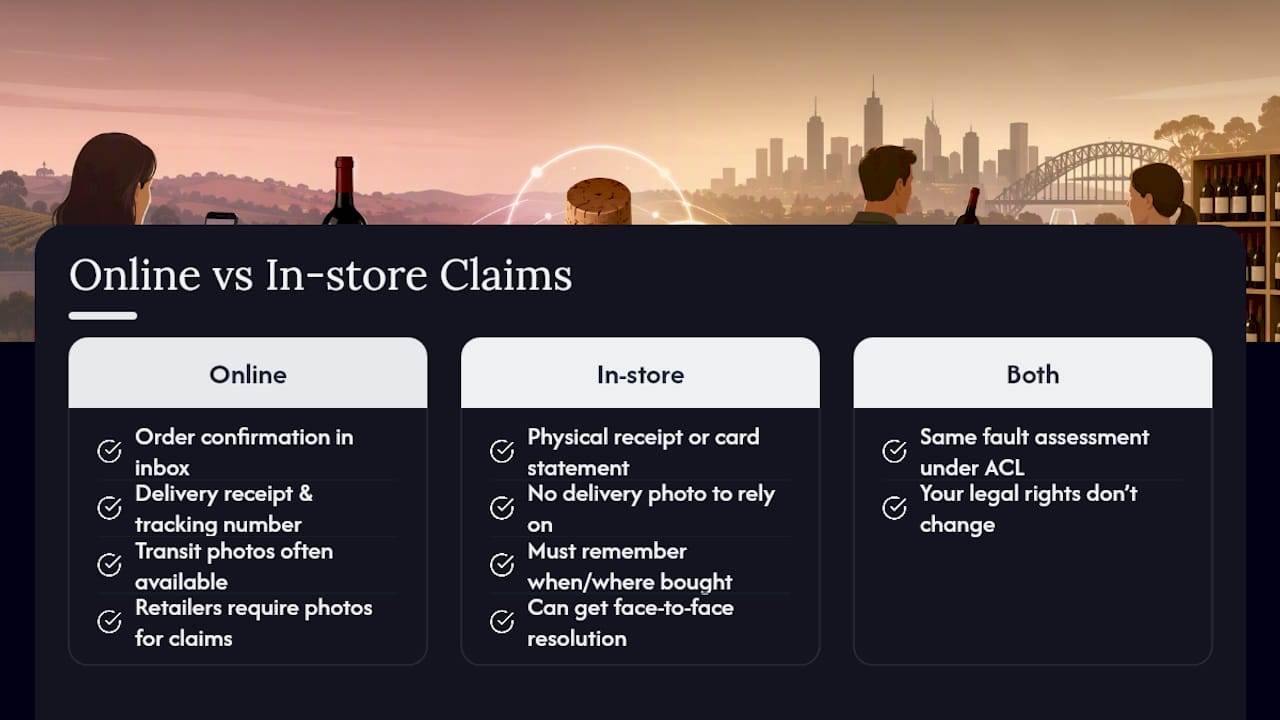
Your legal rights under the ACL don’t change based on where you handed over your card. A faulty bottle is a faulty bottle whether you grabbed it off a shelf or had it delivered to your door. But the practical process for lodging a claim looks quite different.
Online purchases give you a paper trail almost automatically. Your order confirmation, delivery receipt and tracking number are usually sitting in your inbox already, which makes proving the purchase date and delivery condition straightforward. Transit damage is also more common with online orders, so retailers selling wine by post tend to build clear photo evidence requirements into their process, partly to protect themselves, partly to speed up genuine claims.
In-store purchases rely more heavily on you keeping a physical receipt or a card statement as proof. There’s no delivery photo to fall back on if a bottle turns out to be corked a week later, so the burden shifts slightly toward remembering when and where you bought it. The upside is you can often walk back in and get a face-to-face resolution rather than waiting on email replies.
Either way, the fault itself, cork taint, oxidation, breakage, is assessed the same way regardless of sales channel. What changes is the evidence you’ll need to pull together and how quickly you can get it in front of someone.
What if you don’t want a straight refund?
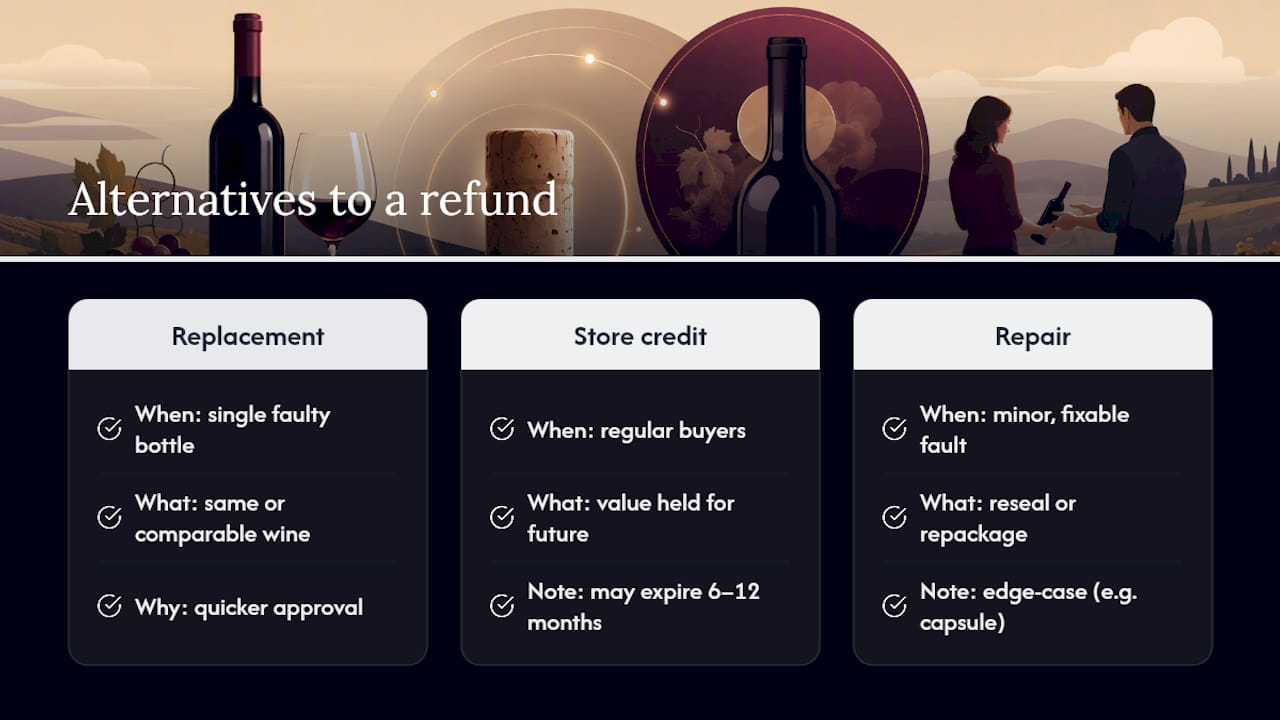
A refund isn’t always the best outcome, and plenty of retailers know it. If you’ve genuinely enjoyed a producer’s other vintages but got one dud bottle, a straight swap for an identical or similar wine often makes more sense than getting your money back and starting your search over.
Replacement is the most common alternative, particularly for a single faulty bottle within a mixed case. You get the same wine (or a comparable one if that vintage’s sold out) without the hassle of reordering.
Store credit suits buyers who order regularly and don’t mind holding the value for a future purchase. It’s worth asking whether the credit carries an expiry, some retailers set a 6 or 12 month window, so you’re not caught out later.
Repair sounds like an odd word for a bottle of wine, but it applies in edge cases, like a leaking capsule on an otherwise sound bottle, where resealing or repackaging fixes the actual problem without needing a full replacement.
None of these options are required over a refund if the failure is major. That’s your call to make, not the retailer’s. But if you’re dealing with a minor issue on a wine you actually want to keep drinking, asking for a replacement or credit upfront can get you a faster yes than a formal refund request.
What if the faulty wine was a gift?
Gift bottles create one genuine headache: proof of purchase. If your dad handed you a bottle of Shiraz for your birthday and it turns out to be corked, you likely don’t have the receipt, and he might not remember exactly where he bought it either.
The ACL doesn’t require you personally to be the one who paid, but you do need to establish that a valid purchase happened. A few things can substitute for a physical receipt:
- A gift receipt, if the giver kept one or asked for one at checkout.
- An order confirmation email, if the wine was bought online and forwarded to you.
- A bank or card statement showing the transaction, held by whoever paid.
- Packaging or labelling that identifies the specific retailer, useful for tracking down the sale even without a receipt in hand.
If none of that’s available, contact the retailer anyway. Many will still investigate a fault claim, especially for a clear physical defect like a broken seal or oxidised wine, because the fault itself is visible independent of who paid. It just may take a little longer, and you might end up with store credit rather than a cash refund, since there’s no original payment method to refund back to.
A trade perspective on getting faulty wine claims sorted fast
Genuine faults get fixed quickly when the evidence is clean, that’s the pattern across most Australian retailers. Two habits save everyone time: hang onto the cork and don’t let bottles sit in a hot car or letterbox. If you’re chasing a corked bottle or shipping damage, our corked wine guide and summer shipping tips cover the practical side.
— Damien
Where to check the rules yourself
For the legal basics, go straight to the ACCC’s guarantee guidance. For sensory detail on faults, see Australian Wine’s fault-finding article, and for a real-world policy example, Cellared’s returns page.
Life’s too short to keep drinking dud bottles, and honestly, life’s too short to overpay for good ones either. If a faulty bottle’s put you off your last purchase, have a browse through FU Wine’s current line-up instead of settling for average. We source the rare, cellar-aged and hard-to-find stuff at prices that don’t insult you, no pretension, no markup games, just good wine that’s earned its spot in your glass.
This article is general information, not a substitute for advice from a qualified lawyer. Consult a qualified legal professional about your own circumstances before acting on anything here.
Sources
- Repair, replace, refund or cancel | Australian Competition and Consumer Commission (ACCC)
- Finding faults: when to send wine back | Australian Wine
- Returns policy | Cellared
FAQ
Can you return wine if you simply don’t like it?
Generally, no, not as a legal right. “Not to my taste” isn’t a fault under the ACL, so any change-of-mind return depends entirely on the retailer’s own goodwill policy rather than a guarantee.
Can you return unopened alcohol if you change your mind?
Some retailers accept unopened bottles back within a set window as a customer service gesture rather than a legal obligation. Always check the specific seller’s returns policy before assuming this applies, since it varies retailer to retailer.
What are the rules for returning faulty goods in Australia?
Under the Australian Consumer Law, you’re entitled to a refund, replacement or repair when goods fail to be of acceptable quality, fit for purpose, or as described. Major failures give you the choice of refund or replacement; minor issues can be addressed with a repair or other reasonable fix first.
What is the “20 minute wine rule”?
This isn’t a recognised legal or industry standard, it’s more of an informal tasting tip some drinkers use, suggesting a wine’s true character shows after sitting open for a short time. It has no bearing on your rights to return faulty wine under Australian law.
Who pays for return shipping on a faulty bottle?
If the fault stems from transit damage or a packing error, the retailer typically covers the return postage. If you’re returning wine simply because you changed your mind, that cost usually falls to you.