

Pairing wine with aged cheese: rules that actually work
Four wine lanes cover almost every aged cheese you’ll meet: traditional-method sparkling, dry or ripe Riesling (or another high-acid white), structured reds like Cabernet Sauvignon or Barolo, and sweet or fortified wines for the salty blues. That’s the whole game, honestly. If you’re building a mixed board, Grab the sparkling or the dry Riesling and you’re covered for most of what’s on the platter. Going deep on one hero wheel, something like a 36-month Parmigiano-Reggiano or a properly funky Stilton? That’s when you reach for the structured red or the tawny Port, because contrast beats safety when the cheese has real character to push back with.
Pro Tip: If you only remember one thing, remember this: acid and bubbles are the universal cheat code. When in doubt, pour something with bite.
Three bottles to keep in rotation if you’re building a home collection for cheese nights:
- Sparkling (Champagne, Cava, Prosecco) — the safest first pour for any mixed board, full stop.
- Dry Riesling — handles washed rinds, aged Gouda and most hard cheeses without a fuss.
- Cabernet Sauvignon or Barolo — bring these out when the cheese is aged, dense and ready to fight back.
Key Takeaways
Aged cheese pairs best with wines chosen for intensity, regional harmony or contrast, not by memorised lists, and acid, tannin and sweetness each solve a specific tasting problem.
| Point | Details |
|---|---|
| Match intensity first | When rules conflict, weight and power should decide the pairing before region or contrast do. |
| Sparkling is the safest first pour | Acidity and bubbles cut fat and reset the palate, making it ideal for mixed boards. |
| Bottle age matters with mature cheese | High glutamate in aged wheels can amplify bitterness in young tannin, so give structured reds some time in the bottle. |
| Pull cheese early | Remove cheese from the fridge 45 to 60 minutes before serving so fat softens and aromas open up. |
| Buy the rare stuff for less | Com sources cellar-aged and limited-release bottles at steep discounts, giving you access to the exact wine lanes this guide recommends without inflated retail pricing. |
Table of Contents
- Pairing wine with aged cheese: the three rules that never fail
- The best wine for aged cheese, cheese by cheese
- The four bottles worth keeping for a mixed cheese board
- How to serve wine and cheese so the pairing actually shows
- Common wine and cheese pairing mistakes to avoid
- The science behind why these pairings work
- Where to actually buy the bottles this guide just recommended
- Sources
Pairing wine with aged cheese: the three rules that never fail
Forget memorising a hundred combinations. There are only three rules, and they explain almost every good pairing you’ll ever have.
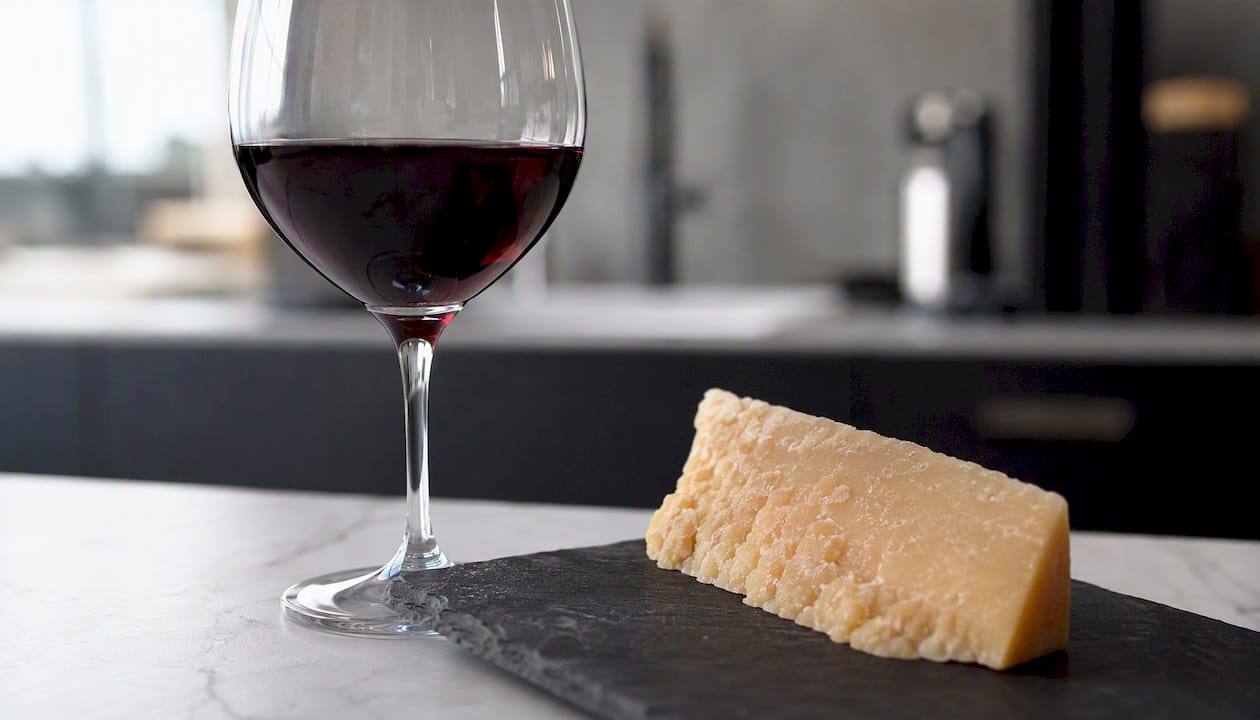
Rule one: match intensity. A delicate wine gets flattened by a powerful cheese, and a powerful wine bulldozes a delicate cheese. Aged cheddar, dense, sharp, crystalline with tyrosine, needs a wine with equivalent muscle. A bold Cabernet Sauvignon with real tannin and dark fruit stands up to it; a light Pinot Grigio simply disappears.
Rule two: pair by region. Wines and cheeses that evolved in the same soil tend to have been shaped by the same climate, the same farming rhythms, the same food culture. Tempranillo with Manchego. Nebbiolo or Sangiovese with Pecorino and Parmigiano. This “grows together, goes together” logic is especially reliable with hard aged cheeses, where centuries of trial and error already did the pairing homework for you.
Rule three: contrast salt with sweetness. Stilton and Sauternes is the textbook example, and it works because the wine’s sugar cancels the cheese’s salt, leaving pure creamy, honeyed fruit behind. When all three rules pull in different directions, industry pairing guides agree on the tiebreaker: match weight and intensity first. Everything else is fine-tuning.
Acidity cuts fat the way vinegar cuts through a greasy meal, keeping each bite of cheese moreish rather than heavy. Tannins bind to the proteins and fats in cheese, which softens their astringency, and bubbles physically scrub the palate clean between mouthfuls.
That’s the whole mechanism, and once it clicks, you stop guessing and start reasoning your way to good matches. If you want the underlying chemistry of how tannin, acid and sweetness actually register on your tongue, our beginner’s primer on how wine works breaks it down without the jargon.
The best wine for aged cheese, cheese by cheese
Different cheeses ask for different structural strengths in a wine, and the age of the wheel itself shifts the answer. Here’s the practical shortlist.
| Cheese | Best wine lanes | Why it works | Serving notes |
|---|---|---|---|
| Aged cheddar (18+ months) | Cabernet Sauvignon, Tawny Port | Tannin and dark fruit match the cheese’s density; Port’s sweetness plays off the crystalline saltiness | Serve red at 16-18°C, no decanting needed for most cheddar pairings |
| Parmigiano-Reggiano (30-36+ months) | Barolo, Chianti Classico, Lambrusco | High-acid Italian reds cut the fat while matching the cheese’s savoury intensity | Younger 18-24 month wheels suit lighter Chianti; 36-month wheels want Barolo or aged Nebbiolo |
| Aged Gouda | Dry Riesling, Amontillado sherry | Riesling’s acid balances the caramel sweetness that develops with age | Serve Riesling well chilled to keep the acid crisp |
| Manchego | Tempranillo, dry Fino sherry | The regional pairing principle at its cleanest, both born in the same Spanish landscape | Light decant on younger Tempranillo softens any grippy tannin |
| Gruyère / Comté | Oaked Chardonnay, aged Jura Vin Jaune | Nutty, oxidative cheese flavours mirror an oxidative or barrel-aged white | Serve slightly warmer than most whites |
| Stilton / blue cheeses | Sauternes, Tawny Port, Vintage Port | Sweetness directly counters salt; this is the most reliable contrast pairing in the whole category | No decanting required for Sauternes; Vintage Port benefits from an hour in the decanter |
Notice the pattern with Parmesan specifically: the wine changes as the cheese ages. An 18 to 24-month wheel is milder and works with a straightforward Chianti Classico. Push past 30 months and the umami intensity climbs, and that’s when Barolo or an older Nebbiolo earns its place, because a young, aggressive tannin actually clashes with high-glutamate cheese rather than complementing it.
- Classic regional matches (Parmigiano with Barolo, Manchego with Tempranillo) are traditional, not compulsory. Treat them as your reliable fallback, not a rule you have to follow.
- If you’re serving charcuterie alongside the cheese board, check our guide to pairing wine with red meat before locking in your reds, because cured meats shift the intensity calculus.
The four bottles worth keeping for a mixed cheese board
You don’t need forty bottles in the cellar. You need four that cover almost every scenario.
| Wine style | Best for | Why it’s versatile | When to reach for it |
|---|---|---|---|
| Dry traditional-method sparkling | Mixed boards, first pour | Acidity and fine bubbles cut through richness and reset the palate between wildly different cheeses | Opening pour for any board with three or more cheese styles |
| Dry Riesling | Washed rinds, aged Gouda, hard cheeses | High acid balances fat without overwhelming subtler flavours | Second pour, especially if the board leans toward firmer cheeses |
| Off-dry Gewürztraminer | Pungent, washed-rind or blue-veined cheeses | A touch of sweetness tames aggressive salt and funk | Reach for this when a cheese is more aroma than flavour, think Époisses-style intensity |
| Medium-bodied Pinot Noir | Semi-hard cheeses, transitional pour | Enough structure for firmer cheeses, gentle enough not to clash with milder ones | Bridges the gap between whites and your heaviest reds |
Building a mixed board means choosing one versatile bottle that won’t fight anything on the platter — learn more about wine pairing on a charter yacht to see how expert hospitality settings scale pairings for events. Focusing on a single hero cheese, an aged Comté you’re genuinely excited about, means abandoning versatility altogether and matching that one wheel specifically, even if it means the wine would clash with everything else on the table.
For a small home tasting, two to three bottles is plenty. Start with sparkling, move to the Riesling or Pinot Noir, and save your most structured red or fortified wine for last, when the cheeses are at their most intense.
How to serve wine and cheese so the pairing actually shows
Getting the wine right means nothing if the cheese is cold and mute. Temperature control is where most home tastings quietly fall apart.
- Pull the cheese out early. Remove cheese from the fridge 45 to 60 minutes before serving. Cold cheese mutes its own aromatics and the fat turns claggy on the palate instead of melting.
- Serve whites and sparkling chilled, reds cooler than you think. Most reds paired with cheese show better at 16-18°C, noticeably cooler than “room temperature” in a heated house.
- Order the board light to heavy. Start with sparkling and a mild cheese, move through medium-bodied whites and semi-hard cheeses, and finish on your densest cheese with your most structured red or a fortified sweet wine.
- Cleanse between styles. Plain crackers or a neutral bread reset your palate between very different cheeses, especially when moving from blue to hard.
- Pour small. A tasting-sized pour (around 60ml) across five or six wines beats one big glass of everything, because your palate fatigues fast once tannin and salt start stacking up.
Pro Tip: Set a kitchen timer the moment you pull the cheese out. Forty-five minutes disappears fast when you’re arranging the board, and cold cheese ruins more pairings than the wrong bottle ever does.
If you’re hosting something more structured than a casual Friday night board, our guide to building a wine pairing tasting menu walks through sequencing for a proper multi-course tasting, and our piece on hosting tastings at home covers the logistics for a bigger group.
Common wine and cheese pairing mistakes to avoid
Most bad pairings trace back to one of a handful of predictable errors.
- Defaulting to a big, young, tannic red for everything. A punchy three-year-old Cabernet with sharp tannin can taste bitter against very aged cheese, because high glutamate in mature cheese amplifies harshness in young tannin. Reach for something with a few more years in the bottle, or drop down to a medium-bodied red instead.
- Choosing a low-acid white for salty hard cheeses. An oaky, buttery Chardonnay with no backbone just sits there next to Manchego or aged cheddar. Swap in a Riesling or a crisp Sauvignon Blanc instead.
- Serving cheese straight from the fridge. Covered above, but worth repeating: cold cheese mutes everything, wine included.
- Pairing Parmesan with sweet Moscato. It sounds intuitive, salty cheese, sweet wine, but Parmesan’s dry, granular texture and nutty depth actually wants acid, not sugar. Go Lambrusco or Chianti instead.
- Ignoring your own palate because a “rule” says otherwise. These frameworks explain why pairings tend to work, not a rulebook that overrides your own enjoyment. If you genuinely love a combination that breaks every guideline here, pour it anyway. Harmony is the goal, not compliance.
The science behind why these pairings work
None of this is guesswork dressed up as expertise. There’s real food chemistry underneath the rules, and understanding it means you can improvise confidently instead of memorising lists.
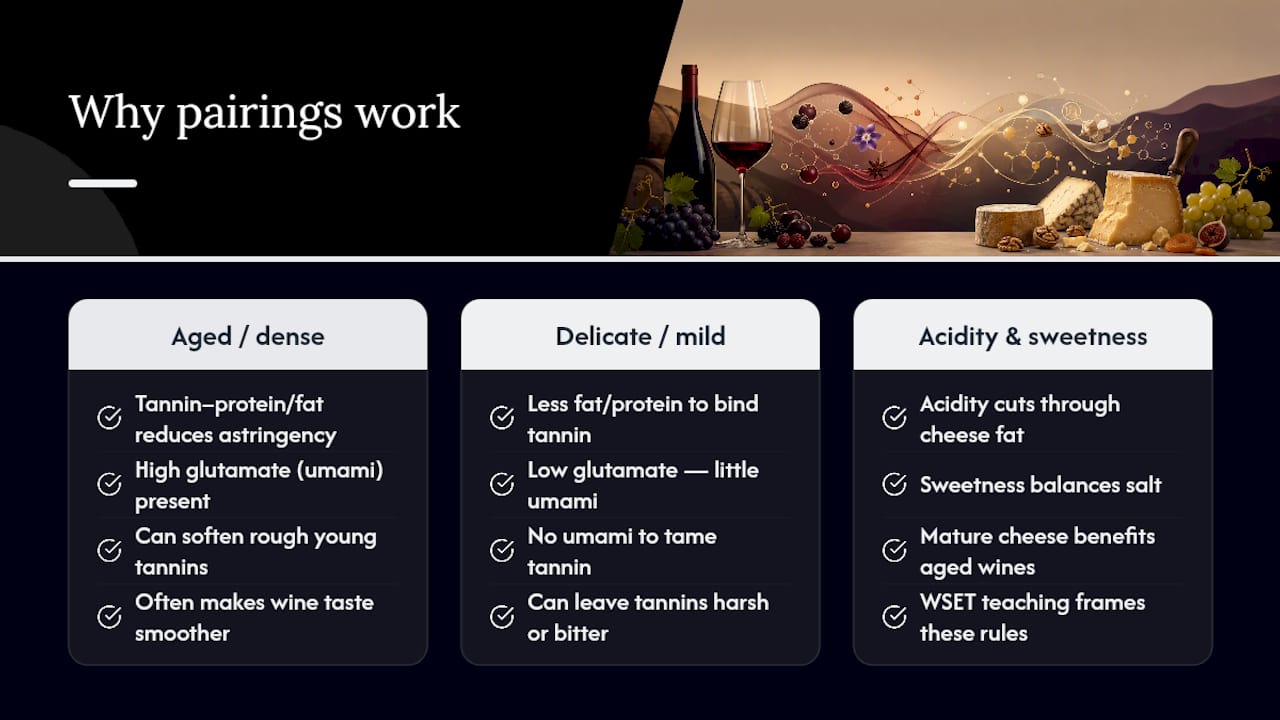
Tannin–protein and tannin–fat interactions in the mouth physically reduce perceived astringency, which is why a tannic red tastes smoother alongside cheese than it does alone. But high glutamate, the umami compound concentrated in aged cheese, can amplify bitterness in wines with young, harsh tannin.
That single mechanism, documented in food chemistry research, explains almost every “this red tastes better with cheese” experience you’ve ever had, and why a rough young Cabernet needs either more bottle age or a genuinely dense cheese to soften into something enjoyable. It also explains the reverse: pour that same rough Cabernet with a delicate, mild cheese, and the umami boost simply isn’t there to tame it.
The acid-cuts-fat and sweetness-balances-salt principles come from the same place wine educators have taught them for decades. WSET-style teaching frames it plainly: acidity behaves like vinegar on a rich dish, cutting through cheese fat rather than letting it coat your palate, while sweetness works as a direct counterweight to salt. As a general rule, the more mature and intense the cheese, the more you benefit from a wine that’s had some time in the bottle itself, rather than something youthful and sharp-edged.
A regional wine collector’s honest take
I lean regional more often than I lean “safe” these days, and it’s changed how I build every board I put together. There’s something almost lazy about always reaching for Cabernet with everything hard and aged. Try Tempranillo with Manchego once, properly, side by side with a Cabernet, and you’ll taste the difference between a wine that merely survives the cheese and one that was practically built for it.
Two bottles I never let run dry: a dry traditional-method sparkling for the opening pour, no exceptions, and a tawny Port sitting in reserve for whenever a blue cheese or an extra-sharp cheddar shows up uninvited. Between those two, I’ve rescued more cheese boards than I can count.
The biggest thing people underestimate is how much bottle age matters with genuinely mature cheese. A three-year-old red with grippy, unresolved tannin is a rougher partner for a 36-month Parmigiano than a wine with a decade on it, softer, more integrated, more willing to meet the cheese halfway. If your cheese has had time to develop, give your wine the same courtesy.
Where to actually buy the bottles this guide just recommended
Retail wine pricing has one dirty secret: half of what you’re paying for is the label’s reputation, not what’s in the bottle. Com exists because we got sick of watching genuinely excellent, cellar-ready wine sit unsold at inflated prices while the people who’d actually appreciate it walked past.
Building the four-cheese board this guide walks through? Look for a traditional-method sparkling, a dry Riesling or structured white, a medium-bodied red like Pinot Noir or Cabernet, and a tawny Port to close things out. That’s your entire rotation covered in four bottles, and every one of them is the kind of rare, high-scoring or cellar-aged wine that usually sits well outside a casual buyer’s budget. Com sources exactly those bottles, limited releases, boutique producer runs, allocation wines, and passes on the kind of discount that comes from cutting out the usual markups and middlemen, not from clearance stock nobody wanted.
Check out the current wine catalogue and grab whatever’s dropped this week before it’s gone. Stock moves fast, and that’s the whole point.
Sources
- How to pair wine and cheese: rules that work | KnowTheCheese
- Best wines for hard aged cheese: Barolo, Tawny Port, Chianti | WineWiki
- PMC — food chemistry research on tannin–protein interactions
- Cheese and wine: the ultimate guide — Decanter