

Identify quality wine: key techniques every wine lover needs
TL;DR:
- Price is not a reliable indicator of wine quality, and blind tastings often favor cheaper wines.
- Quality is based on balance, length, intensity, and complexity, assessed through the systematic SAT method.
- Trust your own senses and judgment over scores or labels to find true value and enjoyment in wine.
Cheap wine beats expensive bottles in blind tastings more often than the wine industry would like to admit. Seasoned tasters, critics, and everyday drinkers have all been fooled by labels. The truth? Price is one of the worst predictors of quality in the glass. Learning to assess wine yourself is genuinely one of the most rewarding skills you can build, whether you’re hunting for a bargain or deciding if a pricey bottle is worth it. This guide walks you through the evidence-backed techniques that experts actually use, so you can trust your own palate and stop paying for prestige you can’t taste.
Table of Contents
- What makes a wine ‘quality’?
- Using the systematic tasting method (WSET SAT)
- Spotting faults versus styles: Don’t get fooled
- Decoding scores, reviews, and tech: What really matters
- Putting it together: How to shop for real value
- Our take: Why your judgement matters more than numbers
- Discover and enjoy quality wine your way
- Frequently asked questions
Key Takeaways
| Point | Details |
|---|---|
| BLIC is your compass | Assess Balance, Length, Intensity, and Complexity for a reliable quality check any time. |
| Fault check comes first | Rule out cork taint, oxidation, and other faults before judging wine quality. |
| Scores are just guides | A wine’s rating can help but trust your own senses and judgement for the final say. |
| Affordable value is real | Great bottles don’t have to be expensive—many quality wines are accessible with the right method. |
What makes a wine ‘quality’?
Many assume price equals quality, but what actually makes a wine stand out? Let’s define the standard.
Quality in wine is not about a fancy label or a cellar full of heritage. It’s about what’s in the glass. Experts across the industry have landed on a core framework that cuts through the noise: BLIC. That stands for Balance, Length, Intensity, and Complexity. These key quality indicators are what underpin serious wine assessment, and they apply equally to a $20 bottle and a $200 one.
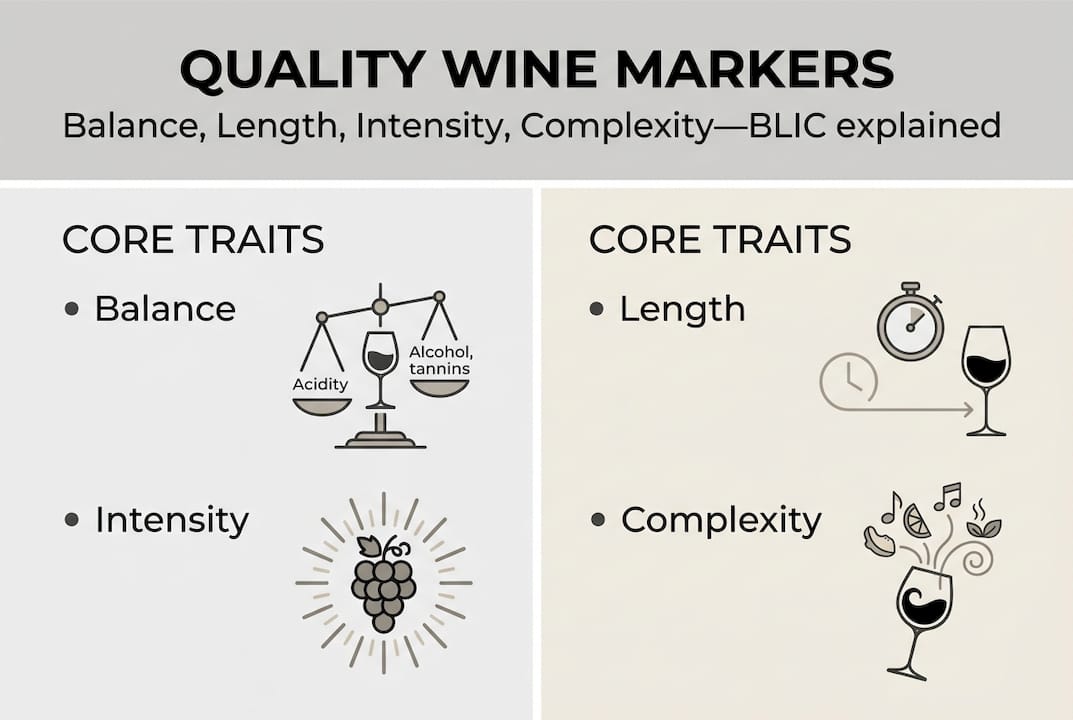
Balance means no single element is shouting over the others. Acid, tannin, alcohol, and fruit should feel like they belong together. Length is how long the flavour lingers after you swallow. A wine that disappears instantly is rarely a great one. Intensity is the concentration and vibrancy of aromas and flavours. Complexity is the layering, where one sniff or sip reveals something different each time.
Beyond BLIC, there’s an important distinction between objective and subjective quality. Objective quality is technical. It’s measurable. Faults, balance, structure. Subjective quality is personal preference. You might love a grippy, tannic Barossa Shiraz while your mate finds it overwhelming. Both responses are valid, but only one is a quality judgement.
The wine industry sometimes muddles this. A wine can be technically flawless but boring. Another might be unusual and polarising but genuinely excellent. Our guide to wine quality and value explores this tension in more depth.
For a grounding in how expert wine evaluation works at a professional level, the frameworks are consistent: absence of faults is the baseline, and BLIC is the ladder above it.
“A wine without faults is not automatically great. But a wine with faults is never great.” This is the baseline truth every serious taster starts with.
Here’s what quality wine typically demonstrates:
- Balance: Acid, tannin, alcohol, and fruit in harmony
- Length: Flavour that persists well after swallowing
- Intensity: Vivid, concentrated aromas and flavours
- Complexity: Multiple layers that evolve in the glass
- Absence of faults: No cork taint, oxidation, or volatile acidity
Using the systematic tasting method (WSET SAT)
Now that we know what quality means, how can you assess it in practice? Here’s the professional approach.
The WSET Systematic Approach to Tasting, known as the SAT, gives you a repeatable, structured method for assessing any wine. It’s the same framework used by sommeliers, educators, and judges worldwide. And the good news? You can start using it tonight.
The four steps work like this:
- Appearance: Look at the wine in good light. Note clarity (is it clear or hazy?), intensity of colour, and the actual colour itself. A deep ruby red tells a different story to a pale garnet. Browning at the edges of a red wine can signal age or oxidation.
- Nose: Swirl and sniff. Note the intensity of aromas (light, medium, pronounced) and the types of aromas present. Fruit, floral, spice, earth, oak. Are they primary (from the grape), secondary (from fermentation), or tertiary (from ageing)?
- Palate: Now taste. Assess sweetness, acidity, tannin (for reds), alcohol, body, flavour intensity, and finish. This is where BLIC really comes alive.
- Conclusions: Bring it all together. Is the wine balanced? Is the finish long? Is there complexity? Rate the quality: faulty, poor, acceptable, good, very good, or outstanding.
The wine tasting process becomes intuitive with practice. You stop guessing and start reading the wine.
| SAT step | What to assess | Quality signal |
|---|---|---|
| Appearance | Clarity, colour, intensity | Clarity suggests fault-free |
| Nose | Aroma types, intensity | Complexity signals quality |
| Palate | Structure, balance, finish | Long finish = quality indicator |
| Conclusions | BLIC overall | Rates the wine’s quality level |
For more on wine scoring explained, understanding how tasting notes translate to scores helps you use reviews more critically.
Pro Tip: Practise blind tasting whenever you can. Cover the label, pour the wine, and assess it purely on what’s in the glass. It’s humbling, but it trains your palate faster than anything else. You’ll be surprised how quickly bias disappears when you can’t see the bottle.
When you’re ready to put this into action, spotting wine value becomes much easier once the SAT is second nature.
Spotting faults versus styles: Don’t get fooled
Knowing how to taste is half the battle. But how do you avoid common pitfalls and mistakes?

This is where even experienced tasters get tripped up. A wine that smells unusual isn’t automatically faulty. And a wine that smells clean isn’t automatically good. Learning to separate faults from stylistic choices is a genuinely useful skill.
The three most common faults are:
- Cork taint (TCA): Smells like musty cardboard or a damp basement. It strips fruit and makes the wine flat and lifeless.
- Oxidation: The wine smells sherry-like or nutty when it shouldn’t. Colours often turn brown. Happens when too much oxygen gets in.
- Volatile acidity (VA): A sharp vinegar or nail polish smell. A tiny amount can add complexity, but too much is a fault.
As fault identification guidelines confirm, checking for these three is your baseline before you assess anything else. If a fault is present, quality assessment becomes almost irrelevant.
But here’s where it gets interesting. Some aromas that seem wrong are actually intentional. A funky, barnyard note in a natural wine might be low-level Brettanomyces, a wild yeast. At low levels, intentional oxidation and Brett can genuinely add character and complexity if they’re balanced within the wine’s overall profile. Natural wines may also appear hazy rather than crystal clear, but haziness alone does not indicate a fault.
The key question to ask yourself: does this characteristic add to or detract from the wine’s overall balance and enjoyment? If it’s distracting and unpleasant, it’s likely a fault. If it’s interesting and integrated, it may well be style.
Researchers are even using AI to evaluate wine quality and distinguish faults from stylistic variation with impressive accuracy. But your nose and palate, trained with practice, can get you a long way.
Pro Tip: Always check for faults before you start assessing quality. It’s the baseline. If something smells wrong, investigate before you dismiss the wine entirely. You might be smelling style, not failure.
Finding accessible quality wines means being confident enough to know when a wine is genuinely flawed versus just different.
Decoding scores, reviews, and tech: What really matters
Beyond taste and faults, many rely on published scores and reviews. But should you?
Wine scores are everywhere. A 95-point rating on a shelf sticker feels authoritative. But here’s what most people don’t realise: scoring systems cluster in ways that make small differences statistically meaningless. A wine rated 89 and one rated 91 may be virtually identical in quality. The gap feels significant, but it often reflects reviewer mood, palate fatigue, or even label recognition more than actual substance.
Human scores carry inherent subjectivity. Critics have preferences. They can be influenced by brand reputation, region, or winemaker fame. This doesn’t make scores useless, but it does mean you should treat them as one data point, not gospel.
“Scores are a shortcut, not a destination. Use them to narrow the field, then trust your own tasting to make the final call.”
AI is entering the space too. AI and machine learning models can predict wine quality from empirical data with 89 to 91% accuracy. That’s genuinely impressive. But AI can’t capture the sense of place, the story of a vintage, or the way a wine evolves in your glass over two hours. It measures what it can measure.
Here’s how to use scores and reviews intelligently:
- Use scores to identify wines worth investigating, not to make final decisions.
- Read the tasting notes for language that matches your own preferences.
- Cross-reference at least two or three sources before putting weight on a rating.
- Apply your own BLIC assessment once the wine is in your glass.
- Remember that Michelin wine standards and similar prestige markers reflect expert consensus, not personal taste.
To understand wine scoring more deeply, and to see how high-scoring wines sometimes fail the value test, it helps to approach ratings with healthy scepticism.
Putting it together: How to shop for real value
Armed with knowledge, it’s time for you to find the bottles that deliver the most pleasure for your money.
Here’s the thing about value: it has nothing to do with the price on the tag. A $30 wine that scores brilliantly on BLIC is better value than a $120 wine that coasts on its reputation. Using BLIC on affordable bottles is one of the most powerful moves a savvy wine buyer can make, because it cuts through marketing and gets straight to what matters.
When you’re shopping, in-store or online, run through this quick checklist:
- Check the vintage and producer for any reviews or scores as a starting point.
- Look for clarity and appropriate colour in the bottle if you can see it.
- Assess on the nose first: any obvious fault signals before you even taste.
- Apply BLIC on the palate: is it balanced, complex, intense, and does it linger?
- Put the score in context: is a 93-point wine at $150 actually better than an 89-pointer at $35?
Not all high scorers offer real value. Some are priced for their story, not their substance. The best wine value buys often come from lesser-known regions, emerging producers, or overlooked varietals where prestige hasn’t inflated the price yet.
Pro Tip: Do a blind tasting at home with a few bottles at different price points. You’ll quickly find that your palate often disagrees with the price tag. That’s not a flaw in your judgement. That’s your judgement working exactly as it should.
For those ready to go deeper, aspirational wine discovery is about finding bottles that punch well above their weight. That’s the real game.
Our take: Why your judgement matters more than numbers
Here’s the uncomfortable truth about wine scores: they were never really designed for you. They were designed for the trade, for buyers ordering by the pallet, for critics building reputations. The 100-point scale is a marketing tool as much as a quality measure. As subjective versus objective quality debates in the industry show, scores reflect one person’s palate on one particular day.
Blind tasting teaches humility fast. You’ll pick a $25 wine over a $100 one. You’ll love a wine you expected to hate. That’s not embarrassing. That’s your palate doing its job without interference from labels and price tags.
BLIC gives you a repeatable, independent framework. It doesn’t care about prestige. It rewards what’s actually in the glass. And the more you use it, the sharper your instincts become. Your wine quality and value judgement becomes genuinely your own, not borrowed from a critic you’ve never met.
Trust your senses. They’re more reliable than you think.
Discover and enjoy quality wine your way
You’ve got the tools now. BLIC, the SAT, fault detection, score scepticism. The next move is putting them to work on bottles worth your attention.
At FU Wine, we source premium and hard-to-find bottles at prices that make the establishment uncomfortable. No inflated markups. No gatekeeping. Just genuinely great wine at prices that respect your intelligence. Our FU Wine curated selection is built for exactly the kind of savvy, quality-focused drinker you’re becoming. And if you want to keep sharpening your eye for a bargain, our expert guide to value wine buys is the perfect next read. Every bottle is a small rebellion. Come find yours.
Frequently asked questions
What are the BLIC criteria in wine?
BLIC stands for Balance, Length, Intensity, and Complexity, the four main markers experts use to judge wine quality across all styles and price points.
How can I check if a wine is faulty?
Look for cork taint, oxidation, and volatile acidity before anything else: musty cardboard, sherry-like browning, or a vinegar sharpness are the key signals to watch for.
Does a higher wine score always mean better quality?
Not always. Scoring systems cluster statistically, meaning a difference of a few points may be insignificant, so your own tasting assessment matters just as much.
Can inexpensive wine be high quality?
Absolutely. Using BLIC on affordable bottles reveals that many lower-priced wines deliver genuine balance and complexity, making them quality picks regardless of what they cost.