

How wine value is determined: a collector's guide to fair pricing
TL;DR:
- Wine value is primarily determined by actual market transactions, not retail shelf prices.
- Key factors influencing wine worth include producer reputation, vintage quality, scarcity, and critic scores.
- Savvy collectors focus on market data, provenance, and emerging regions rather than hype-driven labels.
You’ve stood in a bottle shop, stared at two reds side by side, and thought: what’s the actual difference? One’s $30, one’s $180. Both look the part. The higher price must mean better wine, right? Not always. Wine pricing is one of the most misunderstood corners of the drinks world, and it costs collectors real money every time they reach for the pricier label without knowing why. The truth is, wine value is shaped by a tangle of market forces, expert opinions, and scarcity signals that have nothing to do with what’s actually in the glass. This guide cuts through the noise.
Table of Contents
- What really sets wine value? Market mechanisms explained
- The core qualities behind a wine’s worth
- How expert scores and critical reviews impact pricing
- Market cycles, trends and pitfalls: Why value isn’t always appreciation
- Finding fair value: Practical strategies for collectors
- Why chasing the priciest labels misses the point
- Find premium wines with true value at FU Wine
- Frequently asked questions
Key Takeaways
| Point | Details |
|---|---|
| Market-driven value | Wines get their real value from auction results, exchange prices and secondary market data, not retail stickers. |
| Critical scores matter—but | High critic scores can spike prices quickly, but not every wine continues to appreciate. |
| Beware market hype | Trends, climate shifts and global demand can create bubbles—buy with careful research. |
| Collect for enjoyment | Choosing wines that bring you joy and prove value over time is smarter than chasing prestige labels. |
What really sets wine value? Market mechanisms explained
Shelf prices are a story. They reflect distributor margins, retailer markups, import duties, and a healthy dose of brand prestige. None of that tells you what a wine is actually worth on the open market. For that, you need to look at where real transactions happen.
Secondary markets, auction houses, and fine wine exchanges are where wine value is primarily determined through auctions, secondary market transactions, and exchange prices like Liv-ex mid-prices, which aggregate transaction data to create reliable benchmarks. These platforms strip away the retail theatre and show you what buyers are genuinely willing to pay.
The Liv-ex Fine Wine 1000 index is one of the most trusted tools in the game. It tracks prices across a broad range of fine wines using actual trade data. Think of it as the ASX for premium bottles. When you check a wine’s Liv-ex price, you’re seeing the market’s honest opinion, not a retailer’s wishful thinking.
Auctions add another layer of insight. Christie’s auction insights reveal how hammer prices ripple outward to influence what retailers and collectors charge globally. A strong auction result for a particular vintage can shift the whole market within weeks.
Auctions set hammer prices plus 20-25% buyer’s premium, meaning the final cost to a buyer is always significantly above the winning bid.
Here’s a quick comparison to put it in perspective:
| Pricing source | Reflects market reality? | Transparency |
|---|---|---|
| Retail shelf price | Low | Opaque |
| Auction hammer price | High | Public |
| Liv-ex exchange price | Very high | Transparent |
| Secondary market sale | High | Moderate |
The takeaway is simple. Always check recent transaction prices before you buy. Not the RRP. Not the shelf tag. Actual trades. Understanding wine vintage and value is another piece of the puzzle, but the market data is your foundation.
- Check Liv-ex or Wine-Searcher for recent sale prices
- Look at multiple auction results across different houses
- Compare exchange mid-prices to retail before committing
- Factor in the buyer’s premium when calculating true auction cost
The core qualities behind a wine’s worth
Market mechanisms set the stage, but what actually makes one wine worth ten times another? It comes down to four factors that every serious collector should know cold.
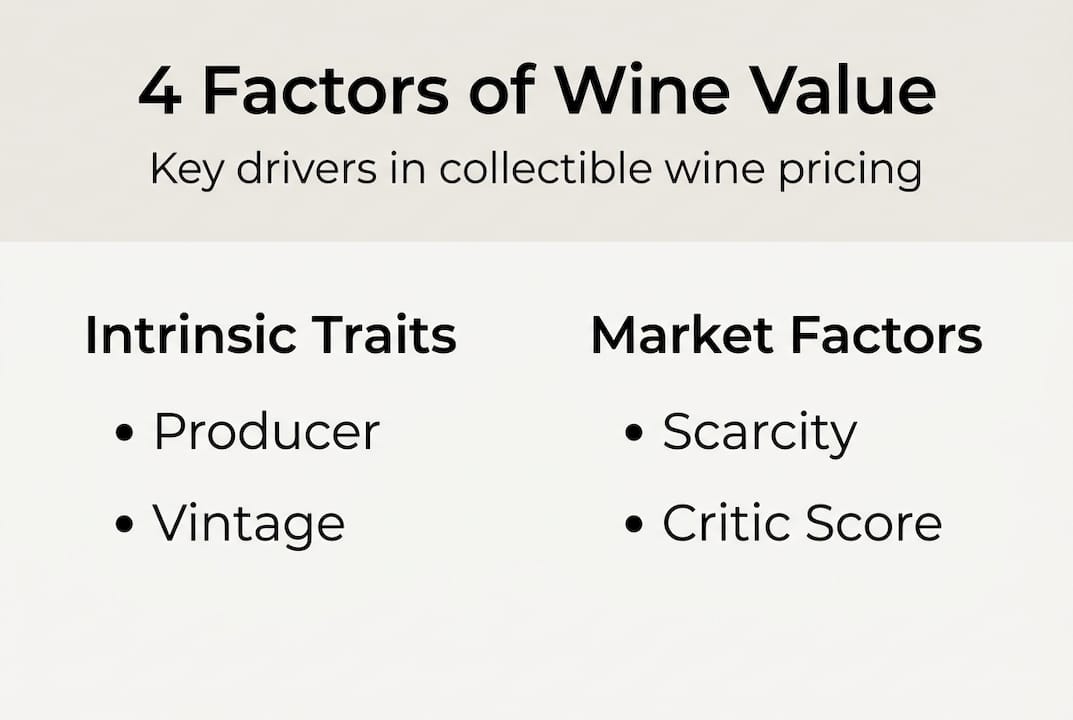
Key intrinsic factors include producer reputation, vintage quality driven by weather conditions, scarcity from low production volumes, and critical scores from respected experts like Robert Parker of Wine Advocate or Wine Spectator. These four pillars underpin almost every significant price movement in the fine wine world.
Producer reputation is built over decades. A domaine in Burgundy with a 200-year track record carries weight that a flashy newcomer simply cannot buy. That heritage translates directly into demand, and demand sets price.

Vintage quality is weather-dependent and wildly variable. A single summer hailstorm can decimate a crop and send prices for the surviving bottles skyward. Conversely, a warm, consistent growing season can produce an abundance of quality fruit, keeping prices more accessible.
Scarcity is perhaps the most powerful driver. When a producer makes only 500 cases of a wine and collectors across three continents want it, basic economics takes over. Low production plus strong demand equals serious price pressure.
Then there are the scores. A 98-point rating from a respected critic can shift a wine’s value overnight. We’re talking price jumps of 30 to 50 percent in some cases, sometimes within days of a review dropping. Understanding wine quality and desirability helps you read these signals before the market fully reacts.
Pro Tip: Cross-reference vintage charts with regional weather reports from the growing season. A chart tells you the score; the weather data tells you why, and that context helps you judge whether the rating is likely to hold up over time.
Here’s your collector’s checklist before any premium purchase:
- Producer reputation: Does this domaine or winery have a proven, consistent track record?
- Vintage quality: Was the growing season exceptional, average, or difficult?
- Production volume: How many cases were made, and how many are still available?
- Critical score: What did Wine Advocate, Wine Spectator, or Decanter say, and when?
Knowing how to assess these factors is what separates savvy collectors from people who just buy the prettiest label. Check out understanding wine scoring to get across the scoring systems in detail.
How expert scores and critical reviews impact pricing
Critic scores are rocket fuel for wine prices. A single review from the right person at the right time can transform a $60 bottle into a $200 bottle overnight. But the mechanics behind this are worth understanding before you get caught chasing a number.
The main scoring systems run on a 100-point scale. Wine Advocate (founded by Robert Parker), Wine Spectator, Decanter, and James Suckling are the heavyweights. Scores of 90 and above signal quality. Ninety-five and above signals something special. And 98-100 point scores cause immediate price jumps, with the Bordeaux 1982 vintage being the most famous example of a critic score rewriting market history.
Here’s how a review score typically translates into market movement:
- Critic publishes a score of 97 or above for a specific wine
- Wine merchants and collectors take notice within 24-48 hours
- Available stock on secondary markets gets snapped up quickly
- Remaining inventory reprices upward to reflect new demand
- Auction estimates for future sales adjust accordingly
- Retail prices follow, often with a delay of weeks or months
The speed of this cycle has accelerated dramatically with social media and online wine communities. What once took months now happens in days.
A 100-point score can make prices surge, but not every collector reaps a return. Buying after the hype has already hit means you’re paying for the excitement, not the wine.
The smarter play is to understand how vintages are rated before a big score drops, so you’re positioned ahead of the crowd rather than chasing it. And always look at multi-year price trajectories, not just the post-review spike. A wine that scores 96 points but has a five-year history of steady, modest appreciation is often a better bet than one that shot up 80 percent after a single glowing review and then plateaued. Dig into wine scoring explained for the full picture.
Market cycles, trends and pitfalls: Why value isn’t always appreciation
Here’s the part nobody loves to talk about. Wine can be a genuinely poor investment. And that’s not cynicism; it’s data.
Wine returns are lower than stocks over comparable periods. The Liv-ex 100 index has historically underperformed the Dow Jones Industrial Average, particularly when you factor in storage costs, insurance, and the ever-present risk of provenance issues. If pure financial return is your goal, equities are a more reliable vehicle.
| Asset | Avg annual return (10yr) | Key risks |
|---|---|---|
| Liv-ex 100 fine wine index | 5-7% | Storage, provenance, liquidity |
| DJIA (equities) | 10-12% | Market volatility |
| Premium real estate | 7-9% | Illiquidity, maintenance |
Market cycles introduce their own chaos. Climate change is increasing vintage variability, particularly in regions like Napa Valley where high scores can limit appeal if over-hyped, and unpredictable seasons create boom-and-bust cycles. Chinese demand spikes in the early 2010s caused a Bordeaux bubble that corrected sharply, wiping out gains for collectors who bought at peak hype.
The pitfalls to watch:
- Hype cycles: Trending grapes or regions attract speculative buying that inflates prices beyond fundamentals
- Provenance scandals: Fake or poorly stored bottles have burned serious collectors
- Liquidity risk: Rare wines can be hard to sell quickly without taking a loss
- Climate variability: Increasingly unpredictable seasons make vintage quality harder to forecast
Pro Tip: For wine investment benefits that actually hold up, prioritise wines with proven secondary market liquidity and documented provenance over fashionable labels. Boring and reliable beats exciting and speculative most of the time. Explore premium wine trends and think carefully about building a wine portfolio that balances enjoyment with sensible value.
The real lesson? Wine’s greatest return is often personal. The joy of drinking something exceptional, shared with people you care about, is a return no index can measure.
Finding fair value: Practical strategies for collectors
Right. You’ve got the theory. Now here’s how to actually use it when you’re hunting for bottles worth buying.
For affordable premiums, focus on secondary markets and indices for fair value, avoid hype-driven retail, and seek wines with liquid, proven demand and good provenance. That’s the framework in one sentence. Here’s how it plays out in practice:
- Check Liv-ex or Wine-Searcher first. Before you buy anything above $80, look up the current market price. If the retailer is asking 40 percent above the exchange price, walk away.
- Target under-the-radar regions. Wines from emerging appellations often deliver exceptional quality at a fraction of the price of their famous neighbours. Think Languedoc instead of Burgundy, or Ribera del Duero instead of Rioja.
- Buy on the way up, not at the peak. Identify wines with rising scores and growing collector interest before they hit mainstream attention.
- Verify provenance every time. Ask for purchase receipts, storage records, and condition reports. A premium wine with dodgy provenance is worth nothing.
- Avoid trend-driven buying. If every wine magazine is raving about a particular grape or region, the value has likely already been priced in.
Pro Tip: Use market data and provenance reports together. A wine might look like a bargain on price alone, but if the storage history is unclear, you’re taking on serious risk. Always validate both dimensions before committing.
Secondary markets and exchanges are your best friends here. They show you what the market actually thinks, not what a retailer hopes you’ll pay. For unlocking rare wines at genuine value, and for navigating smart wine deals, the approach is always the same: data first, emotion second.
A fair deal gives you something money can’t fully quantify. Peace of mind, genuine quality, and the satisfaction of knowing you didn’t overpay.
Why chasing the priciest labels misses the point
Here’s our honest take. The collectors who get the most out of wine are rarely the ones spending the most. They’re the ones who’ve stopped letting price tell them what to enjoy.
Market price reflects consensus, hype, and sometimes pure fashion. It does not reliably reflect what will delight you on a Tuesday night or what will genuinely improve in your cellar. Some of the most memorable bottles we’ve encountered cost less than $50. Some of the most disappointing cost ten times that.
The smartest collector wisdom we know is this: buy what genuinely excites you, not what the market says you should want. Under-the-radar producers, overlooked regions, and unfashionable vintages are where real value hides. They’re also where the best stories live.
True wine lovers measure joy, not just return on investment. If you want to find those hidden gems without the usual gatekeeping, our expert guide to rare wines is a solid place to start.
Find premium wines with true value at FU Wine
Knowing how wine value actually works is your superpower. Now put it to use.
At FU Wine, we’ve built something specifically for collectors and enthusiasts who are done paying inflated retail prices for bottles they could source smarter. We cut through the markups, skip the middlemen, and bring you premium and rare wines at prices that actually make sense. Flash deals, limited releases, cellar clearances. Real value, no pretension. If you’re ready to drink better without the usual BS attached to fine wine pricing, come and see what’s waiting for you. Every bottle is a small rebellion against overpriced mediocrity, and we think you’ll like the taste of that.
Frequently asked questions
Do wine critic scores always predict value increases?
Critic scores strongly influence prices in the short term, but not all highly rated wines keep appreciating over time, with empirical studies showing wine returns often trail equities.
What is the buyer’s premium at wine auctions?
Most wine auctions charge a 20-25% buyer’s premium on top of the hammer price, making the final cost to buyers significantly higher than the winning bid.
Are retail prices a good indicator of wine value?
No. Retail prices often reflect markups and marketing spend rather than true worth. Market exchanges and auctions provide far more reliable benchmarks for what a wine is genuinely worth.
How does scarcity affect wine pricing?
Wines with smaller production runs and solid provenance typically hold or increase in value because collector demand consistently outpaces available supply, pushing prices upward over time.