

How wine deals work: Snagging premium bottles smart
Premium wine doesn’t have to mean a premium price tag. That’s not wishful thinking — it’s the reality for collectors and enthusiasts who know where to look. The traditional wine world loves its gatekeepers, its markups, and its mystique. But the smartest drinkers have figured out that wine basics don’t require a black card or an industry contact. Auctions, flash deals, and wine clubs have cracked the door wide open. This guide shows you exactly how each channel works, what to watch for, and how to score bottles that punch well above their price.
Table of Contents
- The landscape of modern wine deals
- How auctions bring rare wine within reach
- Flash deals, clubs and direct: Getting premium for less
- What to check before you buy: Risks and real value
- Making wine deals work for you
- Explore curated premium wine deals
- Frequently asked questions
Key Takeaways
| Point | Details |
|---|---|
| Know your sources | Wine deals come from auctions, clubs, and flash sales—each with unique advantages for collectors and enthusiasts. |
| Check before you buy | Due diligence on provenance, condition, and reputation is essential for genuine bargains. |
| Set your own benchmarks | Determine what value looks like for your cellar or table before bidding or buying. |
| Act fast or be patient | Flash deals reward speed while auctions require research and restraint for the best results. |
The landscape of modern wine deals
The premium wine market has shifted. Rare bottles and high-scoring vintages are no longer locked behind cellar doors and private networks. Three main channels now drive the action: auctions, wine clubs and direct sales, and flash deals. Each suits a different kind of buyer, and understanding wine distribution for premium collectors is the first step to knowing which lane is yours.
Wine auctions allow collectors to bid on rare, mature, or large-format premium wines, and 2026 auction data confirms demand is surging. These platforms attract serious bottles with serious provenance. If patience is your thing, auctions can deliver extraordinary value.
Wine clubs and direct sales offer discounts through curation and membership, giving you access to handpicked bottles at prices below standard retail. The trade-off is less control over exactly what lands on your doorstep, but the savings and discovery factor are real.
Flash deals are the wild card. Time-limited, high-energy, and often surprisingly premium. They reward the quick and the prepared.
| Channel | Best for | Typical savings | Speed required |
|---|---|---|---|
| Auction | Rare and aged bottles | 20 to 50% | Low (patient bidding) |
| Wine club | Variety and discovery | 15 to 40% | Low (subscription) |
| Flash deal | Premium at speed | 30 to 70% | High (act fast) |
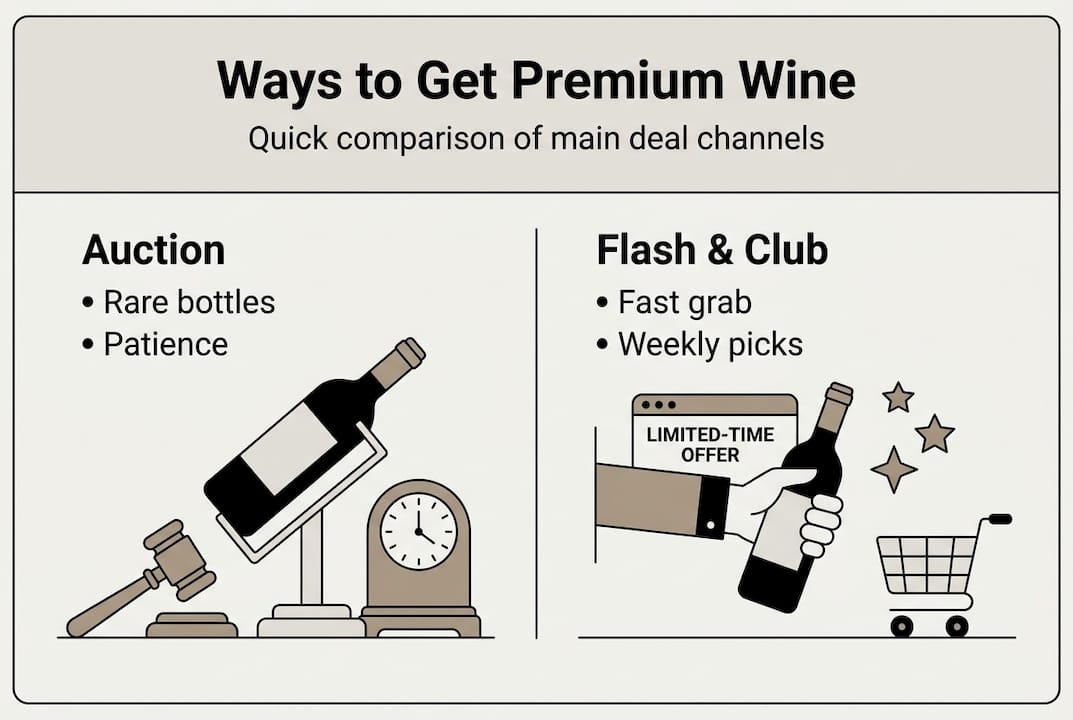
Demand for rare finds and accessible premiums is growing fast. Knowing which channel fits your style means you stop missing out and start drinking better.
How auctions bring rare wine within reach
Auctions feel intimidating until you understand the mechanics. Then they feel like a treasure hunt with a very good prize at the end.
Here’s how the process works:
- Register with a reputable auction house. Most require basic identity verification and a payment method on file.
- Browse and vet the lots. Each lot comes with condition notes. Read them carefully.
- Check the critical details. Ullage (the gap between wine and cork), seepage, provenance, and label condition all affect value and drinkability.
- Set your maximum bid before the auction opens. Decide your ceiling and stick to it.
- Bid strategically. Early bids can signal interest; late bids can catch bargains in overlooked lots.
Pro Tip: Always set your maximum bid before the auction starts. Auction adrenaline is real, and it will push you past your budget if you let it. Decide your number in advance and treat it as non-negotiable.
Reputable auction houses drive high sell-through rates and can yield genuine bargains, but buyers must be diligent. The condition notes are not just formalities — they are your due diligence.

Burgundy lots have achieved record-high multipliers versus benchmarks, which means label, ullage, and provenance checks are more important than ever. A bottle with a slightly damaged label but perfect provenance is often a smarter buy than a pristine-looking bottle with a murky storage history.
Mixed lots and conditioned lots are where the edge-case bargains live. Experienced buyers know that a mixed lot with one standout bottle can deliver exceptional value if you do the sums. Auction region data shows that regional performance varies significantly, so knowing your regions pays off.
For cellar-aged wines in particular, auctions are often the only realistic access point. And the benefits for wine collectors who buy well at auction extend beyond the glass — these bottles hold and grow in value.
“Checking wine provenance is not optional. It is the difference between a great deal and an expensive disappointment.”
Flash deals, clubs and direct: Getting premium for less
Not everyone wants to wait for an auction to close. Flash deals, wine clubs, and direct-to-consumer allocations are built for speed and convenience without sacrificing quality.
Wine clubs work on a membership model. You pay a subscription or commit to a minimum purchase, and in return you get curated selections, member pricing, and often free or discounted shipping. The best clubs also offer promo codes and early access to limited releases. Wine clubs and flash deals offer steep discounts and exclusive perks, with code values and price ranges that can make a serious dent in your usual spend.
Direct-to-consumer allocations are the insider move. Wineries sell direct to bypass the retail chain entirely, passing savings straight to you. These allocations are often limited and go fast.
Flash deals are exactly what they sound like. A premium bottle, a sharp price, a short window. En primeur deals now require deep discounts to be competitive, especially amid current surpluses, which means buyers who move fast can access Bordeaux-level quality at genuinely accessible prices.
Pro Tip: Sign up for SMS alerts and app notifications from your preferred platforms. The best flash deals sell out in minutes. Being on the insider list is the difference between scoring and missing out entirely.
When building a versatile wine portfolio, mixing club subscriptions with flash deal grabs gives you both consistency and excitement. And if you want to understand whether a deal is genuinely good value, understanding wine scoring helps you cut through the marketing noise. For cellar finds in wine clubs, look for clubs that source aged stock rather than just current releases.
For practical guidance on receiving your bottles in top condition, online wine shipping tips are worth a read before your first delivery.
What to check before you buy: Risks and real value
A deal is only a deal if the wine is actually good. Here’s your pre-purchase checklist.
Provenance. Where has this bottle been stored? Temperature-controlled cellars are ideal. Unknown or warm storage is a red flag.
Ullage. The gap between the wine and the cork. A small ullage is normal for older wines. A large gap suggests evaporation or a compromised seal.
Seepage. Any sign of wine leaking past the cork is a serious concern. Check the capsule and label for staining.
Label condition. Damaged labels matter less for drinking wines than for display or resale. Don’t let a scruffy label put you off a well-provenanced bottle.
Format. Large formats like magnums and double magnums age more slowly and often represent better value per glass.
Condition issues, provenance, and format all impact value and enjoyment. A bottle that ticks every condition box but has no provenance story is riskier than one with minor cosmetic issues and a clear, documented history.
Quality scores don’t guarantee deal value; a 95-point wine at full retail might be worse value than an 88-point wine at 50% off. Label damage is often just cosmetic, especially if you’re buying to drink rather than display.
For confident wine choices, prioritise provenance over perfect presentation every time. And always cross-reference the deal price against the guide to wine vintages to confirm the vintage actually warrants the excitement. Checking wine vintage quality in 2026 is especially useful for recent releases hitting the market now.
Making wine deals work for you
Knowing the channels is one thing. Putting them to work for your collection is another. Here’s a practical approach.
- Define your collecting style. Are you cellaring for the long term, drinking now, or building a mixed collection? Your answer shapes which channel suits you best.
- Set your criteria upfront. Decide on your price ceiling, preferred regions, and minimum provenance standards before you start browsing.
- Use auctions for rare and aged bottles. Patience pays here. Flash sales require speed; auctions reward patience; clubs offer steady access, so choose based on your collecting style.
- Use clubs for consistent discovery. A good club keeps your cellar stocked with variety without requiring constant active searching.
- Use flash deals for opportunistic grabs. Set your alerts, know your budget, and move fast when something exceptional appears.
- Review and rotate. Reassess your subscriptions and deal sources every six months. The market shifts, and so should your strategy.
| Strategy | Best channel | Key action |
|---|---|---|
| Long-term cellaring | Auction | Vet provenance carefully |
| Regular drinking | Wine club | Lock in member pricing |
| Rare finds | Flash deal | Set alerts, act fast |
| Portfolio building | All three | Diversify your collection |
The collectors who drink best aren’t the ones with the biggest budgets. They’re the ones with the sharpest strategy and the willingness to act when the right bottle appears.
Explore curated premium wine deals
You’ve got the knowledge. Now put it to work. FU Wine was built for exactly this kind of buyer — someone who knows quality, refuses to overpay, and loves the thrill of finding something exceptional at a price that makes sense.
The premium wine deals collection is a rotating catalogue of rare releases, cellar-aged bottles, and high-scoring vintages sourced through direct relationships and opportunistic buying. No inflated retail markups. No pretentious gatekeeping. Just genuinely great wine at prices that feel like a win every time. Flash deals move fast, so get on the list and be ready to move when something special drops.
Frequently asked questions
What is the difference between a wine auction and a flash wine deal?
Wine auctions offer rare bottles via competitive bidding and reward patient, research-driven buyers, while flash deals are time-limited fixed-price offers that suit collectors who want quick access to premium or surplus wines without the wait.
How can I tell if a discounted premium wine is genuine?
Check the provenance, storage history, and seller reputation before committing; provenance is critical for rare wines, and label damage is usually cosmetic rather than a sign of deeper problems.
Are wine clubs actually good value for collectors?
Wine clubs offer discounts and exclusive perks through memberships and promo codes, making them excellent value for collectors who want variety, steady access, and the occasional surprise without the effort of constant deal-hunting.
What should I look for in a wine auction lot?
Always check provenance, ullage, label condition, and whether it’s a mixed lot; critical auction factors include storage history and seal integrity, which tell you far more about a bottle’s quality than its appearance alone.