

Collectors: Authenticate Wine Before Buying, Provenance First Then Labs
Authenticate a bottle by combining a targeted physical inspection, documentary provenance and, only for high value or ambiguous lots, forensic laboratory tests. That’s the whole game, in that order. Skip straight to a lab and you’ve wasted money on bottles a good look would’ve cleared or condemned. Trust your palate alone and you’re gambling, because taste tells you almost nothing about a fake.
TL;DR:
- Physical inspection should be prioritized over laboratory tests for most bottles, focusing on label quality, capsule, cork, fill level, and sediment patterns.
- Provenance verification through detailed documents and chain of custody is the most reliable method to confirm authenticity, especially for high-value bottles.
- Laboratory tests like GC-MS, ICP-MS, and NMR are useful only for high-value or ambiguous wines, with results relying heavily on reference libraries and specific testing techniques.
- Non-destructive methods such as UV light, high-resolution photography, and X-ray imaging can detect relabeling and tampering without opening the bottle.
- Secure purchases from reputable sources that provide provenance documentation, inspection rights, and transparent return policies to reduce the risk of buying counterfeit wine.
Table of Contents
- Quick physical inspection checklist collectors can use now
- Provenance verification: documents and chain of custody to demand
- Laboratory and analytical techniques explained
- Non-destructive inspection methods collectors can use or ask for
- Safe buying practice: vendors, pricing and seller vetting
- When to commission professional authentication and what to expect
- FU Wine’s provenance and recordkeeping checklist
- A collector’s take on realistic risk management
- How FU Wine helps you buy with confidence
- Sources
Quick physical inspection checklist collectors can use now
Get your eyes and hands on the bottle before you get your wallet out. Most fakes fall apart under basic scrutiny, and you don’t need a lab coat to spot the tells.
Start with the label. Genuine labels from established estates are printed with consistent registration, proper ink saturation and paper stock that ages predictably. Counterfeiters working from a scanned image often produce digital printing artefacts, dot patterns, or slightly blurred text where the original used plate printing. Hold it at an angle under strong light and check for a slick, uniform sheen that shouldn’t be there on an older bottle.
The capsule and seal deserve just as much attention. Look for fingerprints pressed into wax, seams that look recut, or foil that’s been reglued around the neck. Genuine capsules from the era usually show consistent wear patterns matching the claimed age, not fresh crimping over an old bottle.
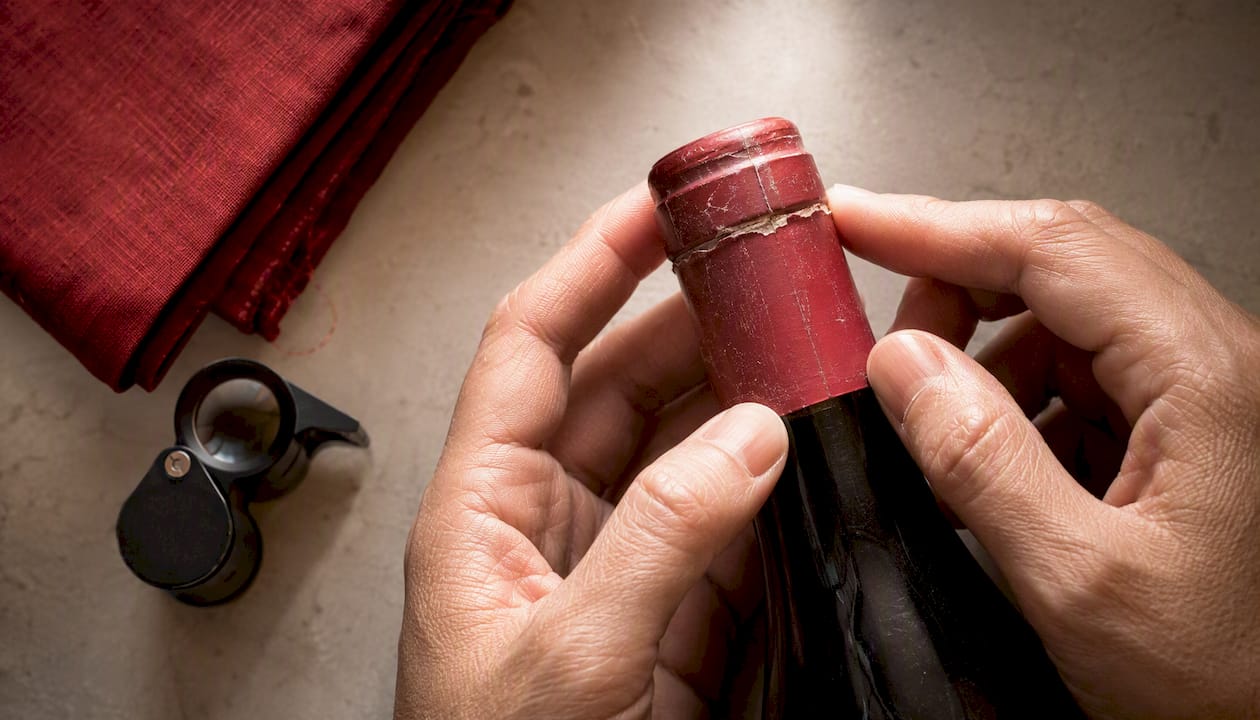
Check the cork next, if you can see it through the capsule or if the seller can remove the foil for inspection. An authentic cork carries a producer imprint that matches the label vintage, and staining should be consistent with genuine ullage over decades. Evidence of recorking, a cork that’s too clean, too new, or stamped with mismatched details, is one of the clearest fraud signals going. It’s worth reading up on what a corked or reworked cork actually looks like before you rely on this alone.
Fill level matters more than most buyers realise. Older bottles lose volume through the cork over time, so ullage sits within predictable ranges by vintage. A 30 year old Bordeaux with a suspiciously high fill, or a five year old bottle with heavy ullage, is telling you something’s off.
Round it out with glass and punt inspection: weight, embossed markings, and how sediment has settled. Genuine aged reds throw sediment in a way that’s hard to fake convincingly.
- Magnifier for label print quality and micro text
- UV lamp for ink and adhesive checks
- Reference photos from verified sales
- A kitchen scale to compare bottle weight against known genuine examples
Pro Tip: Photograph every angle of a bottle before you buy it, including the base and capsule seam. If a dispute arises later, that timestamped photo record is worth more than your memory of “it looked fine.”
Provenance verification: documents and chain of custody to demand
Unbroken documentation is the single most important structural defence against counterfeit risk, more reliable than any visual check because paper trails are harder to fabricate convincingly across multiple independent sources, according to provenance guidance from VinoFYI. A bottle with a clean chain of custody rarely turns out to be fake. A bottle with a vague or missing one should worry you regardless of how good it looks.
What you actually want to see:
- Original purchase invoices naming the estate, vintage and retailer, ideally matching a known merchant or négociant.
- Bonded warehouse or storage logs showing temperature-controlled conditions and dates of entry and exit.
- Auction lot records where the bottle has previously sold, including lot numbers and house names you can cross-reference.
- Transport and insurance documents covering any move between cellars, especially international shipments.
- Prior ownership history, even informally, that lines up with the documents above rather than contradicting them.
Verifying storage records means more than accepting a PDF. Call the bonded facility if the seller names one. Auction houses keep searchable archives, so if a bottle claims a prior sale through a major house, that lot should be findable or the house should confirm it on request.
Common fabrications include storage logs with no facility name or contact detail, invoices with mismatched dates against the claimed vintage’s release, and chains of custody that skip suspiciously large stretches of time with no explanation.
Before you commit to a purchase, send a short email checklist: request the original invoice, ask which bonded facility stored the bottle and for what period, ask for any auction lot reference, and ask directly whether they’ll permit an independent inspection. A seller with real provenance will supply all four without hesitation. Our provenance guide breaks down how to read these documents in more detail.
Laboratory and analytical techniques explained
Lab testing exists for the bottles where a visual check and a paper trail still leave doubt, usually because the value at stake justifies the cost. Chemical and elemental fingerprinting from methods like GC‑MS and ICP‑MS can verify origin, vintage and grape variety with a level of objectivity taste and appearance simply can’t match.
Here’s what each technique is actually good at:
- GC‑MS (gas chromatography-mass spectrometry) separates and identifies volatile compounds, useful for detecting solvents, additives or flavour profiles inconsistent with the claimed region.
- ICP‑MS (inductively coupled plasma mass spectrometry) measures trace elements and metals, which can flag soil and water signatures that don’t match the stated vineyard.
- IR/FTIR (infrared spectroscopy) gives a rapid chemical fingerprint useful for comparing a bottle against known authentic reference samples.
- NMR (nuclear magnetic resonance) maps molecular structure in detail, strong for detecting adulteration or blending inconsistent with a single-vintage claim.
- Isotope ratio analysis examines carbon and other isotope signatures tied to climate and growing conditions in a specific year and region.
Modern approaches increasingly combine these with chemometrics, statistical modelling that turns raw spectral data into classification results, and this pairing sits at the centre of current scientific work on wine authentication and traceability. There’s a real distinction between targeted marker tests, which look for one specific known compound, and non-targeted fingerprinting, which builds a full chemical profile and compares it statistically against a reference library.
Some of these tests are destructive (they consume a small sample) and some aren’t. Turnaround varies from days to a few weeks depending on the lab’s queue and the technique. This is genuinely advancing science: research applying metabolomics and PLSR modelling has shown strong calibration results predicting quality grades from chemical profiles, which hints at where forensic wine science is heading over the next decade.
Reading a lab report means understanding that results are only as good as the reference library behind them. A report saying “consistent with” a regional profile is meaningful only if the lab has genuine authenticated samples from that region and vintage to compare against.
Non-destructive inspection methods collectors can use or ask for
You don’t need to open a bottle to learn a lot about it. UV light, photographic comparison and X-ray imaging are effective non-destructive screening tools that regularly expose relabelling, adhesive mismatches or cork manipulation, according to fraud analysis from Sommelier Business.
- UV light makes modern inks and adhesives fluoresce differently to older, genuine materials, which is often the fastest way to spot a relabelled bottle.
- High-resolution photo forensics compares your bottle against verified reference images from auction houses or producer archives, catching font, colour and layout mismatches invisible to the naked eye.
- X-ray imaging reveals whether a cork has been removed and reinserted, or whether there’s tampering inside the bottle that no external check would catch.
- Producer tags, NFC chips, QR codes and bubble codes can be validated directly against the estate’s own verification system, when the producer offers one.
These checks are usually sufficient on their own for mid-value bottles with solid provenance. Escalate to lab analysis when the non-destructive checks turn up something ambiguous, or when the bottle’s value makes a wrong call expensive.
Safe buying practice: vendors, pricing and seller vetting
Where you buy matters as much as what you inspect. Favour allocated merchants, bonded warehouses and auction houses that run their own authentication programmes over private sellers with no institutional backing.
- Treat unusually low prices on rare or high-scoring bottles as a warning, not a bargain.
- Be suspicious of sellers offering large volumes of bottles that are genuinely scarce on the open market.
- Require provenance documents, inspection rights before final payment, and clear return terms in writing before you send funds.
- For high-value lots, use an escrow arrangement or an independent consultancy to hold funds until authentication is confirmed.
- Walk away from any seller who refuses to permit inspection, whether that’s a photo request or a third-party check.
A seller unwilling to let you inspect a bottle, or evasive about where it’s been stored, is telling you everything you need to know.
Pro Tip: Ask for the seller’s return policy in writing before you pay, not after. A legitimate dealer will have one ready; a fraudster will stall.
When to commission professional authentication and what to expect
Lab work and independent expert opinions make economic sense once a bottle’s value, or the size of a collection lot, is high enough that a wrong call costs more than the test itself. Rare and high-value bottles generally justify the expense, whereas ordinary bottles typically do not.
Providers generally fall into three camps: independent authenticators who specialise in physical and documentary review, auction house specialists who authenticate as part of the consignment process, and accredited analytical labs that run the chemical tests described earlier.
Costs scale with the technique and the lab, but analytical testing for high-value lots commonly falls in the $200 to $500 range, reasonable against a bottle worth many times that. Isotope analysis and NMR sit toward the higher end.
- A written report stating findings and confidence level, not a simple pass or fail
- Results that directly affect insurability and resale value
- Documentation you can pass on to the next buyer
FU Wine’s provenance and recordkeeping checklist
Good recordkeeping is a habit, not a one-off event. The moment a bottle arrives, photograph it from every angle, front, back, capsule and base, and file that alongside the original invoice.
Log storage conditions as they change: temperature, humidity, and every time the bottle moves between locations. Keep any bonded storage contracts, auction records or producer serial tags exactly as supplied, never summarised from memory.
None of this is glamorous work. But a bottle with a complete paper trail is dramatically harder to dispute, and it’s the single biggest lever collectors have over long-term resale value. More detail on building this habit sits in our wine provenance guide.
A collector’s take on realistic risk management
Not every bottle in your cellar needs a lab report. That’s an expensive way to treat your whole collection like a crime scene. Weigh cost against value: a $60 weeknight red doesn’t need NMR, a rare allocation might.
Buy from sellers who make provenance easy to check, and you’ll rarely need to escalate at all. Recordkeeping remains the cheapest, most effective fraud deterrent available to any collector.
— Damien
How FU Wine helps you buy with confidence
FU Wine exists to smash the pretentious pricing games, not to skip the paperwork that protects you. Every rare or cellar-aged bottle we feature is accompanied by provenance documentation available on request, because a good deal means nothing if the bottle’s story doesn’t check out.
We’re not interested in mystery bottles with fuzzy histories. If you’re building a serious collection, or just want premium wine without the insider markup, check out what’s currently in stock at FU Wine and ask us directly about provenance on anything that catches your eye. Every bottle should earn its place in your cellar, paperwork included.
Sources
For deeper reading on the science and practice behind this guide: the MDPI review of chemical fingerprinting techniques, the ScienceDirect overview of current authentication science, practical fraud guidance from Winefraud, the VinoFYI provenance guide, and applied spectroscopy research covering rapid fingerprinting methods.
- Wine authentication: Current progress and state of the art (ScienceDirect 2024)
- Provenance verification guide (VinoFYI)