

High-scoring wines: quality, scores, and value explained
TL;DR:
- Wine scores on the 100-point scale indicate quality, with 90 and above deemed outstanding or classic.
- Scores influence market value and shelf placement, often leading to higher prices for higher-rated wines.
- Critics’ ratings can vary, so aggregating multiple reviews and reading tasting notes ensures better buying decisions.
A wine’s score can shift its price overnight, fill or empty a shelf, and turn an unknown producer into a household name. Yet most drinkers, even seasoned ones, don’t fully understand what those numbers actually mean. Is a 92-point wine genuinely better than an 88? Who decides? And why does a single point sometimes cost you an extra $30? This guide cuts through the noise. We’ll break down how scoring works, what critics actually measure, how scores drive market pricing, and how you can use all of this to drink better without paying through the nose.
Table of Contents
- How wine scoring works: the 100-point scale and critic methods
- What makes a wine ‘high-scoring’? Character, complexity, and balance
- The role of wine scores in pricing, shelf space, and market value
- Navigating score reliability: critic disagreement and finding real value
- Why wine scores shouldn’t be your only guide: our collector’s take
- Explore affordable high-scoring wines at FU Wine
- Frequently asked questions
Key Takeaways
| Point | Details |
|---|---|
| 90+ points means quality | Wines rated 90 or higher are considered outstanding, but personal preference and style still matter. |
| Critic scores drive price | A one-point rise in score can boost wine prices by 5–7% and raise shelf visibility. |
| Scores vary, so compare sources | Reviewer disagreement is common; check aggregator scores and tasting notes for reliability. |
| Affordable gems exist | Value designations and ‘Best Buy’ lists highlight high-scoring wines at accessible prices. |
How wine scoring works: the 100-point scale and critic methods
The 100-point scale is the dominant language of the wine world. It’s the shorthand critics, retailers, and collectors use to communicate quality at a glance. But it’s not as intuitive as it looks.
In practice, wine rating methods don’t actually start at zero. The real scoring range sits between 80 and 100 for any wine worth reviewing. Wines below 80 are rarely published at all. Critics tend to only review bottles they consider worth a buyer’s attention, so the published scale is compressed by default.
Here’s how the numbers break down according to Wine Spectator’s scoring scale: a score of 90 or above signals outstanding to classic quality, and that threshold is the magic number that drives purchasing decisions across the industry.
| Score range | Descriptor | What it signals |
|---|---|---|
| 95 to 100 | Classic | A great wine, exceptional character |
| 90 to 94 | Outstanding | Superior quality, well above average |
| 85 to 89 | Very good | Special qualities worth seeking out |
| 80 to 84 | Good | Solid, well-made, everyday drinking |
| Below 80 | Not recommended | Rarely published |
According to Wine Spectator’s tasting format, critics assess wines blind wherever possible, removing label bias from the equation. Tasters evaluate appearance, aroma complexity, palate weight and balance, finish length, and overall typicity (how well the wine expresses its variety and region).
Different publications use slightly different methods. Wine Advocate leans heavily on individual palate scores from a single critic. Wine Enthusiast uses a panel approach. Wine Spectator runs large blind tastings with multiple tasters. These methodological differences matter more than most people realise, and we’ll get to that shortly.
One more thing worth knowing: barrel sample scores. Some critics rate wines before they’re even bottled, based on early tastings from the barrel. These scores can shift by the time the wine hits shelves. Always check whether a score is from a finished bottle or a barrel sample, especially for high-demand releases. You can also explore wine vintage ratings to understand how vintage conditions layer on top of individual bottle scores.
What makes a wine ‘high-scoring’? Character, complexity, and balance
Knowing the scale is one thing. Understanding what earns a wine a 93 versus an 88 is where things get genuinely interesting.
Critics evaluate wines across several key dimensions. Scores assess appearance, nose intensity and complexity, palate balance and weight, finish length, typicity, and ageing potential. Each element contributes to the final number, though the weighting varies by critic and publication.

Complexity is the big one. A complex wine reveals layers over time, in the glass and across the palate. It doesn’t give you everything at once. Balance means no single element, whether acid, tannin, alcohol, or fruit, dominates aggressively. Finish refers to how long the flavour lingers after you swallow. A great finish can last 30 to 60 seconds on a truly exceptional wine.
Typicity is the concept most drinkers overlook. It asks: does this wine taste like where it’s from and what it’s made of? A Burgundy Pinot Noir should smell like red cherries, earth, and subtle spice. If it tastes like a jammy Australian Shiraz, it might be delicious but it’s not typical, and critics will mark it down.
“A high score guarantees a technical quality floor, but it doesn’t guarantee a style match for your palate or your dinner table.” This is the distinction that separates smart buyers from label chasers.
Blind tasting is critical here. It removes the psychological pull of a famous label or a high price tag. Critic score differences between publications often come down to tasting conditions as much as palate preferences.
The practical takeaway? High scores guarantee technical quality but not personal enjoyment. A 95-point Barolo might be objectively brilliant but completely wrong for someone who prefers lighter, fruit-forward styles. That’s not a flaw in the scoring system. It’s just a limitation you need to work around.
Pro Tip: Always read the tasting notes alongside the score. The notes tell you the style. The score tells you the quality floor. Together, they give you a much clearer picture of whether a wine is right for you. Our wine desirability guide breaks this down further if you want to go deeper.
For more on how to use scores as part of a broader buying strategy, the understanding premium wine scores guide is worth your time.
The role of wine scores in pricing, shelf space, and market value
Here’s where scores stop being academic and start costing you money, or saving it.
The relationship between scores and price is well documented. A 1-point score increase correlates with a 5 to 7% price rise in the secondary market. That’s not a small number. On a $100 bottle, a two-point jump can mean an extra $10 to $14 at auction. On a $500 collector’s bottle, the maths gets uncomfortable fast.
Retailers use scores to decide shelf placement. A 90-plus wine gets prime eye-level positioning. An 87 gets buried on the bottom shelf. That visibility loop reinforces demand, which pushes prices higher, which makes the wine feel more prestigious, which attracts more buyers. It’s a self-reinforcing cycle.
Here’s how score ranges typically translate into market behaviour:
| Score | Typical retail impact | Collector demand |
|---|---|---|
| 95 to 100 | Premium pricing, often allocated | Very high, often waitlisted |
| 90 to 94 | Above-average pricing, strong shelf presence | Moderate to high |
| 85 to 89 | Competitive mid-range pricing | Lower, value-focused buyers |
| 80 to 84 | Budget to mid-range | Minimal collector interest |
For collectors, the key insight is this: the biggest price jumps happen at the 90-point threshold and again at 95. Wines sitting at 88 or 89 often deliver comparable drinking quality at significantly lower prices. The market undervalues them simply because they missed a round number.
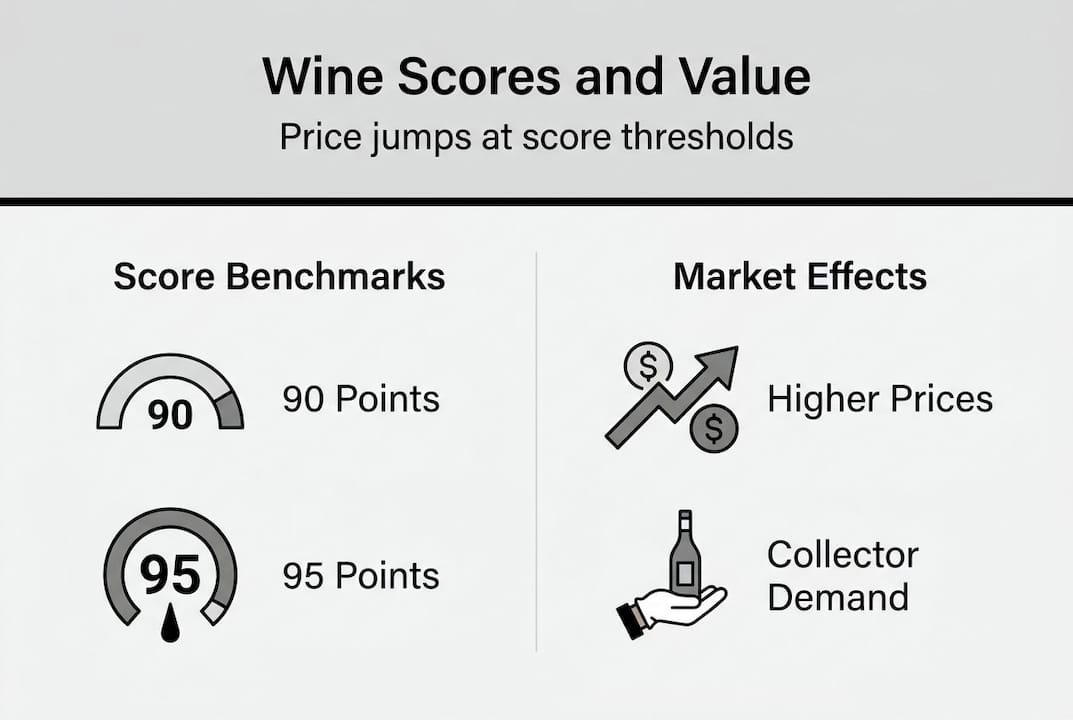
Smart buyers watch for wines just below those thresholds. They also pay attention to wine value and pricing signals beyond the score itself, including producer reputation, vintage quality, and regional benchmarks.
Scarcity adds another layer. Limited-production wines that score 92-plus can appreciate rapidly once released. Understanding wine scarcity tips helps you move before the market catches up.
Navigating score reliability: critic disagreement and finding real value
Here’s the uncomfortable truth the wine industry doesn’t advertise loudly: critics disagree. A lot.
The same wine can vary 5 to 8 points across different critics. That means a wine rated 91 by Wine Advocate might score 84 from a different respected taster. Both are legitimate assessments. Both reflect real palate differences and methodological variation. Neither is definitively correct.
This variability matters enormously for buyers. If you’re paying a premium based on a single critic’s 93-point score, you’re essentially betting on one person’s palate on one particular day.
The smarter approach is aggregation. Aggregated wine scores from platforms like Wine-Searcher use a Bayesian average (a statistical method that accounts for the number and spread of ratings) to produce a more reliable consensus score. It smooths out individual outliers and gives you a cleaner signal.
Here’s a practical process for choosing reliable high-scorers:
- Start with an aggregated score rather than a single critic’s rating.
- Check that at least three credible sources have reviewed the wine.
- Read two or three tasting notes to confirm the style suits you.
- Look for value designations like ‘Best Buy’ listings, which flag quality-to-price ratio.
- Cross-reference with vintage quality for the region and year.
Pro Tip: Value designations are your best friend. They highlight wines where quality outpaces price, which is exactly the sweet spot you’re hunting for. Explore affordable top-rated wines for a curated starting point.
Avoiding prestige traps means focusing on typicity and balance rather than famous names. A boutique producer’s 91-point Shiraz from a lesser-known region will often outdrink a famous label’s 91-point offering at half the price. Knowing how wine deals work gives you the edge to act when those opportunities appear.
Why wine scores shouldn’t be your only guide: our collector’s take
Scores are useful. We’d be lying if we said otherwise. But treating them as gospel is a trap we’ve watched too many collectors fall into.
Here’s the real deal: a score sets a technical floor. It tells you the wine is well made, balanced, and worth considering. What it doesn’t tell you is whether it’ll pair with your Saturday roast, whether it suits your palate, or whether it’s actually worth the price the market has attached to it.
The collectors who drink best aren’t the ones chasing 95-point scores. They’re the ones who’ve learned to read tasting notes, understand regional typicity, and spot the 88-point gem that outperforms its score at the table. Aggregated scores reduce individual bias. Tasting notes reveal style. And wine value gifting tips remind us that the best bottle is often the one that surprises everyone, not the one with the biggest number on the label.
Chase quality and uniqueness. Leave the prestige chasing to people who care more about impressing others than actually enjoying what’s in the glass.
Explore affordable high-scoring wines at FU Wine
You’ve now got the tools to decode scores, spot value, and drink smarter. The next step is finding wines that actually deliver on all of it without the inflated price tag.
At FU Wine, we source premium, high-scoring bottles from boutique producers, limited releases, and cellar clearances, and we make them available at prices that make sense. No gatekeeping. No markup for the sake of a label. Just quality wine at honest prices. If you’re ready to explore affordable high-scoring bottles that match critical acclaim with real-world value, you’re in the right place. Every bottle is a small rebellion against overpriced mediocrity.
Frequently asked questions
What score defines a ‘high-scoring wine’?
A high-scoring wine is most often rated 90 points or above, indicating outstanding or classic quality according to leading critics. This threshold is the widely recognised benchmark across major publications.
Why do wine scores vary between critics?
The same wine can vary 5 to 8 points across critics due to palate differences and methodological variation. This is why aggregated scores from multiple sources are more reliable than a single review.
Do higher scores mean more expensive wines?
Generally yes. A 1-point increase correlates with a 5 to 7% price rise in the secondary market, and high-scoring wines also secure better retail shelf placement, reinforcing demand.
How can I find high-scoring wines that don’t break the bank?
Seek out value designations and use aggregator scores for consistency across critics, then read tasting notes to confirm the style matches your preferences before buying.
What is the lowest score published for finished wines?
Scores below 80 are rarely published, as most critics only review wines they consider worth recommending. The practical published range sits between 80 and 100 points.