

Only 5,000 RMs: Grower vs House Champagne Label Clues for Enthusiasts
Grower Champagne (RM) is estate made and terroir driven. House Champagne (NM) is blending driven, built for a consistent style year after year. If you want site specific character and vintage surprise, drink grower. If you want dependable, recognisable flavour every time you pop a cork, reach for a house bottle.
TL;DR:
- Grower Champagne typically displays site-specific character and vintage variation, making each bottle a unique reflection of a single vineyard or village.
- Label codes reveal whether a bottle is grower made (RM), house blended (NM), or cooperative (CM), with RM indicating a grower-owned and vinified product.
- Grower Champagnes often emphasize minerality and acidity, with less blending or reserve wine used to preserve the wine’s regional and vintage identity.
- Buying grower Champagne usually involves smaller production runs, limited availability, and storage in a cool, dark place for optimal aging potential.
- Select grower bottles for special, intimate occasions and house wines for large celebrations requiring consistent, crowd-pleasing profiles.
Table of Contents
- Grower vs house Champagne: what the labels actually mean
- How production methods differ from vineyard to bottle
- How do you tell if a bottle is grower or house Champagne?
- What does grower Champagne actually taste like compared to house Champagne?
- Choosing and buying grower vs house Champagne
- FU Wine’s take on grower and house Champagne
- Find your next bottle at Com
- Sources
Grower vs house Champagne: what the labels actually mean
The whole grower vs house Champagne question comes down to who grows the grapes and who bottles the wine. That distinction is coded, literally, on every bottle produced in the region.
The Comité Champagne (CIVC) requires a small alphanumeric code near the serial number on the back label. It tells you exactly what kind of business made your wine:
- RM (Récoltant Manipulant), a grower who farms the fruit and vinifies it themselves, under their own name.
- NM (Négociant Manipulant), a house or maison that buys grapes (or finished wine) from multiple growers to build a blend.
- CM (Coopérative Manipulant), a cooperative that vinifies fruit pooled from member growers.
- RC (Récoltant Cooperate), a grower who has their wine made by a cooperative but sells it under their own label.
This isn’t a niche technicality. Growers own nearly 90% of Champagne’s vineyard land, yet houses market roughly two thirds of the wine the region produces. Only around 5,000 of those growers actually vinify and bottle under their own RM label. Most sell their fruit straight to the big houses, which explains why maison names dominate bottle shops while grower producers stay comparatively hidden. The code is the one bit of label transparency that tells you who is really behind what’s in your glass.
How production methods differ from vineyard to bottle
Houses build their reputation on sameness, and that’s not a criticism. A maison blends fruit and reserve wine from dozens, sometimes hundreds, of plots across multiple villages and vintages to hit the same house style every single year. That’s the entire craft: making a wine from 2026 taste recognisably like the one from 2019.
Growers work the opposite way. With smaller estates and shallower reserve wine stocks, they lean into what a single vineyard or village gives them in any given year rather than smoothing it out.
- Houses draw on deep multivintage reserve pools to soften the swings between harvests, according to VinePair’s analysis of grower Champagne.
- Growers typically bottle site-specific or single-village wines with less blending to hide behind.
- Dosage (the sugar added before final corking), oak use, and extended lees ageing shift final flavour in both camps, but growers use these tools to sharpen a site’s character rather than mask vintage variation.
Pro Tip: If a producer lists a specific village or lieu-dit on the front label instead of just “Champagne,” that’s usually your first clue you’re holding a grower bottle rather than a blended house wine.
How do you tell if a bottle is grower or house Champagne?
Reading a Champagne label properly takes about thirty seconds once you know where to look.
- Find the producer code. It’s a tiny two-letter prefix followed by a licence number, usually printed low on the back label near the barcode.
- Check the prefix. RM means grower made, NM means house made, CM means cooperative made, RC means grower with cooperative winemaking. This code is the single most reliable identifier a shopper has, more useful than any front-label marketing.
- Look for site language. Words like “village,” “lieu-dit,” or a single vineyard name on the front label often signal a smaller, more focused production run.
- Ask the retailer. A specialist wine shop or boutique producer specialist will usually know the producer’s story, not just the price point.
What does grower Champagne actually taste like compared to house Champagne?
This is where the grower vs house Champagne debate gets genuinely interesting, because the production differences translate directly into what lands on your palate.
Grower Champagnes tend to show site-specific minerality, more pronounced vintage character, and often a leaner, higher-acid profile if dosage runs low. You’re tasting a place and a year, not a formula. House Champagnes lean into blended consistency: a broader, rounder flavour architecture, often smoothed by generous reserve wine and a dosage level chosen to suit a mass market palate.
Champagne’s three main grapes, roughly 31% Chardonnay, 38% Pinot Noir and 31% Meunier across the region’s plantings, get used very differently by each camp. Growers often champion a single variety from a single plot; houses blend all three across dozens of sources to hit their signature note.
- Grower style: bright acidity, chalky or saline minerality, noticeable year-to-year shift.
- House style: layered, consistent, often creamier on the palate thanks to larger reserve wine use.
- Pairing angle: grower bottles suit food-focused dinners where terroir echoes the plate, house bottles suit celebrations where predictable crowd-pleasing matters more. For match ideas, see this guide to pairing white wine with food.
Think of it like single-origin coffee versus a reliable blend. One gives you a closer sense of place and year, the other gives you the same cup every single morning.
Choosing and buying grower vs house Champagne
Match the bottle to the occasion, not the other way around. A milestone dinner where you want to talk about what’s in the glass calls for a grower bottle with a story. A wedding toast for two hundred people calls for house consistency, because nobody’s palate needs a debate at that moment. Wedding-focused buying advice backs this occasion-first approach for events specifically.
- Occasion: intimate and exploratory favours grower, large-scale and celebratory favours house.
- Price and value: grower bottles can undercut famous house names for comparable quality, since you’re not paying for global marketing.
- Ageing plans: house prestige cuvées are built for the cellar, but plenty of grower wines reward a few years too.
- Availability: small grower estates produce limited runs, so scarcity is real, not just marketing spin.
Pro Tip: Grower Champagnes rarely sit on shelves long once word gets out, so if you spot a genuinely good-value bottle from a small estate, buy it that day rather than waiting for a “better deal.”
Store both styles the same way: on their side or upright in a cool, dark spot away from vibration, ideally below 14 degrees Celsius.
FU Wine’s take on grower and house Champagne
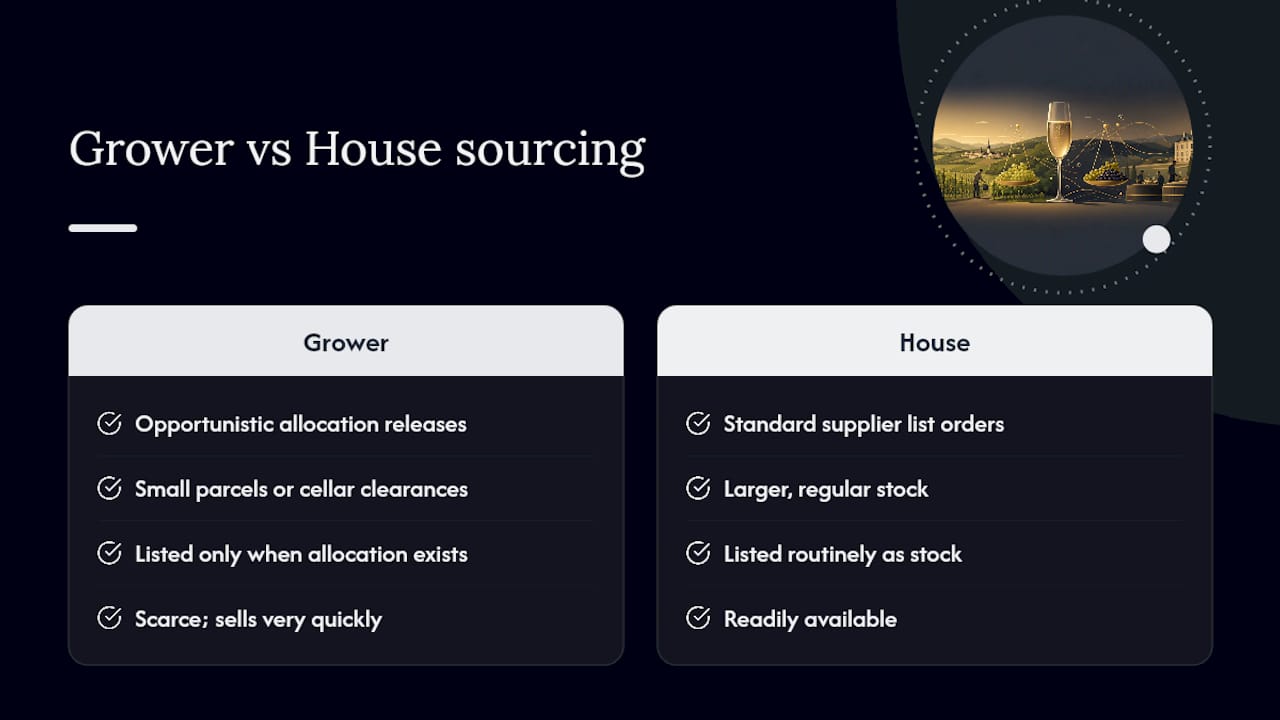
Sourcing grower Champagne isn’t like ordering a house name from a standard supplier list. It usually means opportunistic buying: allocation releases, small parcels from estates that don’t have the marketing budget of a maison, cellar clearances that surface a handful of cases nobody outside the trade even knew existed.
That’s exactly the kind of hunting a flash-deal model is built around. Grower bottles are listed when genuine allocation is available, not filler stock, alongside recognisable house names when deals are attractive. Realistically, if you want first crack at a scarce grower release, signing up for alerts can help. These wines move fast and don’t get restocked.
— Damien
Find your next bottle at Com
Some businesses exist because premium Champagne, grower or house, shouldn’t come wrapped in inflated pricing and gatekeeping. They hunt down limited releases, cellar-aged bottles and boutique producer runs, and pass them on at discounted prices.
Whether you’re chasing a scarce RM bottle for a dinner party or a reliable house name for a celebration, our rotating catalog changes fast, so the good stuff doesn’t sit around waiting for full retail price. Check what’s live right now on Com and grab it before the next drop replaces it.
Sources
- Champagne
- Everything You Need to Know About Grower Champagne | VinePair
- Getting into Grower Champagne | Wine Folly
- Maison vs grower-Champagne (WineWiki) | WineWithSeth