

Disgorgement Date: The 2–3 Year Sweet Spot for Drinkers and Collectors
The disgorgement date is the day a Champagne house yanked the dead yeast out of your bottle, topped it up, and jammed the final cork in. It’s not a vintage. It’s not an expiry date. It’s the moment the wine’s clock properly starts ticking towards your glass, and it’s the single best clue you’ll get about whether that bottle’s going to taste bright and zesty or rich and toasty.
TL;DR:
- Disgorgement date reveals how long a Champagne has been aging post-release, affecting its flavor profile and complexity.
- Bottles disgorged within the last year typically showcase fresher, fruitier notes, while older ones develop richer brioche and honey flavors.
- Most non-vintage Champagne should be enjoyed within two to three years after disgorgement to maintain its intended freshness.
- Disgorgement is marked on labels by back labels, lot codes, or RD notation, but not all bottles display this info publicly.
- Tracking disgorgement dates helps collectors and consumers predict a wine’s current state and choose the right bottle for the occasion.
Table of Contents
- What is the disgorgement date and why should you care?
- How is disgorgement actually performed?
- What does the disgorgement date reveal about flavour?
- How long can you keep a bottle after disgorgement?
- Where do you find the disgorgement date on a label?
- How do you track disgorgement across a cellar?
- Fresh or developed: which disgorgement should you pour tonight?
- Sources
What is the disgorgement date and why should you care?
Here’s the bit most wine lists skip: Champagne spends years sitting on its lees, the spent yeast cells from that second fermentation in the bottle. Eventually someone has to get rid of them, and the moment that happens is the disgorgement date — the wine’s official “clock starts now” moment.
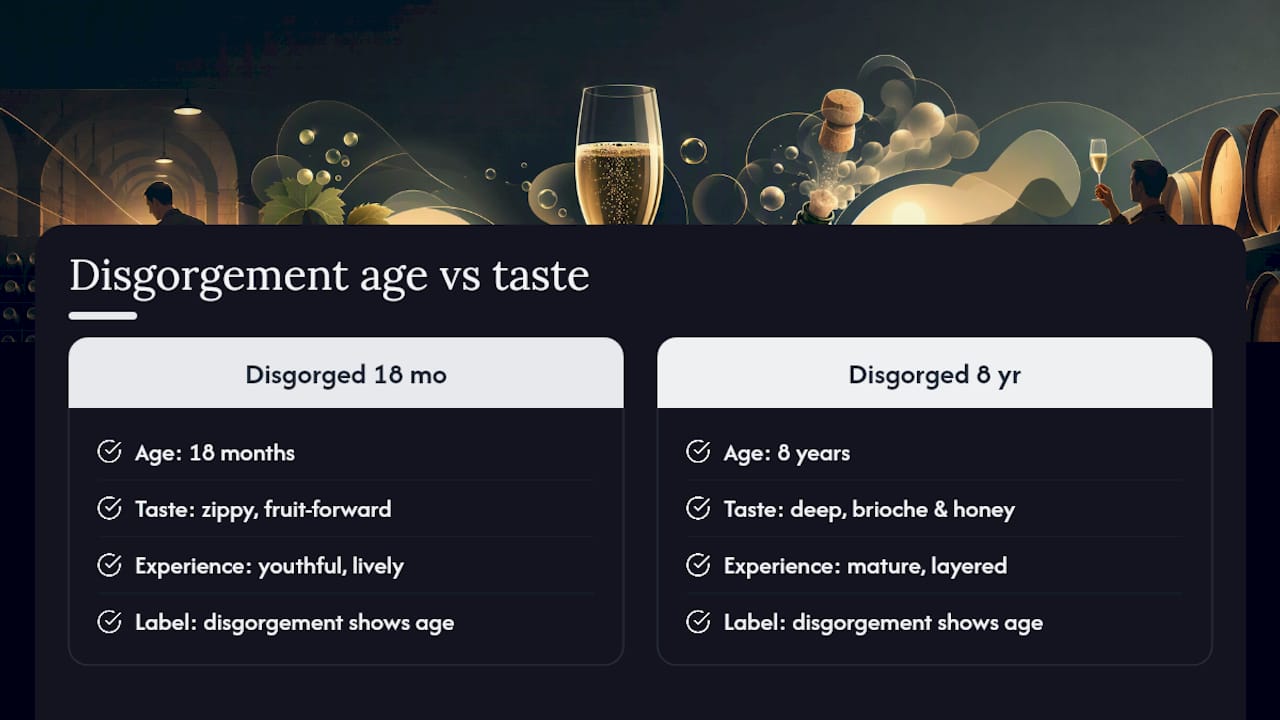
It matters because a bottle disgorged eighteen months ago drinks differently to one disgorged eight years ago, even if they’re the exact same cuvée from the exact same house. One’s zippy and fruit forward. The other’s gone deep, developing this brioche and honey notes collectors chase. Same juice, wildly different experience, and the disgorgement date is the only label detail that tells you which one you’ve got.
How is disgorgement actually performed?
The méthode traditionnelle (the classic Champagne process) follows a fairly precise sequence, and each step earns its place, much like the distinctions in distilled vs filtered vodka production methods.
- Secondary fermentation in the bottle creates the bubbles, and it leaves behind lees, that sediment of spent yeast.
- Riddling (traditionally by hand, now mostly by gyropalette machines) slowly tilts and rotates the bottle to walk the sediment down to the neck.
- Neck freezing dips the bottle’s neck into a brine solution, freezing the lees into a solid plug.
- Disgorgement pops the cap, and the frozen plug shoots out under pressure, taking the sediment with it.
- Dosage goes in, a small sugar and wine mixture that determines whether you end up with brut, extra brut, or something sweeter.
- The final cork goes in, and from here the wine is technically ready to sell.
Not every sparkling wine follows this. The transfer method disgorges in bulk tanks before rebottling rather than doing it bottle by bottle, and the ancestral method skips disgorgement altogether, leaving the sediment in (that’s your cloudy natural pét-nat).
One detail worth knowing: disgorgement lets in a small amount of oxygen. That’s the trigger for a faster phase of ageing. Time spent on lees before disgorgement actually slows ageing down and builds texture, so the post-disgorgement clock runs at a completely different speed to the pre-disgorgement one.
What does the disgorgement date reveal about flavour?
Think of the disgorgement date as a flavour time stamp, not a report card. It doesn’t tell you if the wine is good. It tells you which direction it’s heading.
- Recent disgorgement (within the last year or so) tends to preserve primary fruit character, citrus, green apple, that lively zing you want in an aperitif style.
- Older post-disgorgement wines lean into secondary and tertiary notes: toasted brioche, roasted nuts, honey, sometimes dried fruit.
- RD markings (short for récemment dégorgé, or “recently disgorged”) signal a house has deliberately released a wine soon after disgorging it to showcase freshness. It’s a stylistic choice, not a technical requirement.
- Some producers practise late disgorgement on purpose, holding wine on its lees for years longer than usual before finally disgorging it for a richer, more layered result.
None of this ranks better against worse. A young disgorgement isn’t “less developed” in a bad way, and an old one isn’t automatically superior. They’re different experiences built for different moments, and the disgorgement date is what helps you tell them apart before you’ve even popped the cork.
How long can you keep a bottle after disgorgement?
For most non-vintage Champagne, experts point to a window of roughly two to three years after disgorgement as the sweet spot for the fresh, vibrant style the house intended. Push past that and you’ll often lose primary fruit before you gain much in complexity.
Vintage and prestige cuvées play a different game. Because resting periods after disgorgement vary house to house and cuvée to cuvée, a top-tier bottle might rest for years after disgorgement, precisely because it’s built to age well past that two to three year non-vintage window.
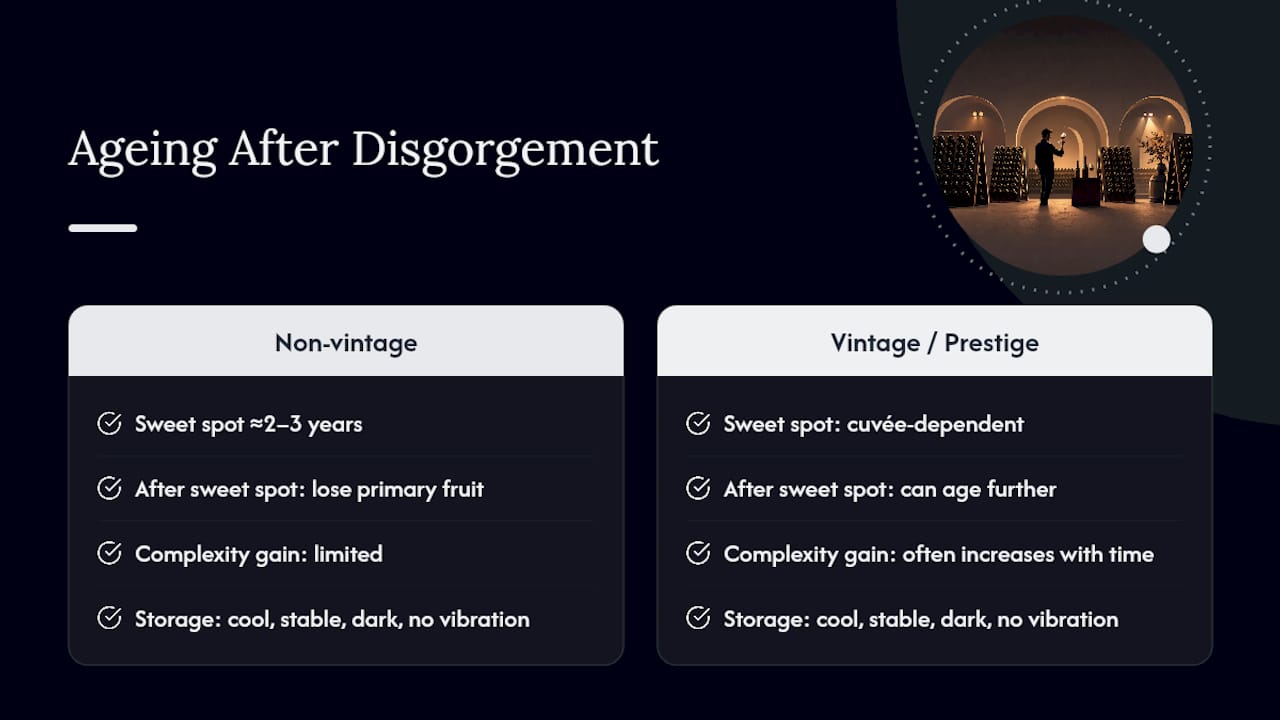
Storage matters just as much as timing. Keep bottles cool and at a stable temperature, away from light, and away from vibration. All three protect the character the winemaker locked in at disgorgement, and skipping any of them speeds up decline. If your bottle’s travelled recently, give it proper rest time before you judge it.
Pro Tip: If a bottle’s gone flat, smells sherry-like, or the fruit’s vanished into a dull, brownish flatness, that’s oxidation talking. It’s had too long post-disgorgement in bad conditions, not a sign the wine was ever faulty.
Some houses have begun printing dosage and blend info alongside the disgorgement date, giving drinkers a fuller picture of what’s actually in the bottle and how it’s likely to hold up.
Where do you find the disgorgement date on a label?
Disgorgement dates hide in a few predictable spots, and once you know what you’re scanning for, they’re easy to spot.
- Check the back label first, usually printed as a small date or a lot code near the barcode.
- Look for RD or R.D. shorthand, standing for récemment dégorgé, often paired with a date.
- Some bottles carry a unique ID or lot code instead of a plain date, meant to be looked up rather than read directly.
- If nothing’s printed, scan any QR code on the label. More houses are pushing disgorgement details online rather than onto the glass.
- No QR code either? Check the producer’s website or ask the retailer. Serious sellers usually have lot data on file.
Printing the date is still optional under regional rules, so plenty of solid Champagne carries no visible disgorgement info at all. That’s not a red flag on its own.
How do you track disgorgement across a cellar?
Collectors treat the disgorgement date almost like a second birthdate for the bottle, and it’s worth borrowing that habit even for a modest collection.
- Write the purchase date on the bottle with a metallic marker if the producer hasn’t printed a disgorgement date, since that gives you a usable reference point even without official data.
- Log dates in a simple spreadsheet alongside cuvée and producer, so you’re not relying on memory when deciding what to open.
- Use disgorgement data as a buying filter for limited-release or cellar-aged bottles, where a wine sitting on a retailer’s shelf for years might already be well past its ideal freshness window.
- Prioritise transparency when sourcing rare bottles, because knowing when a wine was disgorged tells you far more about its current state than the vintage alone ever will.
This is exactly the thinking behind how Com sources cellar-aged and limited-release bottles. When a rare bottle turns up at a steep discount, disgorgement information (where a producer publishes it) is one of the clearest signals for whether that bottle’s still in its prime or riding the edge of decline, and it shapes which bottles land in the rotating catalogue in the first place.
Fresh or developed: which disgorgement should you pour tonight?
Recent disgorgement wins for aperitif hour, seafood, or anything where you want that citrus snap front and centre. Older disgorgement earns its place at the table, alongside roast chicken, mushroom risotto, aged cheese, where those brioche and nutty notes have room to shine.
Where the information’s available, Com weighs disgorgement dates when curating listings, because a rare bottle’s real value depends on where it sits on that curve, not just the label on the front.
— Damien
Sources
- Champagne disgorgement (‘degorgement’) — Difford’s Guide
- Champagne and their disgorgement dates explained — Decanter China
- How wine disgorgement works — MasterClass
- The secret to buying bubbly: disgorgement dating — VinePair
- The role of disgorgement in Champagne making — Champagne Lallier