

Creating wine education for front of house staff
TL;DR:
- Effective front-of-house wine training builds staff confidence by focusing on practical tasting and sales skills. Short, regular micro-sessions tailored to guest needs are more effective than lengthy lectures. Measuring success with sales data and maintaining consistent, repeatable modules ensures continuous improvement.
Creating wine education for front of house is the process of systematically building staff knowledge and confidence so they can recommend, describe, and sell wine with authority. The industry term for this is a structured wine training programme, and it covers everything from tasting technique to guest-facing sales language. Done well, it lifts the entire team’s performance, not just the one person who did a WSET course. Credentials like WSET Level 1 and Level 2, along with informal pre-shift tastings, form the backbone of most effective programmes. The goal is never to produce sommeliers on every shift. The goal is consistent, confident wine service across the floor.
What do you need before starting wine training for staff?
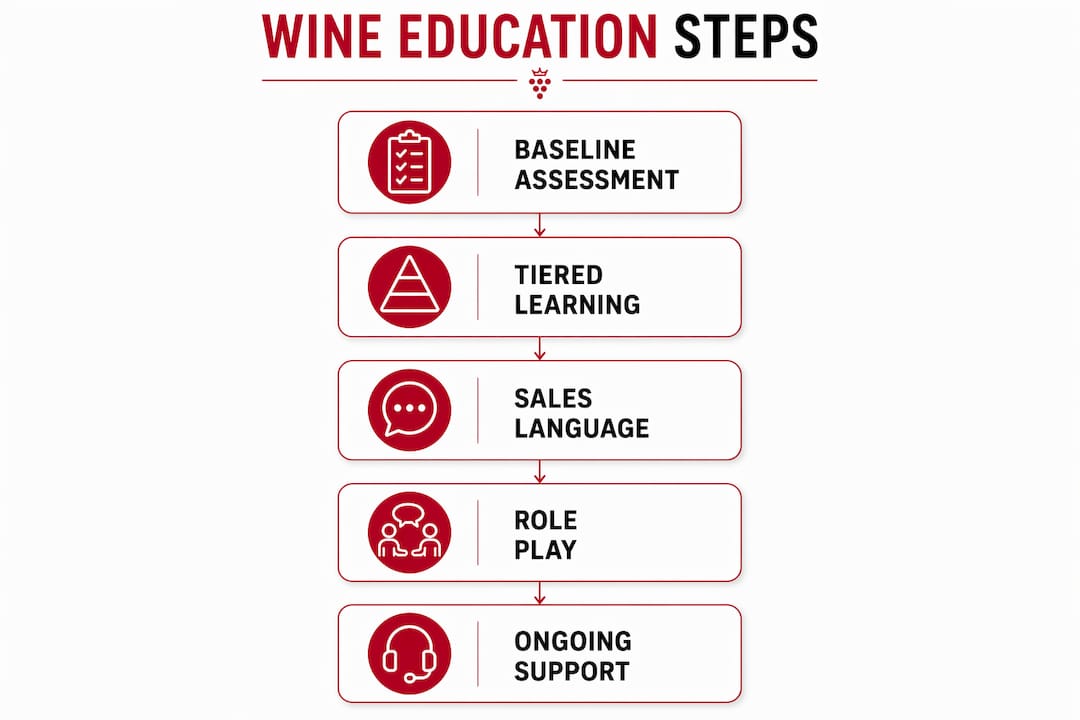
Before you run a single session, you need an honest picture of where your team stands. Assess baseline knowledge by asking staff to describe two wines on your current list without prompting. The results will tell you more than any survey. High staff turnover is the other reality check. If your team changes every six months, enrolling everyone in formal credentials is not cost-effective.
A train-the-trainer model works better in high-turnover environments. One or two people hold the deeper knowledge and deliver it to the rest of the team in short, repeatable sessions. This keeps the programme running even when faces change.
Budget matters too. WSET Level 3 costs between $600 and $1,200 per person as of 2026. That is a serious investment for a role that may turn over within the year. In-house modules cost far less and can be updated as your wine list changes.
Before your first session, gather these tools:
- Tasting bottles: One open bottle per session, focused on a single variety or style
- Tasting notes: Simple, guest-friendly language, not technical jargon
- Quizzes: Short, five-question checks at the end of each session to reinforce retention
- POS tracking: Set up your system to monitor individual server wine sales versus house pours
- Wine list complexity map: Identify which bottles need the most explanation for your guest profile
Pro Tip: Start with your three best-selling wines and your three highest-margin bottles. Build the first sessions around those. Staff will see immediate relevance on the floor.
Your guest profile also shapes the programme. A casual bistro needs staff who can say “this is crisp and goes well with the fish.” A fine dining room needs more layered knowledge. Match the depth of training to the room you are running.
How to design effective wine education sessions for your team
The most effective approach is a tiered, scalable structure. Think of it as three levels: baseline, working competence, and specialist. Every staff member reaches baseline. Senior floor staff reach working competence. One or two reach specialist level, and they become your internal trainers.
Micro-sessions of 15 minutes before shifts using one bottle and a focused topic build sustainable knowledge across the team. Short sessions work because they fit into real operations without disrupting service. Staff retain more from a focused 15-minute tasting than from a 90-minute lecture.
Structure each session like this:
- Open one bottle and pour small tastes for everyone present
- State the topic in one sentence: “Tonight we are talking about this Barossa Shiraz and why it works with the lamb”
- Give two or three talking points that staff can use directly with guests, such as flavour profile, food match, and price justification
- Run a quick scenario where one staff member practises recommending the wine to another playing a guest
- End with one question to check understanding, such as “What would you say if a guest asked why this costs more than the house red?”
Education sticks best when tied to sales language. Abstract theory about wine regions and soil types does not help a server at table six. Flavour profiles, pairing rationale, and value justifications do. Keep every session anchored to what a guest might actually ask.
Distributor reps are an underused resource. Most are happy to come in before service, pour their range, and talk through the wines. This costs you nothing and gives your team direct access to producer stories and tasting notes. Use them for two or three sessions a year to add variety and credibility.
Role play is uncomfortable for most staff at first. Do it anyway. Confidence in recommending wine comes from practising the words out loud, not from reading about it. A wine pairing tasting menu experience is a great reference point for staff learning to connect food and wine in guest conversations.

Pro Tip: Give staff a laminated card with three talking points per wine. Keep it behind the bar or in their apron. It is a confidence prop, not a crutch, and it works.
Formal credentials like WSET Level 1 can be completed in one day and Level 2 in two days, with WSET Level 2 requiring 25–30 study hours in total. These are worth pursuing for senior staff or those on a hospitality career path. For the broader team, informal training delivers faster, more practical results.
How do you measure success in a front-of-house wine education programme?
Training without measurement is just a tasting. You need numbers to know whether the programme is working. POS sales reports that monitor individual server wine sales versus house pours give you a clear picture of training impact. If a server’s wine upsell rate increases after a session on premium bottles, the training worked.
Set clear KPIs before you start:
- Upsell rate: The percentage of tables that order a bottle above the house pour price
- Average bottle price: Track this monthly and watch for movement after training cycles
- Guest satisfaction scores: Look for mentions of wine service in reviews and feedback
- Knowledge retention: Use short quizzes two weeks after each session to check what stuck
Wine training is a revenue tool. Restaurants see measurable impact on average check size and inventory movement when staff are trained to describe and recommend wine confidently. That is the business case you take to ownership when requesting training budget.
Refresh content regularly. When new wines arrive on the list, run a session within the first week. Staff who cannot describe a new bottle will avoid recommending it. Avoidance costs you margin.
Pro Tip: Schedule a 10-minute “wine of the week” slot at the start of every Monday briefing. It takes almost no preparation and keeps knowledge current without feeling like a formal training commitment.
Avoid building a programme that depends entirely on one person. If your head sommelier leaves, the knowledge should not walk out with them. Tiered, repeatable modules keep knowledge inside the business regardless of who delivers them. Document every session, every talking point, and every quiz. That library becomes your training asset.
Motivate staff with recognition, not just information. A monthly “wine champion” shoutout, a small incentive for the highest wine upsell rate, or a sponsored WSET enrolment for top performers all signal that wine knowledge is valued and rewarded.
What are the common mistakes in front of house wine courses?
The biggest mistake is making training feel like homework. Effective programmes avoid abstract lessons and focus on guest-relevant talking points. If staff feel like they are studying for an exam, engagement drops fast.
Watch out for these pitfalls:
- Too much theory too soon: Starting with wine regions and soil types before staff can describe a single bottle’s flavour profile
- Infrequent sessions: Running one big training day every six months instead of short, regular sessions
- Single-trainer dependency: Letting all knowledge sit with one person, which creates a fragile programme
- Ignoring turnover: Failing to onboard new staff into the programme within their first two weeks
- No floor application: Teaching in the classroom but never connecting it to real guest interactions
The primary goal of front-of-house wine education is to lift the floor so all staff can confidently recommend wine. That means consistent sales language matters more than deep expertise. A server who can say “this is a medium-bodied red with dark fruit and a long finish, and it pairs beautifully with the duck” is worth more to your business than one who can name every sub-region of Burgundy but freezes at the table.
High turnover is a structural challenge, not a training failure. Build your programme to absorb new starters quickly. A two-session onboarding module covering your top five wines by sales volume gets new staff floor-ready fast. Pair them with a trained colleague for their first two weeks and the knowledge transfers naturally.
For guidance on building a wine selection process that supports your training goals, the five-step framework at FU Wine is worth bookmarking. The right list makes training easier because the wines tell a clear story.
Key takeaways
Effective wine education for front-of-house staff builds consistent confidence across the team, not deep expertise in a few individuals.
| Point | Details |
|---|---|
| Start with a baseline assessment | Test staff knowledge on your top-selling wines before designing any sessions. |
| Use micro-sessions before shifts | Fifteen-minute tastings with one bottle and three talking points outperform long lectures. |
| Tie every lesson to sales language | Teach flavour profiles, pairings, and price justifications, not geography or theory. |
| Measure with POS data | Track individual upsell rates and average bottle price to prove training impact. |
| Build repeatable modules | Document sessions so knowledge stays in the business when staff move on. |
Damien’s take: lift the floor, not just the ceiling
The most common mistake I see in hospitality wine training is aiming for the wrong target. Managers invest in one brilliant sommelier and assume the knowledge will trickle down. It rarely does. The floor team keeps defaulting to the house pour because they do not have the words to do anything else.
What actually works is relentless focus on the bottom of the knowledge curve. Get every single person on the floor to a point where they can describe three wines confidently and match them to a dish. That is it. That is the win. You do not need a team of experts. You need a team that does not flinch when a guest asks for a recommendation.
The other thing I have learned is that timing matters more than content. A 15-minute session before a Friday dinner service, with a glass in hand and a real guest scenario to practise, lands harder than a two-hour workshop on a Tuesday morning. People learn when they can see the immediate application. Wine education works the same way. Keep it short, keep it relevant, and run it often. The catering tasting event best practices framework is a useful reference for structuring tasting sessions that actually engage a group rather than bore them into nodding along.
Training is not a one-off task. It is a culture. The venues that get this right treat every new bottle on the list as a training opportunity. Every distributor visit becomes a session. Every quiet Monday becomes a chance to run a quick quiz. That consistency is what separates a team that sells wine from a team that just pours it.
— Damien
FU Wine and your wine education programme
FU Wine is built on the idea that premium wine should not come with a side of pretension. That same thinking applies to how you educate your team. You do not need a $1,200 course to build a confident floor team. You need the right bottles, the right talking points, and a bit of consistency.
FU Wine’s wine trends for hospitality content gives your team fresh material to work with as the market shifts. The restaurant wine checklist is a practical tool for structuring your list and your training around the bottles that matter most. Browse the full range at FU Wine and find the bottles worth building your next session around.
FAQ
What is wine education for front-of-house staff?
Wine education for front-of-house staff is a structured programme that builds staff knowledge of flavour profiles, food pairings, and sales language so they can recommend wine confidently to guests.
How long should a wine training session be?
Pre-shift sessions of 15–60 minutes work best. Short, focused tastings with one bottle and a clear topic maintain engagement and fit into real service operations.
Do staff need formal credentials like WSET?
Formal credentials are valuable for senior staff and career development, but not required for the full team. WSET Level 1 takes one day and Level 2 takes two days, making them accessible for motivated individuals.
How do you measure the impact of wine training?
Track individual server wine sales versus house pours using POS data, and monitor average bottle price and upsell rates monthly. Movement in these numbers after a training cycle confirms the programme is working.
What is the biggest mistake in staff wine education?
Making training feel like homework by focusing on abstract theory instead of guest-relevant talking points. Effective programmes teach flavour, pairing, and sales language from the very first session.