

Collectors: Calculate All in Cost for Auction vs Retail Wine
Auctions suit collectors chasing rare back vintages and are willing to trade certainty for potential value. Retail suits buyers who want a guaranteed bottle, right now, with no bidding war attached. The trade-off is simple: auctions can win on price and rarity but load on buyer’s premium and provenance risk, while retail wins on speed and certainty but rarely surprises you with a bargain.
TL;DR:
- Auction prices often appear lower than retail prices before fees, but buyer’s premiums and additional costs can make the final price higher than retail.
- Provenance verification is crucial, especially checking ullage levels and storage history to avoid counterfeit bottles or poor storage conditions.
- Retail offers faster delivery, guaranteed authenticity, and easier returns, making it suitable for immediate drinking rather than collecting.
- Calculating the true cost of an auction lot requires adding premiums, taxes, shipping, and division by the actual number of bottles, not lot size.
- Direct sellers can provide transparent, fixed prices for rare, high-quality bottles without auction fees or long waits, offering a middle-ground option.
Table of Contents
- Auction vs retail wine: the side-by-side breakdown
- How does wine auction bidding actually work?
- What does retail actually deliver that auctions don’t?
- How do you calculate the true cost of an auction lot?
- What should you check before trusting a lot’s provenance?
- When does buying direct from FU Wine make more sense?
- A straight-up decision framework for your next bottle
- Skip the bidding war with FU Wine
- Sources
- FAQ
Auction vs retail wine: the side-by-side breakdown
Auction and retail are not two versions of the same transaction. They’re built on completely different logic, and once you see the gap laid out, the decision gets a lot easier.
Academic research on wine trading venues found auctions consistently produce higher valuations than exchanges or over-the-counter trades once you control for the wine itself. Auctions also show sharper price sensitivity to expert ratings, meaning a 98-point vintage can spike well beyond a 92-point wine from the same producer in a way retail shelf pricing rarely reflects.
- Price realism: hammer price looks cheap; all-in retail is usually the fairer benchmark once fees are added.
- Selection: auctions surface scarce back vintages; retail carries current releases and allocation drops.
- Verification: auction lots come with condition reports; retail comes with a receipt and a guarantee.
- Speed: retail ships this week; auctions run on a sale calendar, often weeks or months out.
- Extra costs: buyer’s premium, GST, shipping and storage stack on top of the auction hammer price.
Buyer’s premium alone commonly adds 20 to 25 percent on top of the hammer price, which is the single biggest reason a “cheap” auction lot can end up costing more than the same bottle sitting on a retailer’s shelf.
How does wine auction bidding actually work?
Getting into an auction means registering with the house first, usually with ID and a payment method on file, before you’re cleared to bid. From there you can bid online, by phone, via absentee instruction, or live in the room, and lots can be single bottles or mixed cases sold as one unit.
- Register with the auction house and confirm bidding limits.
- Review the lot for format, vintage, quantity and any condition notes.
- Bid using your chosen method, watching for the reserve price.
- Pay the hammer price plus buyer’s premium, commonly 20–25 percent depending on the house.
- Arrange logistics, factoring in GST, duty and transfer to storage or your door.
The hammer price is what the auctioneer’s gavel lands on. The realised price is hammer plus buyer’s premium, and it’s the realised, per-bottle figure you should ever compare to a retail tag. Skip that step and you’re comparing apples to invoices.
Pro Tip: Always ask the auction house whether their published estimate is hammer-only or realised. Some catalogues quote hammer to look more attractive, which skews your mental price anchor before you’ve even placed a bid.
What does retail actually deliver that auctions don’t?
Retail wins on certainty. You know the price, you know the bottle is genuine, and you know when it’s arriving, which is a different value proposition entirely to chasing a lot number.
Retail pricing runs on a standard markup over wholesale cost, and reputable merchants back that price with returns and warranty handling if a bottle arrives faulted or corked. Direct-to-consumer channels and allocation lists are retail’s answer to scarcity: producers release limited runs straight to mailing-list members or DTC storefronts, which is how boutique or high-scoring wines reach buyers without ever touching an auction room. Secondary market research on wine auction houses and merchant channels confirms retail and DTC remain the primary route for current releases, while auctions largely handle everything already aged and out of production.
- Immediate possession, no waiting on a sale date.
- Clear returns and fault-handling policies from established merchants.
- Allocation and DTC access to scarce, high-demand releases.
- The right call when you’re drinking soon rather than cellaring for a decade.
Retail is also where value hunting gets interesting, because pricing swings hardest around promotional windows, not auction calendars, and a look at how to organize a wine tasting dinner shows why timing your buy matters as much as the channel itself.
How do you calculate the true cost of an auction lot?
All-in acquisition cost is the number that actually matters, not the number printed next to the lot. It’s hammer price, plus buyer’s premium, plus GST or duty where applicable, plus shipping, plus any storage transfer fee, divided by the number of bottles in the lot.
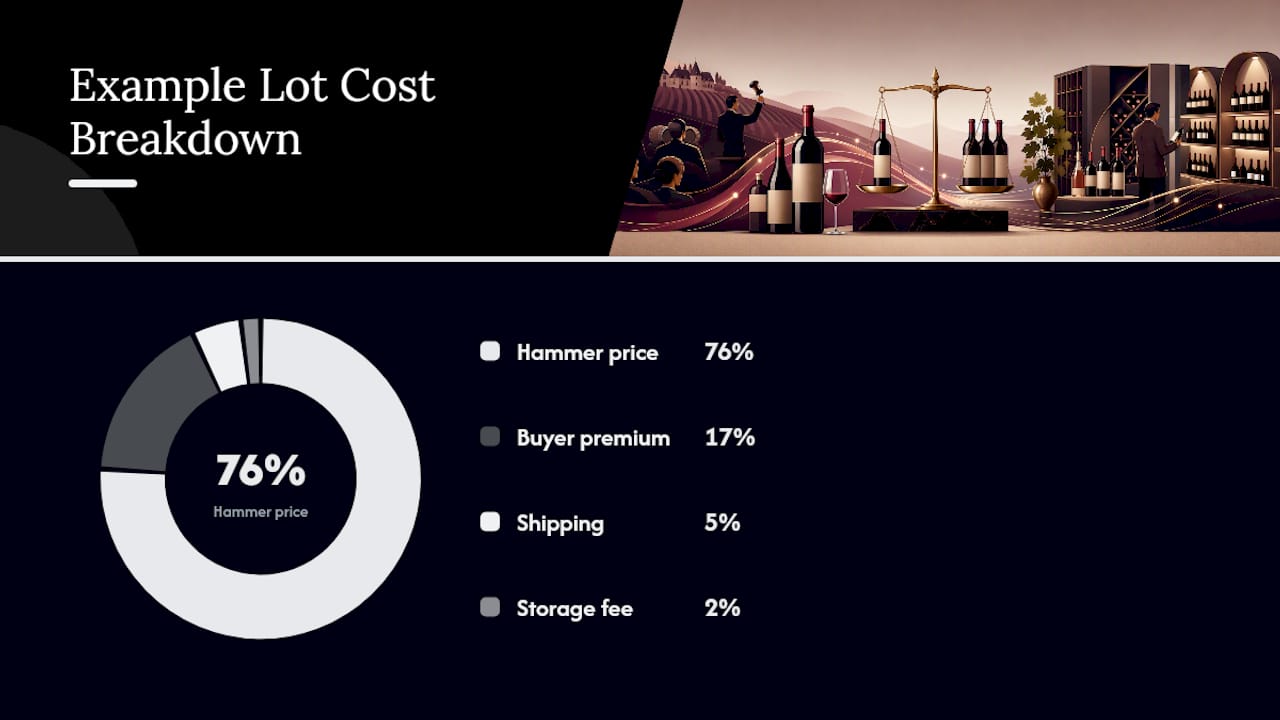
Analysis of 14.6 million completed auction lots found that hammer-only comparisons routinely mislead buyers, because the fees stacked on top can shift a lot from “bargain” to “break-even” fast.
Worked example: a six-bottle lot hammers at $600. Add a 22 percent buyer’s premium ($132), bringing the realised price to $732. Add $40 shipping and a $15 storage transfer fee, and you’re at $787 total, or roughly $131 per bottle. Compare that per-bottle figure, not the $100-per-bottle hammer price, against retail.
- Confirm whether the quoted price is hammer or realised before you bid.
- Convert currency on the sale date if the auction house is overseas.
- Always divide by bottle count, not by lot count, for mixed cases.
What should you check before trusting a lot’s provenance?
Ullage, the gap between the wine and the cork, tells you how much has evaporated or seeped out over time. A little ullage is normal in a 20-year-old bottle; the same fill level on a five-year-old wine is a red flag for poor storage or a compromised seal.
- Check the ullage against the bottle’s age rather than a flat standard.
- Read the provenance statement closely — single-owner cellar history beats an unexplained “consigned by trade.”
- Watch for counterfeit red flags: inconsistent label wear, suspiciously perfect fill levels on old bottles, or a seller unwilling to share storage history.
- Favour houses with inspected consignments and ask directly about temperature-controlled storage before you commit.
Industry coverage of auction performance also notes that regional and varietal results vary widely, with styles like Port historically outperforming Champagne at auction. That’s a reminder that a strong result for one region tells you nothing reliable about another.
When does buying direct from FU Wine make more sense?
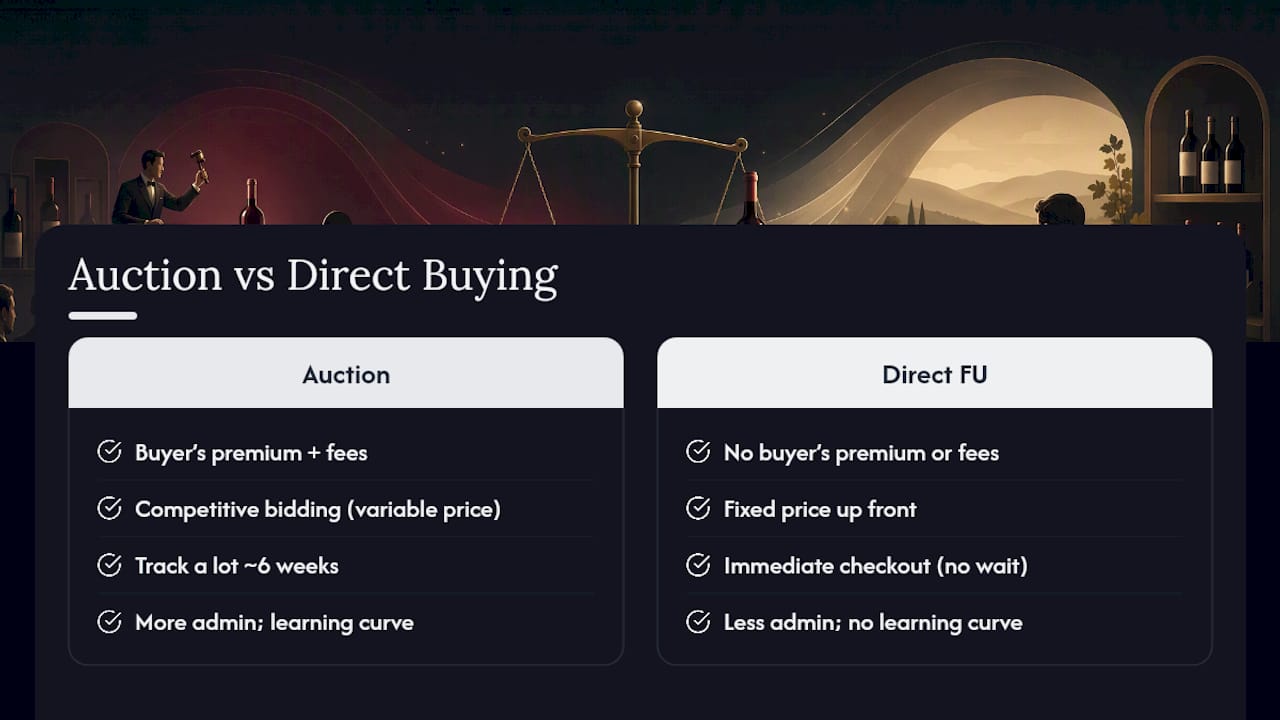
If the auction dance sounds like more admin than you signed up for, there’s a third lane. Some sellers source rare, cellar-aged and boutique-producer bottles similar to those found at auction houses, then sell them direct without bidding, buyer’s premium, or waiting for a sale date.
This suits value hunters who want documented provenance without the auction learning curve, and collectors who’d rather check out immediately than track a lot for six weeks. The honest trade-off: you won’t out-bid the market to snag an ultra-rare single lot the way an auction sometimes allows, but you skip the fees entirely and get a fixed price up front. Anyone weighing where to find genuinely rare bottles without overpaying should treat this as a serious middle path between the two extremes.
A straight-up decision framework for your next bottle
Prefer auction when the bottle is genuinely scarce, provenance is well documented and you’ve got weeks to spare. Prefer retail when you need certainty fast and you’re drinking, not collecting. Consider specialized direct sellers when you want rare stock and a fair price without the fee stack or the wait.
Run through rarity, provenance confidence, budget and urgency before every purchase, then pick the channel that matches, not the one that’s simply familiar.
— Damien
Skip the bidding war with FU Wine
Specialized direct sellers can be an alternative to both the auction room and the marked-up bottle shop: offering rare, cellar-aged and boutique wines with a fixed price you can check out on the spot instead of waiting on a hammer.

No buyer’s premium buried in the fine print, no six-week wait for a sale date, no guessing whether a lot’s provenance stacks up. Every bottle is sourced for scarcity and quality, not clearance stock, which means you get the thrill of finding something rare without the admin. If the worked-example maths above put you off auction fees, or you just want smarter access to premium bottles without the bidding, browse the current rotating deals at FU Wine and grab what’s live before it’s gone.
Sources
- On fine wine pricing across different trading venues — Journal of Wine Economics
- Auction wine prices: What 14.6 million lots tell us | Wine Labs
- Champagne weakest performer at auction but Port shines — The Drinks Business
FAQ
Are wine auctions worth it?
Auctions are worth it when you’re chasing a genuinely rare back vintage and you’ve budgeted for buyer’s premium, which commonly runs 20 to 25 percent on top of the hammer price. For everyday drinking bottles, retail or a direct channel like FU Wine is usually faster and cheaper once fees are factored in.
What is the 30/30 rule for wine?
Definitions vary across the industry, but it’s commonly used as a rough storage guideline: keep bottles away from large temperature swings and avoid storing at low humidity, both of which accelerate cork failure and ullage.
What is the 3-minute rule in auctions?
There’s no standardised “3-minute rule” in wine auction practice; auction houses set their own bidding windows and closing procedures, so check the specific house’s terms rather than assuming a universal timing rule applies.
Can people actually tell the difference between cheap and expensive wine?
Expert ratings do correlate with price at auction, where research shows valuations are more sensitive to ratings than at other trading venues. But blind-tasting research consistently shows casual drinkers struggle to rank wines by price alone, which is exactly why provenance and condition reports matter more than the price tag itself.